Amrit of Oil for America, Austerity for India

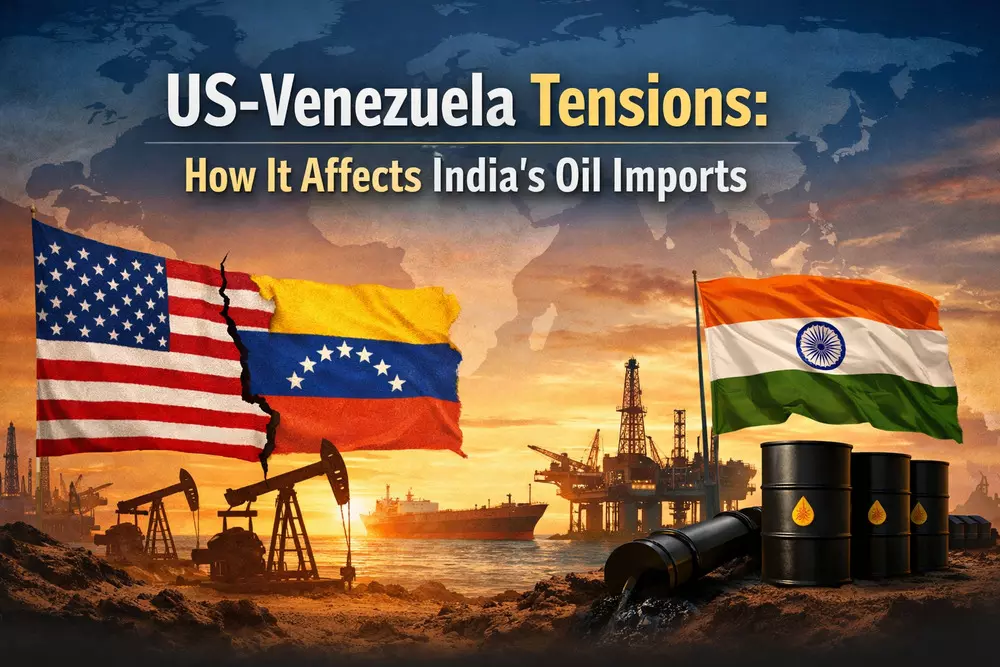
US-Venezuela Conflict and image credit liquide.life
The refusal of Nicolás Maduro to accept charges pressed against him by American President Donald Trump and his insistence in court that he remains the president of Venezuela is not merely a political drama; it is a reminder of how global power struggles often cloak themselves in legal and moral language while the real battlefield lies in finance and oil. The echoes of Saddam Hussein’s trial, where allegations of chemical weapons and brutal suppression of dissent led to his execution, remind us that charges and trials are often shaped by geopolitical interests rather than transparent justice. In Venezuela’s case, the issue is not just governance but the control of the world’s largest proven oil reserves, a resource that has become the pivot of economic wars between America, Russia, and China.
Venezuela holds nearly 19.4% of the world’s crude oil reserves, yet its actual contribution to global supply is only about 1% due to collapsed infrastructure and sanctions. For years, Russia and China have used Venezuelan oil to bypass American influence, but with Washington’s recent military intervention and the capture of Maduro, the United States has signalled its intent to dominate Caracas’s oil sector. American majors are already preparing to pump billions into reviving Venezuela’s broken crude infrastructure. This is not about democracy or justice—it is about who controls the tap of oil, and therefore the levers of global pricing.
Simultaneously, Iran, another country with massive reserves, has been warned by the Trump administration. If both Venezuela and Iran fall under American control, the oil price gambit will shift decisively to Washington’s choices. Oil is not just a commodity; it is the bloodstream of economies. For India, which imports nearly 85% of its crude oil needs, such a shift would mean vulnerability of the highest order. Already, crude prices hover around $60 per barrel after the U.S. strikes, but any sustained American control could push volatility higher, leaving India exposed.
India’s attempts to diversify energy—electric vehicles, ethanol blending, renewables—remain long-term goals, riddled with challenges. EV adoption is slow, infrastructure is weak, and ethanol blending faces questions of agricultural sustainability. In the immediate term, India has little to shield itself from oil shocks. The Trump administration has already declared that India must reduce business with Russia if it wants favourable terms, but that would leave New Delhi even more dependent on American-controlled oil flows. In essence, India is being asked to choose between strategic autonomy and economic survival.
The fragility of India’s economy compounds the problem. Reports from the Comptroller and Auditor General (CAG) have highlighted gaps in accounting for massive government expenditures, raising concerns about fiscal transparency. The Ambani Krishna Basin controversy, where Reliance was asked to pay huge sums to the government, but legislative manoeuvres appeared to spare it from liability, underscores how corporate interests intertwine with state policy. If such standards of governance prevail, how can India hope to withstand external shocks in oil pricing and global finance?
The world economy itself is in a precarious state. Geopolitical conflicts—from Ukraine to the Middle East—have already strained supply chains. The U.S. strike on Venezuela has sent ripples across stock markets, with Indian energy stocks like ONGC and Reliance facing volatility. Investors are nervous, not only about oil prices but about the broader implications of American dominance in energy. For India, where inflationary pressures are already high and unemployment remains a persistent challenge, any spike in oil prices translates directly into higher transport costs, food inflation, and fiscal deficits.
India’s dependence on oil is not just economic but political. The country’s foreign policy has long balanced between Russia, the U.S., and Middle Eastern suppliers. But if Washington consolidates control over Venezuela and Iran, India’s bargaining power diminishes. The promise of alternative energy remains distant, and the reality is stark: India has little to offer in negotiation except compliance.
The situation is pernicious because it exposes the hollowness of India’s economic resilience. We speak of becoming a $5 trillion economy, yet our foundation rests on imported oil. We speak of Atmanirbhar Bharat, yet our energy security is outsourced. We speak of justice and accountability, yet our own daughters like Ankita Bhandari await closure, and our governance allows corporate giants to escape liability. In such a context, the spectacle of Amrit Snan announcements or ritual politics feels like a distraction from the real crisis—the economic war being waged over oil, in which India is but a vulnerable consumer.
The truth is that India faces tough times. The capture of Maduro is not just Venezuela’s problem; it is a signal that America intends to redraw the map of oil politics. Iran may be next, and if that happens, Washington will hold the keys to both reserves and pricing. For India, this means higher costs, reduced autonomy, and deeper dependence. Without structural reforms, transparent governance, and accelerated investment in alternative energy, India risks being trapped in a cycle where its economy dances to the tune of foreign oil masters.
The lesson is clear: oil wars are not fought with guns alone; they are fought with contracts, sanctions, and pricing. And in this war, India must decide whether it will remain a pawn or strive to become a player. Until then, the time is tough, the situation is perilous, and the promises of resilience remain unfulfilled.