Between Transition and Unfinished Reforms: The Story of Indian Agriculture in the Union Budget 2026–27
Union Budget 2026 reimagines Indian agriculture with focus on diversification, technology, and value chains, but income security and institutional reforms remain unresolved.

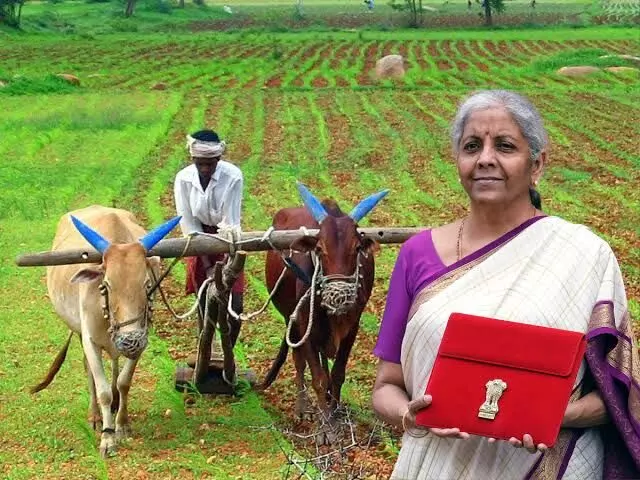
Agriculture in India has always carried a paradox. It sustains nearly half the workforce, secures national food supplies, and anchors rural livelihoods, yet it remains the most vulnerable sector—buffeted by price volatility, climate stress, and institutional neglect. Every Union Budget is therefore read as a statement of intent, a mirror of how the state perceives its farmers and their future. The Union Budget 2026–27 does not announce dramatic farm loan waivers or populist transfers. Instead, it signals a deliberate shift in philosophy: agriculture is no longer seen merely as a subsistence sector to be protected, but as an economic system to be transformed through diversification, technology, and value chains. The question is whether this quiet transition can address the deep structural vulnerabilities that define Indian agriculture.
The most striking aspect of the Budget is its reframing of agriculture. No longer is the narrative confined to foodgrain production or procurement-led price support. Instead, agriculture is positioned within a broader rural bio-economy, linked to processing, exports, entrepreneurship, and allied activities. This is a necessary transition. Shrinking landholdings, rising input costs, and growing climate risks mean that productivity gains in cereals alone can no longer sustain rural incomes. Diversification is not optional—it is inevitable. The Budget places emphasis on high-value crops such as coconut, cocoa, cashew, sandalwood, agarwood, and nuts. These crops are region-specific, export-oriented, and capable of generating higher income per hectare than traditional staples. By supporting such crops, the Budget encourages regional specialisation, export competitiveness, and reduced pressure on water-intensive cereals. Yet diversification is not simply about changing crop choices. It requires market access, risk management, processing infrastructure, and stable demand. Without these, farmers may face even greater price volatility. The challenge lies not in announcing diversification but in ensuring its institutional viability.
Equally significant is the Budget’s recognition of allied sectors—livestock and fisheries—as the real engines of rural income. These already contribute over 30 percent of agricultural Gross Value Added and are less land-dependent than crop farming. Support for integrated fisheries in reservoirs and Amrit Sarovars, livestock entrepreneurship, and dairy and meat value chains reflects an understanding that income stability for small and marginal farmers increasingly comes from non-crop sources. For land-constrained households, livestock and fisheries offer regular cash flow, employment for women and youth, and better risk diversification. This recognition moves policy closer to household livelihood realities rather than abstract production targets. Animal husbandry, contributing nearly 16 percent of total farm income, is given special emphasis through expansion of veterinary infrastructure, loan-linked subsidies, and collaboration with foreign institutions. Such measures aim to improve animal healthcare, disease surveillance, and productivity, while encouraging entrepreneurship in dairy, poultry, small ruminants, and piggery. Similarly, fisheries are positioned as engines of income and nutrition security, with integrated development of reservoirs and coastal value chains, supported by start-ups, women-led groups, and Fish Farmer Producer Organisations. These interventions seek to reduce post-harvest losses, enhance market access, and integrate small fishers into formal markets.
Technology is another pillar of the Budget’s vision. The introduction of Bharat-VISTAAR, an AI-enabled digital advisory platform integrating AgriStack and ICAR’s knowledge systems, is presented as a flagship intervention. Its promise lies in providing location-specific, crop-specific, and climate-responsive advisories to farmers. In principle, such platforms can reduce information asymmetry, improve input efficiency, and enhance adaptive capacity. If effectively implemented, they can democratise access to scientific knowledge that was earlier confined to research stations and extension offices. Yet technology is not a substitute for institutions. Digital advisories cannot compensate for unremunerative prices, inadequate procurement, or market failures. The success of Bharat-VISTAAR will depend on whether it is embedded within a broader ecosystem of credit, insurance, markets, and extension services, rather than functioning as a standalone digital intervention.
The Budget also acknowledges the growing role of women in agriculture. With male out-migration, women’s participation has steadily increased, yet they continue to face limited land rights, restricted access to credit, and invisibility in extension services. Initiatives like SHE-Marts, linked to the Lakhpati Didi programme, aim to move beyond welfare approaches to ownership-based empowerment. By focusing on marketing platforms, branding, and enterprise development, the Budget positions women not merely as cultivators but as economic agents in agri-value chains. This has long-term implications for rural transformation, provided such initiatives are scaled beyond pilot projects and supported with institutional credit and training.
Yet the silences of the Budget are equally telling. Income security remains unresolved. There is no clear framework for farm income stabilisation. Minimum Support Price continues as the primary price policy instrument, despite its limited reach and crop concentration. The absence of experimentation with price deficiency payments or direct income risk coverage leaves farmers exposed to market volatility, especially in non-cereal crops. Small and marginal farmers remain peripheral. Although rhetorically included, many initiatives assume entrepreneurial capacity, risk-bearing ability, and market connectivity—assumptions that do not hold uniformly across India’s agrarian landscape. Tenant farmers and sharecroppers remain largely invisible in policy design. Climate adaptation too lacks urgency. Despite increasing frequency of droughts, floods, and heatwaves, the Budget does not announce a dedicated climate adaptation fund for agriculture. Crop insurance reforms remain incremental, even as claim delays and low coverage persist.
Public investment continues to be emphasised, but its alignment remains questionable. Roads, storage, cold chains, irrigation, and renewable energy must be explicitly linked to agricultural productivity and market access, rather than treated as generic rural development. Without such alignment, agriculture risks becoming a passive beneficiary of growth rather than an active driver. Importantly, the Budget situates agriculture within India’s larger growth strategy—manufacturing, services, exports, and green growth. This integration is essential. Agriculture cannot grow in isolation from the rest of the economy. However, integration must not come at the cost of agrarian equity. As India pursues high-growth pathways, the distributional consequences for rural households must remain central to policy evaluation.
The Budget’s vision for high-value agriculture is ambitious. Coconut promotion, cashew and cocoa programmes, sandalwood revival, and horticulture rejuvenation in hilly regions are all designed to enhance productivity, create global brands, and generate downstream employment. Coconut, with nearly 30 million people dependent on its cultivation, is targeted through schemes for replacing old plantations with high-yielding varieties, improving nurseries, and promoting value-added products. Cashew and cocoa are positioned for self-reliance and export competitiveness, while sandalwood is revived through sustainable cultivation and processing. Horticulture in hilly regions is to be rejuvenated through high-density orchards, youth entrepreneurship, and agri-tourism. These measures, if implemented effectively, can transform regional agriculture into viable livelihood options.
The Budget of 2026–27 is therefore a Budget of direction, not destination. It succeeds in reimagining agriculture as part of a modern, diversified economy. It falls short in providing the income security and institutional depth required to make that transition inclusive and resilient. Whether this Budget becomes a turning point or a missed opportunity will depend less on announcements and more on implementation, institutional reform, and policy continuity. The story of Indian agriculture is one of transition—away from subsistence and monoculture, towards diversification, technology, and enterprise. But it is also a story of unfinished reforms—income stabilisation, climate adaptation, and equity for smallholders. The Union Budget 2026–27 captures this tension, offering a vision of transformation while leaving the hardest questions unanswered. It is a reminder that agriculture cannot be reformed by schemes alone; it requires institutions, continuity, and above all, a commitment to the dignity and resilience of India’s farmers.