India-EU FTA: A Strategic Rebuke to US Protectionism or a Hollow Victory Without Domestic Overhaul?
India-EU FTA offers strategic opportunities but success hinges on domestic reforms. Can India boost competitiveness & seize the moment?

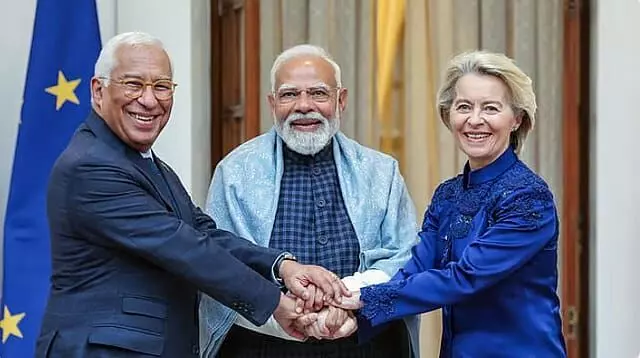
Nobel laureate Abhijit Banerjee’s recent assessment of the India-EU Free Trade Agreement (FTA), concluded on January 27, 2026, cuts through the celebratory rhetoric surrounding the “mother of all deals.” By framing the pact as a “strategic alignment” that signals to Washington that “we don’t need the US as much as the US thinks we do,” Banerjee highlights a potential geopolitical pivot amid escalating transatlantic trade frictions. Yet his cautionary undertone—that gains are far from automatic and hinge on radical improvements in efficiency, logistics, and supply-chain reliability—introduces a critical debate at a pivotal moment. With Finance Minister Nirmala Sitharaman set to present the Union Budget 2026-27 on February 1, 2026, the FTA’s implications for export-led growth, fiscal strategy, and macroeconomic resilience demand rigorous scrutiny.
The strategic dimension is undeniable. President Trump’s administration has imposed punitive tariffs on Indian goods—reaching up to 50% in select categories, including a 25% levy explicitly linked to India’s continued purchases of Russian oil—disrupting bilateral trade flows and exacerbating India’s already sizable goods trade deficit with the US. These measures reflect a broader protectionist stance that has prompted New Delhi to diversify export markets aggressively. The India-EU FTA, covering a combined market of over two billion consumers and roughly a quarter of global GDP, eliminates tariffs on 99% of Indian exports to the EU while slashing duties on over 97% of EU imports into India. Bilateral goods trade stood at approximately $136.5 billion in FY 2024-25, with India enjoying a surplus of around $15 billion (exports $75.85–76 billion, imports $60.68 billion). Sectors poised for gains include textiles, apparel, leather goods, footwear, handicrafts, marine products, and jewellery, where India retains comparative advantage. Conversely, Europe stands to benefit in automobiles, chemicals, pharmaceuticals, and wine.
Banerjee’s point resonates historically. India’s repeated overtures for a bilateral trade deal with the US have met limited reciprocity, despite public assertions of impending agreements during peak tensions. The FTA thus serves as a credible signal of strategic diversification, potentially enhancing India’s bargaining leverage in future US negotiations. In game-theoretic terms, it alters the payoff matrix: by reducing reliance on the US market, India mitigates hold-up risks associated with unilateral tariff impositions. This aligns with broader multilateralism efforts—evident in prior FTAs with the UAE, Australia, and the UK—and underscores supply-chain resilience in an era of geoeconomic fragmentation.
However, Banerjee’s skepticism introduces the counterargument: trade liberalization alone does not guarantee export competitiveness or broad-based welfare gains. He emphasizes that “trade agreements are just a starting point,” requiring competitive products, market demand, and superior delivery capabilities. India’s logistics bottlenecks remain a binding constraint. Retailers in key markets frequently cite Indian suppliers’ slower turnaround times compared to competitors. The World Bank’s Logistics Performance Index underscores this: India’s overall score has improved but lags behind China’s efficiency benchmarks, with persistent challenges in customs clearance, infrastructure quality, and international shipments. China’s “extraordinarily quick turnaround” often trumps marginal price advantages, illustrating that reliability and speed are decisive in global value chains.
Sectoral evidence sharpens the debate. While India excels in jewellery and leather, its apparel and textiles exports have stagnated relative to peers. From 2013 to 2023, Bangladesh’s garment exports surged 69.6% and Vietnam’s 81.6%, while India’s grew a mere 4.6%. Vietnam and Bangladesh benefit from faster ports, better infrastructure, and agile supply chains, capturing buyer preferences even at comparable prices. India’s ports and transportation systems suffer from inefficiencies—congested terminals, slow turnaround, and inadequate last-mile connectivity—translating into higher effective costs despite tariff concessions.
This structural weakness poses risks. Without commensurate reforms, the FTA could yield uneven sectoral outcomes: gains concentrated in high-competitiveness niches like jewellery, while labour-intensive segments face intensified competition. Banerjee’s warning that outcomes “depend entirely on how much India can take advantage of it” highlights the primacy of non-tariff factors—supply-chain reliability, transportation efficiency, and delivery timelines—in determining price competitiveness.
The upcoming budget thus becomes a litmus test for translating FTA opportunities into tangible growth. Expectations center on accelerated capital expenditure (capex) in logistics infrastructure: modernizing ports, expanding dedicated freight corridors, developing multi-modal logistics parks, and enhancing digital customs processes. Such investments would generate fiscal multipliers, boost total factor productivity, and elevate India’s Logistics Performance Index ranking. Complementing this, continuation of Production-Linked Incentive (PLI) schemes in textiles, leather, and electronics could address supply-side rigidities. Fiscal prudence remains essential: maintaining macroeconomic stability amid global volatility requires balancing capex with deficit reduction targets, while monitoring inflationary pressures from potential import surges in automobiles and chemicals.
Optimists argue the FTA cushions against US protectionism and fosters export diversification, potentially offsetting tariff shocks through higher EU volumes. Skeptics, echoing Banerjee, contend that absent efficiency convergence to Chinese levels, gains remain illusory. The pact creates market access but not automatic competitiveness. India’s response must prioritize structural reforms—logistics overhauls, labour-market flexibility, and skill enhancement—to convert strategic alignment into sustained export momentum.
In sum, the India-EU FTA represents a deft geopolitical maneuver, challenging Washington’s assumptions of Indian dependence. Yet Banerjee’s analysis reminds us that trade pacts are enablers, not panaceas. As the Finance Minister prepares her budget, the focus must shift from tariff arithmetic to foundational enablers of competitiveness. Only then can this landmark agreement deliver inclusive, broad-based gains rather than sectoral windfalls. The coming weeks will reveal whether New Delhi seizes the moment or squanders it amid familiar domestic constraints.