Echoes of Silence: When the Speaker Speaks of Dignity

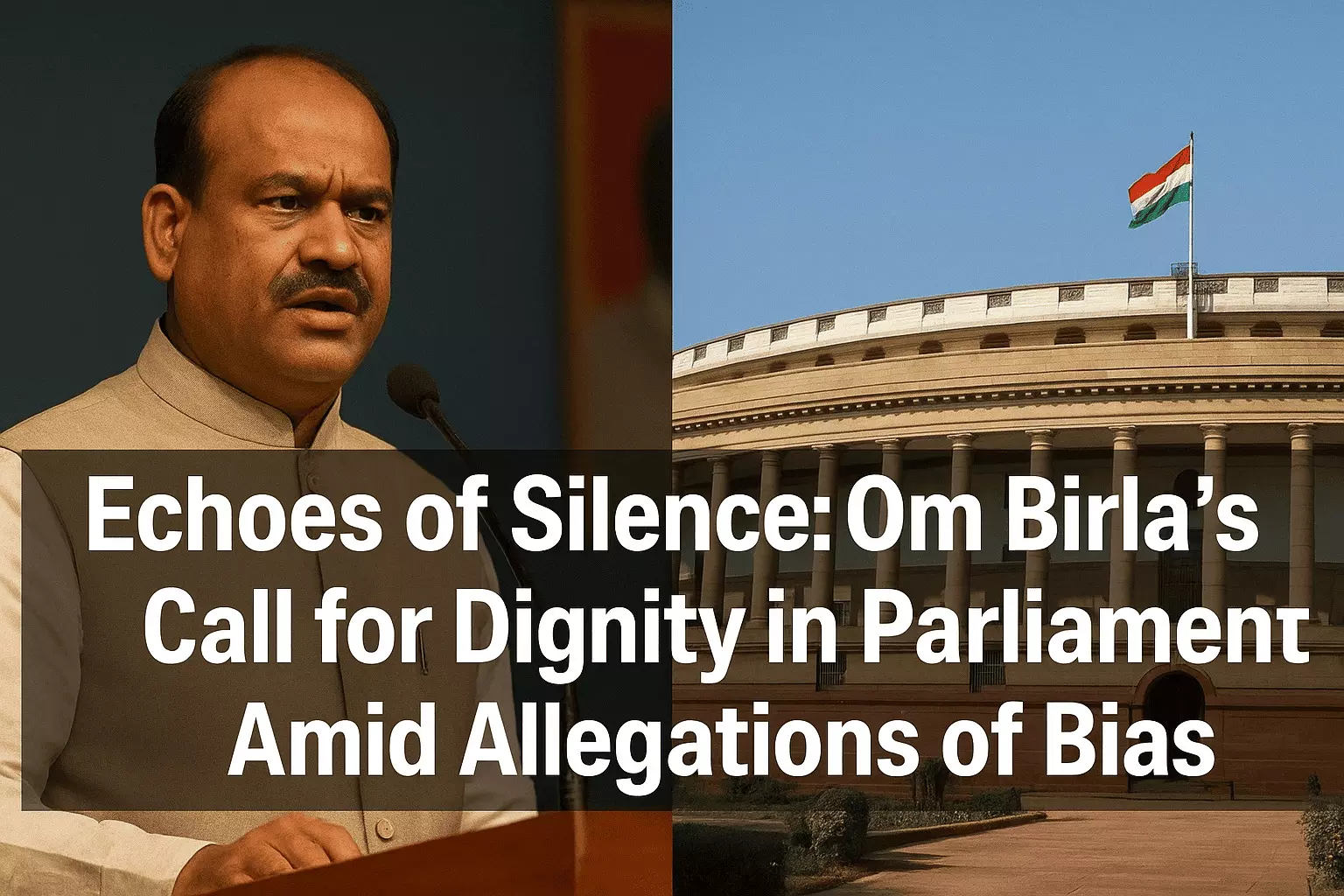
In a democracy, the voice of the people is meant to echo through the halls of Parliament. Yet, when Lok Sabha Speaker Om Birla recently expressed concern over the “decline in the dignity of legislative bodies,” it struck many as ironic. His remarks, delivered during the valedictory session of the All India Speakers Conference, called on lawmakers to rise above partisan interests and uphold the decorum of the House. He emphasized that “freedom of speech and privilege of members should not be construed as the freedom to lower the dignity of the House”. While the sentiment is noble, it comes from a figure whose tenure has been repeatedly criticized for alleged bias and suppression of opposition voices.
The Speaker’s role in Indian parliamentary democracy is constitutionally designed to be impartial. Yet, Om Birla’s term has been marked by frequent walkouts, disruptions, and accusations from opposition parties that their voices are being systematically muted. The most glaring example was the incident involving Rahul Gandhi, where the Congress leader alleged that his microphone was turned off during a speech. Birla responded by saying, “You can check, I don’t have any switch,” implying that technical faults were to blame. But critics questioned why such faults seemed to occur only when opposition members spoke, and not when ruling party MPs took the floor.
This selective silencing has led to a growing perception that the Speaker’s chair, once a symbol of neutrality, has become a tool of political convenience. Parliamentary sessions have seen record lows in productivity, with debates often reduced to shouting matches or adjournments. According to PRS Legislative Research, the 2023 Monsoon Session saw only 23% productivity in Lok Sabha and 26% in Rajya Sabha. These numbers reflect not just inefficiency but a deeper erosion of democratic discourse.
Birla’s recent appeal for dignity and decorum also raises questions about accountability. If the Speaker acknowledges a decline, what mechanisms are being put in place to rectify it? The Constitution guarantees MPs the privilege to speak freely in the House, even against the government. But Birla himself noted that “the intention behind this freedom has seen a decline”. This statement, while valid, sidesteps the structural issues that have enabled such decline—issues that include the Speaker’s own conduct, the ruling party’s dominance, and the lack of institutional checks.
Moreover, Birla’s call for reflection by political parties seems to deflect responsibility. The Speaker is not merely a facilitator; he is the guardian of parliamentary integrity. When opposition members are denied time to speak, when bills are passed without debate, and when dissent is dismissed as disruption, the problem is not just with the parties—it is systemic. The Speaker must ensure that every voice, regardless of affiliation, is heard and respected.
The All India Speakers Conference, where Birla made these remarks, was meant to celebrate the centenary of Vitthalbhai Patel, the first elected Indian Speaker of the Central Legislative Assembly. Patel was known for his fierce independence and commitment to democratic values. His legacy stands in stark contrast to the current climate, where the Speaker’s impartiality is under constant scrutiny. Birla’s invocation of Patel’s name was perhaps an attempt to align himself with that legacy, but the gap between rhetoric and reality remains wide.
In recent years, the erosion of legislative dignity has not been limited to India. Across democracies, parliaments have become battlegrounds for populist agendas, media spectacles, and partisan warfare. But India’s Parliament, with its rich history and constitutional mandate, must rise above these trends. The Speaker’s chair must be a beacon of fairness, not a fortress of favoritism.
Birla’s speech also touched on the importance of respectful language and conduct, both inside and outside the House. “Disagreement is the strength of democracy,” he said, “but members must maintain a code of conduct.” This is undeniably true. Yet, respect cannot be demanded without reciprocity. When opposition leaders are mocked, interrupted, or denied the floor, it breeds resentment and undermines the very dignity Birla seeks to uphold.
The path forward requires more than speeches. It demands structural reforms, transparency in proceedings, and a renewed commitment to democratic values. The Speaker must lead by example—ensuring equal time for all parties, resisting executive pressure, and fostering a culture of debate over diatribe. Only then can the dignity of legislative bodies be restored.
In the end, Birla’s words may serve as a mirror to the institution he represents. They reflect both the ideals of parliamentary democracy and the contradictions that plague it. The question is not whether the decline in dignity is worrisome—it clearly is. The real question is whether those in power, including the Speaker himself, are willing to act on it. Until then, the echoes of silence will continue to haunt the House that was meant to speak for the people.