A Cartographic Provocation: Muhammad Yunus and the Dangerous Game of Political Symbolism
Dr. Muhammad Yunus’s controversial map gift to Pakistan revives fears of “Greater Bangladesh,” straining India-Bangladesh ties amid regional uncertainty.
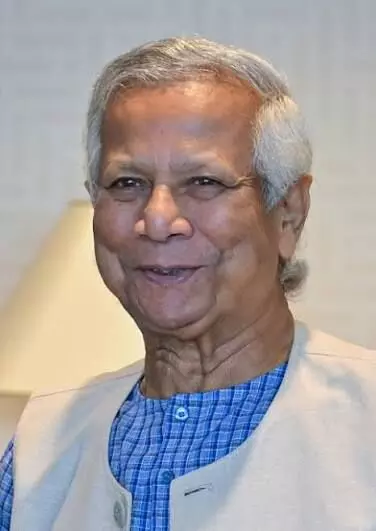
The reported act of Bangladesh’s interim chief, Dr. Muhammad Yunus, gifting Pakistan’s General Sahir Shamshad Mirza a map depicting India’s northeastern states as part of Bangladesh, is not a mere diplomatic blunder—it is a deeply symbolic and politically charged gesture that threatens to unravel decades of carefully nurtured regional stability. At a time when South Asia is reeling under rising political volatility and shifting alliances, such an act cannot be dismissed as symbolic excess. It raises questions not just about Yunus’s intent, but also about the ideological and geopolitical trajectory of the interim government in Dhaka that has already unsettled India since the ouster of Sheikh Hasina.
The image of a Pakistani general accepting a gift from a Bangladeshi leader bearing a distorted territorial map is more than a diplomatic faux pas—it is a deliberate provocation. The cartographic distortion, showing parts of India’s Northeast as belonging to Bangladesh, revives long-dead narratives of “Greater Bangladesh,” a concept propagated by fringe elements that view linguistic and cultural contiguity as justification for territorial claims. Historically, such ideas have remained on the periphery of political discourse, never endorsed by any responsible Bangladeshi government. Yet Yunus’s silence after this episode, and the interim government’s failure to clarify or retract, suggest that this may not be accidental. It reveals a dangerous willingness to play with symbols that can inflame regional sensitivities.
For India, especially for states like Assam, Tripura, and Meghalaya, such developments cut deep into historical wounds. The scars of 1971 still run through the subcontinent’s memory—the brutal war that tore apart Pakistan and gave birth to Bangladesh was itself rooted in questions of identity, sovereignty, and oppression. India’s role in that war was decisive, not just militarily but morally. It extended humanitarian aid to millions of refugees fleeing genocide and, at great political cost, stood firmly behind the Mukti Bahini. To now witness the interim head of Bangladesh appear alongside a Pakistani military leader—whose institution remains unrepentant about its 1971 atrocities—brandishing a map that undermines India’s territorial integrity, is not only ironic but insulting to history itself.
Congress MP Pradyut Bordoloi’s sharp questioning of Assam Chief Minister Himanta Biswa Sarma’s silence underscores the political discomfort such incidents create within India’s own power structure. Sarma, known for his assertive stance on national issues, has yet to issue a statement condemning the episode. His silence is conspicuous and politically loaded, especially in a state like Assam where fears of illegal migration and demographic change have long been politically potent issues. The Congress has seized upon this gap, arguing that New Delhi’s hesitation to confront Dhaka is driven by a larger strategic dilemma—how to maintain influence over a volatile neighbour without further alienating its interim leadership.
India-Bangladesh relations have been steadily deteriorating since Sheikh Hasina’s government fell amid violent protests earlier this year. Hasina’s decision to seek refuge in India has cast a shadow over the new dispensation led by Yunus, who many in New Delhi view as being under tacit Western and Islamic bloc influence. The interim government’s overtures toward Pakistan, as seen in this recent meeting, reinforce suspicions that Dhaka may be attempting to realign itself away from India’s orbit. For decades, India’s eastern diplomacy relied on Dhaka’s cooperation to counter insurgency in the Northeast, ensure border security, and maintain stability along the Brahmaputra basin. Any weakening of this partnership risks emboldening separatist elements and disrupting the fragile peace that has taken years to build.
The Yunus episode also signals a worrying trend—the erosion of historical gratitude in Bangladesh’s political consciousness. The 1971 war forged not just a nation but an emotional bond between the peoples of India and Bangladesh, grounded in shared sacrifice and anti-colonial solidarity. Yet the new generation of Bangladeshi leadership appears eager to rewrite that history, to dilute India’s role and project a narrative of autonomous triumph. Gifting a map that disrespects India’s borders to a Pakistani general is, in essence, a symbolic rewriting of history—a revisionist gesture designed to court nationalist pride within Bangladesh while signaling defiance toward India.
Diplomatically, India must tread carefully but firmly. Any overt confrontation with Dhaka could push it further into Pakistan’s or China’s embrace. Yet silence, too, carries consequences. In international politics, symbols matter as much as treaties, and an unchallenged cartographic insult can easily morph into a normalized narrative. New Delhi should demand an official clarification from Dhaka and mobilize its diplomatic channels to remind the world that territorial integrity is non-negotiable. The Ministry of External Affairs must also engage regional allies like Bhutan and Nepal to prevent similar misinformation from spreading through the subcontinental discourse.
At its core, this controversy is not just about a map—it is about memory, power, and identity. It is about whether Bangladesh will continue to honor the moral foundations of its independence or drift toward geopolitical opportunism. For India, the challenge is equally profound: to assert its interests without losing the moral high ground that once made it the region’s stabilizing force. The map that Muhammad Yunus reportedly presented to General Mirza may exist on paper, but its implications are written across the fault lines of South Asia. A single gesture, when rooted in historical amnesia, can redraw not just borders—but the boundaries of trust.