A Peculiar Cadre, A Muddy Association!
The Eighth Pay Commission Becomes Reality — IEDS Association’s Recognition Now in Jeopardy

Since the advent of the Modi government at the Centre, India has witnessed a wave of transformative reforms — and the bureaucracy has not remained untouched. Coincidentally, this time too, the Pay Commission has once again come into existence. Yes, the Eighth Pay Commission is no longer a rumour; it’s now a reality.
Among Prime Minister Narendra Modi’s many historic initiatives, one notable reform was the creation of the Indian Enterprise Development Service (IEDS) within the Ministry of MSME (Micro, Small & Medium Enterprises). However, even after nearly a decade since its formation, the IEDS remains largely unknown to the wider public — and, surprisingly, even to the MSME sector for which it was established to accelerate growth under the Prime Minister’s vision.
At present, the MSME Ministry is in the spotlight — not because of its developmental achievements, but because of two historic blunders.
The first concerns the unforgettable editorial lapse in the ministry’s in-house publication MSME Journal, under the leadership of IAS officer Dr. Rajneesh, where two officers of the Indian Economic Service, Ashwini Lal and Gaurav Katiyar, were involved in a mishap that discredited the images of both the President and the Prime Minister.
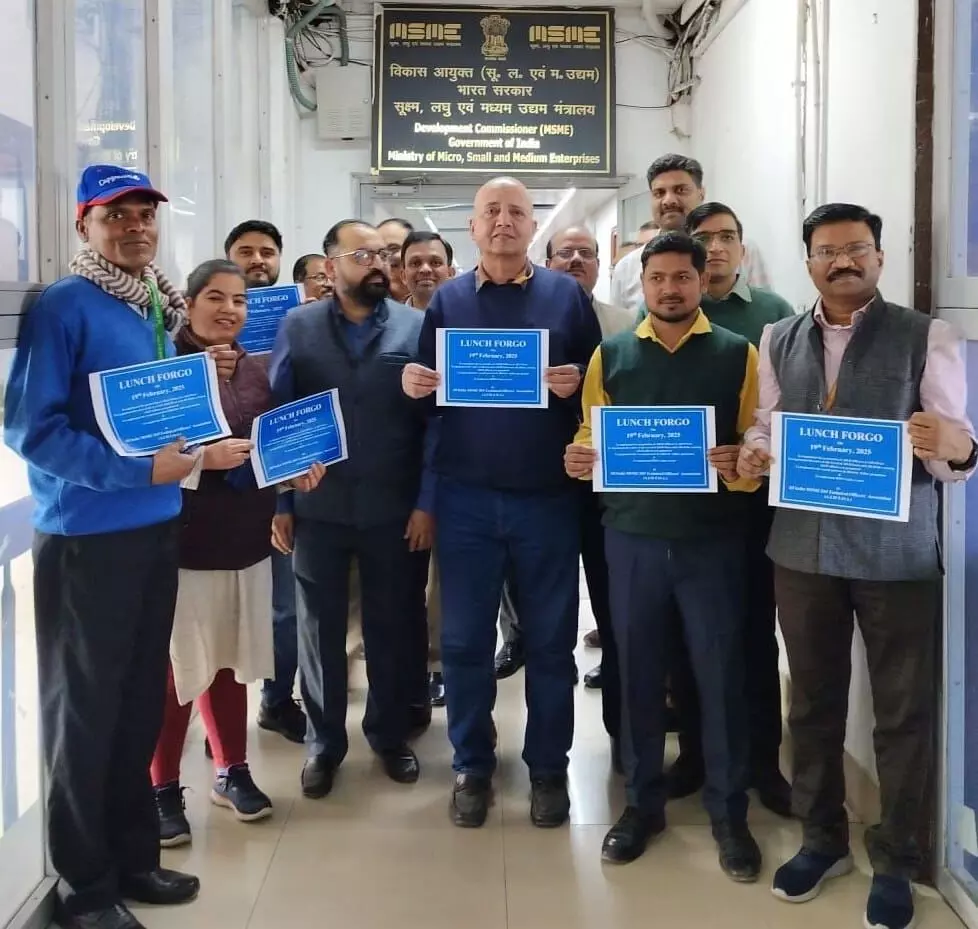
The second controversy stems from the All India MSME DO Technical Officers’ Association, recognized by the Office of the Development Commissioner (MSME). Here, the vice president, G. Veladurai, suddenly declared himself the acting president, causing not only chaos within the Association but also tarnishing the public image of the entire IEDS cadre.
The Association’s constitution — outdated and poorly interpreted — has become practically defunct. The lack of timely amendments has led to the current crisis. On close scrutiny, one finds that under its present provisions, no IEDS officer even qualifies to be a member of this Association.
According to the existing constitution, only officers from the ranks of “Investigator” to “Additional Industrial Advisor” are eligible for membership. The irony is that neither of these designations exist in the IEDS cadre. This means the Association technically represents no one — and certainly not senior officers at the level of Additional Development Commissioner (ADC).
Adding to the farce, four vice presidents were appointed in violation of the constitution, and their selection was never formally approved by the Development Commissioner (MSME).
In such circumstances, the Government of India may revoke the Association’s recognition at any moment. The meetings of this body are neither held constitutionally nor transparently. Membership fees are collected arbitrarily; office-bearers are self-declared, and the race for positions like President and General Secretary has reduced the Association into a playground of ego and politics. No action has been taken so far against activities detrimental to its credibility.
Today, within the MSME Ministry, this Association stands tainted and discredited, and the IEDS — once envisioned as a professional and reform-oriented cadre — has turned into a peculiar, neglected entity following the bureaucratic trails of IAS and IES.
At the MSME Development & Facilitation Office in Kolkata, honest and hardworking officers are reportedly harassed with false charges, while those tainted with corruption are being shielded. At the Development Commissioner’s Office in Delhi, promotion files gather dust for months; cases concerning Assistant Directors’ promotions are deliberately delayed to ensure officers retire without advancement.
Even direct recruitment has begun to look questionable. Every month, yet another officer retires without a single promotion. If things remain unchanged, November will add new names to the long list of IEDS officers who retire unrewarded — becoming symbols of systemic neglect within India’s bureaucracy.
Special Article by Manjari