Dhemaji Bomb Blast 2004: Untold Truth of Assam’s Dark Politics
How the Dhemaji blast blurred lines between insurgency and politics, exposing layers of collusion, betrayal, and unresolved justice in Assam.

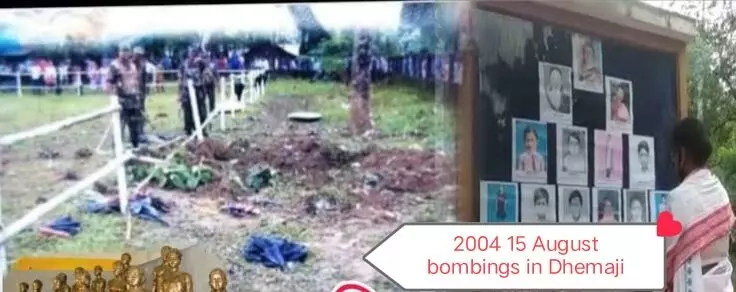
On the morning of August 15, 2004, Dhemaji was ready to turn a page. For decades since 1979, insurgent groups such as the United Liberation Front of Asom (ULFA) had marked 26 January and 15 August as “Indian colonial days,” enforcing boycotts with threats and violence. These dates had been etched into the Northeast’s uneasy political calendar as symbols of resistance and fear.
But that Independence Day, something felt different in the air. The parade ground brimmed with schoolchildren in neat uniforms, teachers in pressed saris and shirts, and district officials overseeing rehearsals for cultural performances. Music floated across the grounds, the tricolour fluttered gently, and after years shadowed by militancy — and the grim “secret killings” of the late 1990s — a fragile optimism took root.
That optimism lasted seconds.
A bomb detonated in the middle of the gathering, cutting down mostly children. The ground of celebration became a ground of blood and chaos. Across Assam, shock and grief swept through homes and headlines. Fingers quickly pointed to ULFA. For many, it appeared to be a clear-cut act of terror. But in Assam’s violent history, what seems obvious often hides a darker, more tangled truth.
The Bandobast – Power for Power
In the weeks and months that followed, whispers began to circulate among investigators and political insiders. The Dhemaji blast, they said, was not solely an insurgent operation — it had been facilitated. Gatekeepers close to a prominent ruling party leader allegedly provided ULFA with the means and opportunity to execute the strike.
The alleged motive was rooted in an election-time pact — a cynical “power-for-power” exchange. The arrangement, as described by those in the know, was simple:
The politician’s camp would give ULFA operational space and political cover.
In return, ULFA would reduce disruptions in targeted areas and influence voting patterns in insurgent-dominated pockets.
Both stood to gain:
For the politician – Control over the state’s machinery and resources.
For ULFA – Freedom to extort, smuggle, and operate with reduced state interference.
It was a transactional alliance between two power brokers from entirely different worlds — one inside the legislative assembly, the other underground. For the people of Assam, it was betrayal in its rawest form.
The Clean-Up – Anup Chetia’s Claim
Years later, ULFA leader Anup Chetia unsettled the narrative once again. In a rare statement, he claimed that every individual involved in the Dhemaji blast had been eliminated in security operations — and that he alone knew their names.
His words opened three possible interpretations:
1. Justice narrative – Security forces acted as avengers, dispensing retribution without the courts.
2. Silencing narrative – Eliminations removed living witnesses who could expose the alleged politician–ULFA nexus.
3. Image management – ULFA sought to close the chapter on its terms, shaping the story’s end and controlling its fallout.
Instead of closure, Chetia’s statement deepened the mystery. The Dhemaji blast appeared less like a straightforward terror attack and more like a managed political episode — with its final truth buried alongside its key participants.
Layers of Truth – Political Anatomy
1. Surface Truth (Official) – ULFA planted the bomb; case closed.
2. Hidden Truth (Bandobast) – An election-time pact between ULFA and a political faction.
3. Buried Truth (Clean-up) – All operatives eliminated in security operations; details suppressed.
4. People’s Truth – All actors complicit; victims abandoned; justice denied.
The Legacy
The Dhemaji blast did more than claim lives — it fractured Assam’s fragile trust in both politics and insurgent movements. ULFA’s ideological standing collapsed under the weight of public fury, while the political class moved on with quiet impunity.
For the families of the victims, the grief was compounded by the knowledge that their children’s deaths had been pawns in a larger game — a game of power, money, and survival.
The official record still reads: case closed. Assam’s collective memory says otherwise. The Dhemaji blast remains an open scar — a reminder that in the Northeast’s shadow politics, truth is layered, alliances are fluid, and the price is often paid in innocent blood.