From Gurus to Clerks — The Silent Tragedy of Indian Classrooms
A detailed analysis of Indian classrooms, teacher struggles, and the need for restoring respect and dignity in education.

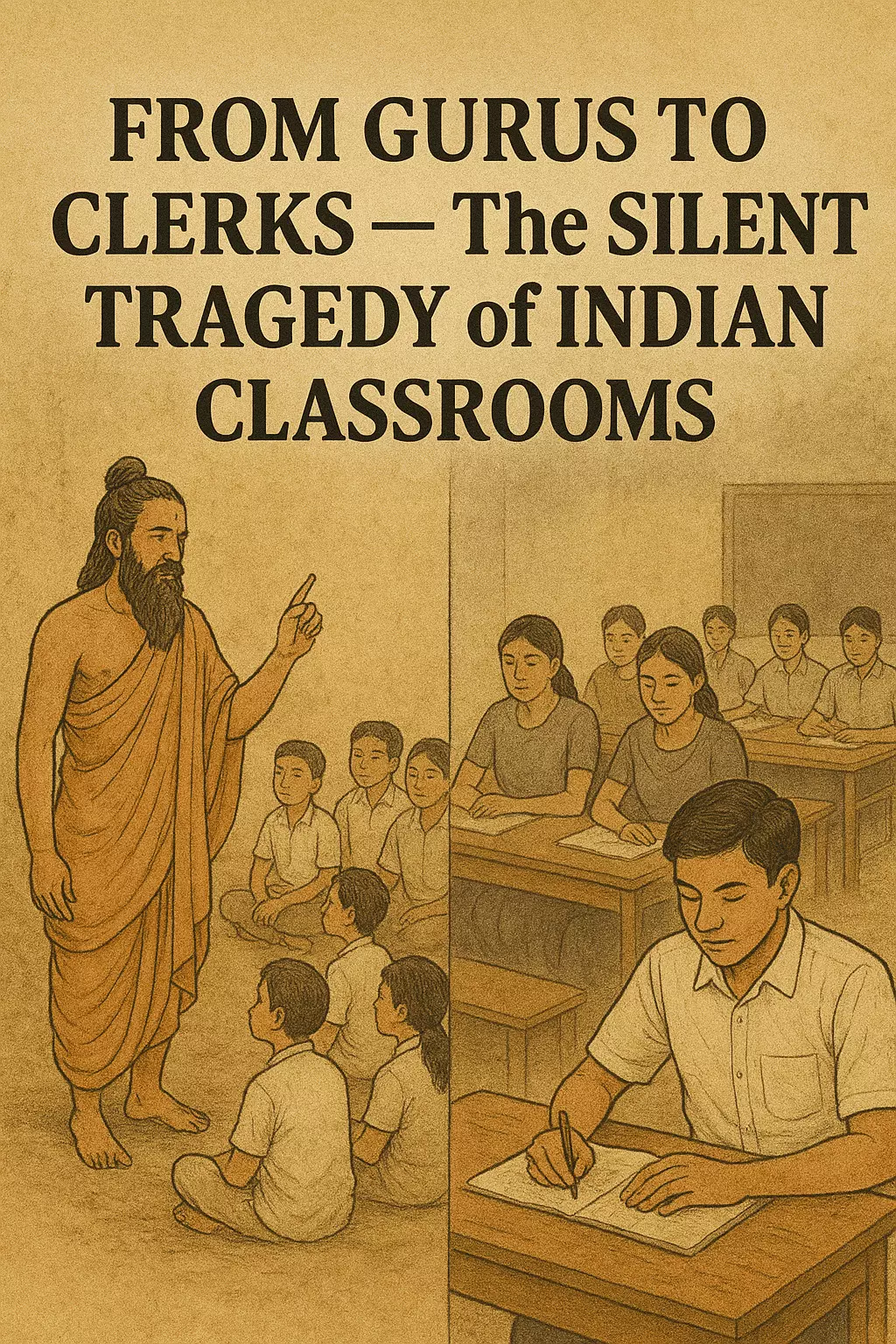
Over the past few years, during countless parent-teacher meetings and informal conversations, I’ve watched the light in many teachers’ eyes slowly dim. In the beginning, it was a faint fatigue, born out of long working hours and mounting responsibilities. But over time, it became something deeper: a quiet disillusionment.
Teachers today seem to be caught in a web not of their making, but one that is woven by an insensitive bureaucratic transformation of schools. Their days are dictated by checklists, digital dashboards, and documentation, all of which have no direct correlation to the genuine joy of teaching.
Lesson plans are no longer crafted with the nuance of human judgment but shaped to fit cold administrative templates. Classrooms, once vibrant spaces of curiosity, increasingly resemble battlegrounds of compliance and discipline. The system seems more concerned with tracking attendance than inspiring attention, more invested in dashboards than in dignity.
A Loss of Reverence
This shift feels especially tragic in a country like ours, where the Guru has always held a sacred place. A Guru was always a figure not just of instruction, but of inspiration. Our history is filled with stories of mentors who went beyond the classroom, like Chanakya and Chandragupta Maurya, being the most enduring example of a relationship where education shaped destiny.
But somewhere along the way, that cultural reverence has been replaced by managerial control.
Today’s teachers often find themselves treated as minions of the school administration, expected to meet revenue goals and reporting metrics rather than nurturing minds. The very institutions meant to foster learning have begun to operate like profit-driven enterprises, leaving teachers to balance impossible expectations from both management and parents, and leaving little room for creativity or care, both of which are the cornerstones of a good education.
Policy Paralysis and the Price of Neglect
Education policy in India, too, seems to oscillate between grand reform and ground reality, rarely finding balance. New curricula and policies are introduced every few years, often with noble intentions, but rarely with the structural support teachers need to implement them effectively. Training programs focus on pedagogy, but seldom on empowerment. Evaluation frameworks measure outputs, not impact.
As Prof. Krishna Kumar recently observed, the Indian teacher’s predicament is not of inadequacy, but of abandonment. They have been left alone in a system that demands everything from them except trust: trust that the teachers can shape citizens of tomorrow.
Restoring the Soul of Education
It’s time to reimagine what we expect from teachers and what we owe them. It should begin with the acceptance of the fact that education is not a service industry; it is an act of nation-building. And that begins with restoring the teacher’s dignity.
A teacher who feels valued, trusted, and free to teach from the heart will always do more for a child than a dozen performance reports ever can. We need to create schools where curiosity counts more than compliance, where lesson plans breathe again, and where children see not supervisors, but mentors who truly care. Because the day we stop respecting our teachers, we stop learning as a nation.
(The writer is a versatile content professional with 20+ years of experience, specializing in customized, high-impact writing across education, PR, corporate, and government sectors.)