From Preamble to Playground: Why Social Justice Needs Schools
Explore how education is key to social justice in India, the impact of school closures, and the urgent need to restore inclusive, accessible public schooling.

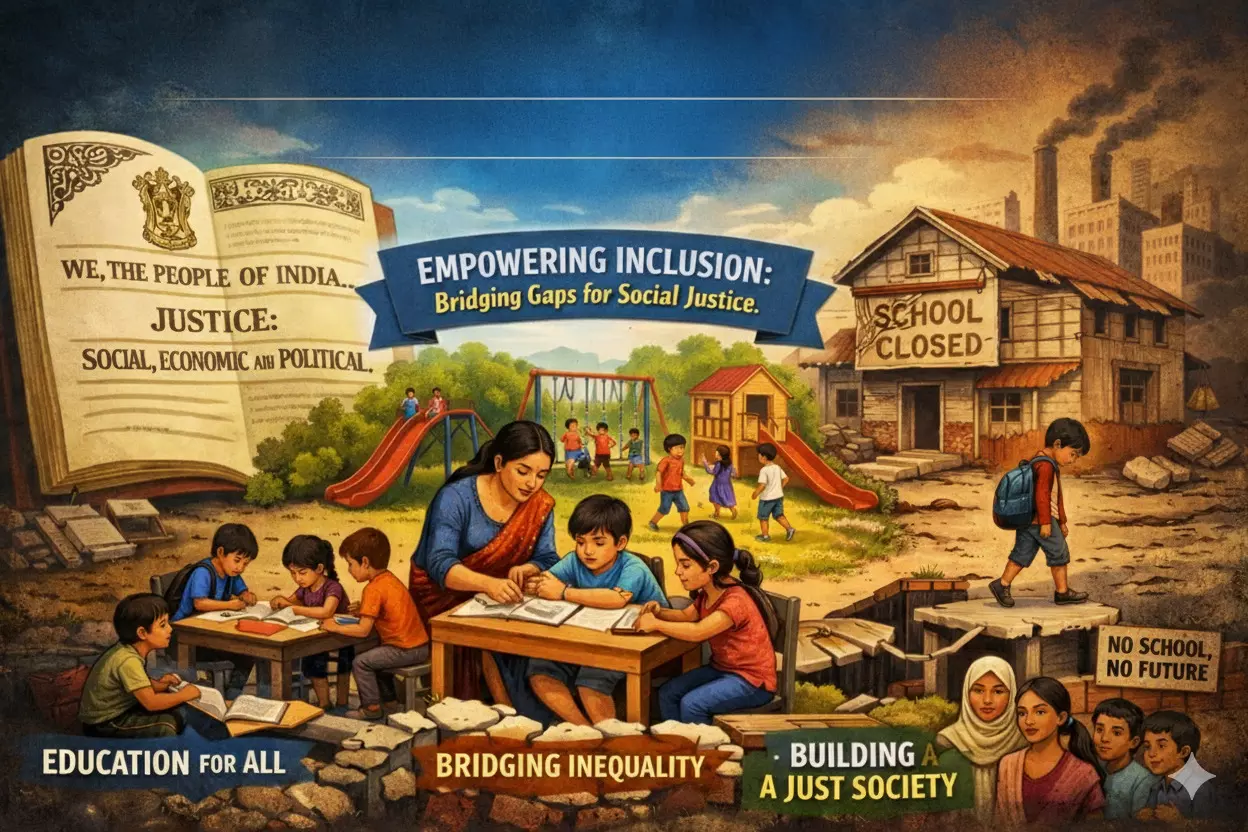
Since 2009, India has observed February 20 as World Social Justice Day, reaffirming its constitutional commitment enshrined in the Preamble and the Directive Principles of State Policy. This observance aligns with the United Nations General Assembly’s declaration of February 20 as the annual World Day of Social Justice, a call to governments, institutions, and individuals to work together to reduce inequalities, promote fair opportunities, and build a more inclusive and just world for future generations. The theme for 2026, “Empowering Inclusion: Bridging Gaps for Social Justice”, resonates deeply with India’s challenges. And at the heart of this mission lies education—the most powerful pillar in seeking these objectives. Education dismantles social and economic barriers, nurtures equality, and creates the foundation for a just society.
From the very first Five-Year Plan (1951–56), education was recognized as central to India’s socio-economic transformation. It was seen not merely as a tool for literacy but as the moving force capable of creating a new social order, one that would foster inclusivity and justice. Yet, despite decades of planning, the trajectory of education in India today raises troubling questions. In 2014, India had 11,07,101 schools, but by 2024, this number had declined to 10,17,660—an 8% reduction. More than 90,000 schools have either been closed or merged in the past decade, often justified under the pretext of “low enrollment” or “rationalization.” Alarmingly, in just the last five years, over 18,000 schools have been shut down. The worst affected states are Uttar Pradesh and Madhya Pradesh, where 25,125 and 29,410 schools respectively have been closed or merged. Together, these two states account for more than 60% of the closures.
The impact of these closures is devastating. These states already suffer from poor socio-economic conditions, and the shutting down of schools has compounded the hardships of marginalized communities. Children are now forced to travel longer distances, increasing both travel time and safety risks. Parents, especially in rural areas, face disrupted working hours as they accompany their children or adjust their schedules. Teachers face retrenchment, and future recruitment prospects shrink. What was once a promise of accessible education has turned into a burden for families already struggling with poverty.
The consequences extend beyond inconvenience. According to National Crime Records Bureau (NCRB) data, atrocities and violence against Scheduled Castes, Scheduled Tribes, and other backward communities have shown a consistent and alarming upward trend over the past decade. States like Uttar Pradesh, Madhya Pradesh, Bihar, Odisha, and Rajasthan—already grappling with socio-economic inequalities—are the worst affected. The closure of schools in these regions has only deepened the divide, depriving vulnerable communities of the one tool that could empower them to resist exploitation and violence: education.
The vacuum left by government schools has become fertile ground for private educational institutions. These schools, often unaffordable for the poor, flourish on the ruins of public education. The Bhuj earthquake offers a telling example: nearly 10,000 government school buildings collapsed, far surpassing hospital buildings. Instead of rebuilding and strengthening public education, the disaster paved the way for private institutions to expand. Over the last decade, private educational institutions have increased by nearly 15%, a trend that signals the commodification of education. What was once a constitutional obligation is now increasingly treated as a market product, accessible only to those who can afford it.
This shift undermines the very spirit of India’s Constitution. Article 45 of the Directive Principles imposed a clear obligation on the State to provide free and compulsory education to children below 14 years of age. The Supreme Court’s declaration of the Right to Education as a fundamental right was hailed as a landmark. Yet, in practice, this transformation has diluted the State’s responsibility. By shifting the right from a positive obligation to a negative right, the State has absolved itself of the duty to actively provide education. Instead, education has become a commodity, a privilege rather than a guarantee. For millions of children, the promise of free and compulsory education remains unfulfilled.
The closure of schools, therefore, is not merely an administrative decision—it is a betrayal of social justice. Education is the foundation upon which equality, dignity, and opportunity are built. Without strong government institutions, the dream of an inclusive society collapses. The observance of World Social Justice Day in India risks becoming a hollow ritual, a slogan without substance, unless the government restores and strengthens its educational institutions. Social justice cannot be achieved through rhetoric alone; it requires concrete action, beginning with ensuring that every child has access to quality education, regardless of caste, class, or geography.
The theme of 2026—“Empowering Inclusion: Bridging Gaps for Social Justice”—demands introspection. Inclusion cannot be achieved if schools are shut down in the very regions where they are most needed. Gaps cannot be bridged if education is left to private players who cater only to the privileged. Justice cannot be realized if the State abdicates its responsibility. The closure of schools is not just an educational crisis; it is a social crisis, a moral crisis, and a constitutional crisis.
India’s journey toward social justice must begin with reaffirming its commitment to public education. Restoring government schools, investing in infrastructure, recruiting teachers, and ensuring accessibility are not optional—they are essential. Only then can the observance of World Social Justice Day carry real meaning. Otherwise, it will remain a mirage, a day of slogans and ceremonies, while the foundations of justice crumble silently in the villages and towns where schools once stood.