AAP Leaders Raise Conflict of Interest Concerns in Excise Case Before Justice Swarna Kanta Sharma
Party questions judicial impartiality as Tushar Mehta appears in case where judge’s children are linked to govt legal panels

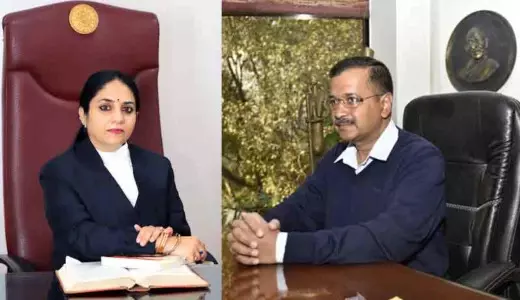
As the High Court hears the Central Bureau of Investigation’s revision petition in the excise policy case, a report by a noted legal journalist reveals that both children of Justice Swarna Kanta Sharma are empanelled as lawyers with the central government and work under Solicitor General Tushar Mehta, who is appearing before her in the matter.
AAP Delhi State President Saurabh Bharadwaj took to social media platform 'X' and wrote, “Justice Swarana Kanta Sharma’s son Ishaan Sharma and daughter Shambhavi Sharma were both empanelled as Union Government panel counsels (Delhi High Court & Supreme Court) in September & November 2025. The same Central Government (via CBI) represented by SG of Central Government Advocate Tushar Mehta is appearing before her against Arvind Kejriwal and other AAP leaders.”
He further wrote, “So careers of Justice Swarna Kanta Sharma’s children are in the hands of SG Tushar Mehta and the Central Government. The same Justice Swarnakanta Sharma attends events organised by the Advocates wing of RSS. Won’t the same Judge be biased in favour of BJP’s Central Government who have empanelled her children ?”
Meanwhile, raising questions over judicial independence, senior AAP leader and Rajya Sabha MP Sanjay Singh said on ‘X’, “Both children of Judge Swarna Kanta Sharma work on the central government’s official panel. They are paid salaries by the central government, and both report to Tushar Mehta as their boss. Does anyone in this country believe that the judge can deliver a verdict against Tushar Mehta and the central government?”
Referring to a recent political remark, Sanjay Singh said, “Last week, Amit Shah had said that Arvind Kejriwal would be punished by the High Court. Now it is becoming clear whether this is the reason behind his confidence.”
On the other hand, pointing to a fresh report, Delhi Assembly LoP Atishi shared, “Another explosive report by Saurav Das has come out. In his previous article, he had shown that Justice Swarna Kanta Sharma was giving unusually little time to the excise policy review petition filed by the CBI after the trial court had dismissed the case. This investigative report shows that both her children are lawyers empanelled with the central government and are working under Solicitor General Tushar Mehta, who is the same lawyer arguing before her in the excise policy case.”
Laying out the details, Atishi further shared, “The facts are that the central government has empanelled both of Justice Swarna Kanta Sharma’s children. Both work under Solicitor General Tushar Mehta, who decides how many cases they are assigned, and therefore how much income and recognition they receive. The same Tushar Mehta is appearing before her in a politically sensitive case. Does the career of her children not depend on Solicitor General Tushar Mehta? Then is this not a clear case of conflict of interest?”
Reacting on X, AAP National Media In-charge Anurag Dhanda stated, “This is shocking. Both the son and daughter of Justice Swarna Kanta Sharma were empanelled in 2025 on the central government’s Supreme Court and High Court panels. These are political appointments, the government chooses people of its preference for these panels. SG Tushar Mehta is the top government lawyer. By that logic, isn't he effectively the boss of Justice Swarna Kanta Sharma’s son and daughter? Is this not a conflict of interest? Can any unbiased decision be expected in Justice Swarna Kanta Sharma’s court against SG Tushar Mehta?”
He asked pointedly, “The Modi government, which is openly conspiring against AAP National Convenor Arvind Kejriwal; why is the government appointing the son and daughter of Justice Sharma, who is currently presiding over several cases involving Kejriwal and other AAP leaders, to every panel? And the most illogical aspect, one that defies comprehension, is that Justice Swarna Kanta herself will decide whether or not a conflict of interest exists, right there in her own court. Whether justice is done or not, it should at least be seen to be done.”
Meanwhile, AAP Chief Spokesperson Priyanka Kakkar wrote on X, “Can a judge remain uninfluenced if the lawyer arguing before her has a hold on the career of her children? Maybe. Can Justice Swarana Kanta afford to upset SG Tushar Mehta? Maybe. Can justice then be seen to be done? Absolutely not. Saurav Das brilliantly explores.”
Report flags conflict of interest and raises concerns over judicial impartiality in excise policy case concerning AAP leaders
In a report shared on X, journalist Saurav Das has raised serious concerns around the CBI’s revision petition in the excise policy case being heard by Justice Swarna Kanta Sharma, pointing to emerging questions of conflict of interest and the appearance of bias. He notes that several of the 23 dischargees in the case had sought the judge’s recusal, but she has not stepped aside, even as Arvind Kejriwal has personally appeared to argue the recusal plea. Das also refers to his earlier analysis of 165 similar criminal revision petitions, where he found that Justice Sharma had deviated from her usual pattern and taken an unusually strong interest in this particular case.
Detailing fresh findings, Saurav Das wrote that both children of Justice Swarna Kanta Sharma, Ishaan Sharma and Shambhavi Sharma, are empanelled as lawyers with the Union government for both the Delhi High Court and the Supreme Court, with their appointments made on the same dates in 2025. He highlights that such empanelments are key sources of government legal work, income, and professional advancement, and notes that Ishaan Sharma in particular has handled a significant volume of government cases in recent years. The journalist points out that these roles operate under the same legal establishment whose top law officers, including Solicitor General Tushar Mehta, are appearing before Justice Sharma in the politically sensitive excise case.
Raising broader institutional concerns, Saurav Das argues that the issue is not about proving actual bias but about whether there exists a reasonable apprehension of bias and whether public confidence in judicial fairness is being affected. He underscores that Indian law recognises the importance of the perception of impartiality, especially in high-profile cases, and questions whether a judge should continue hearing such a matter when close family members hold multiple government-linked positions tied to the same legal ecosystem. He adds that in a system where concerns have already been raised over the manner of panel appointments, such circumstances deepen scrutiny and raise questions about institutional credibility.