L.K. Advani Turns 98: Rajkot Remembers His Historic Ties and Legacy
As BJP patriarch turns 98, the city recalls the warmth, nostalgia, and political legacy that bound L.K. Advani to its people.
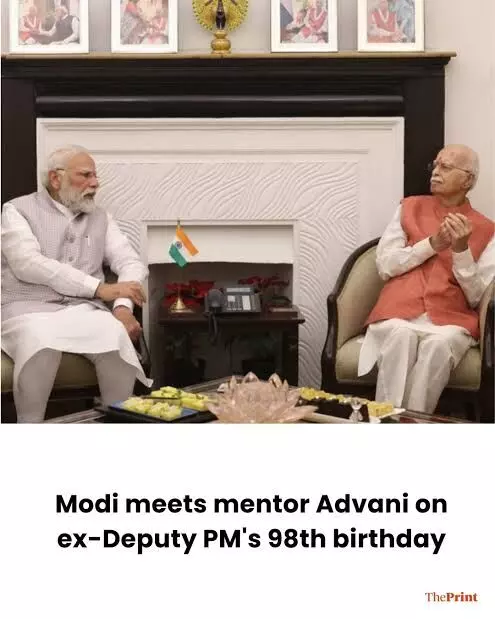
Images Credit -The Print
Former Deputy Prime Minister Lal Krishna Advani celebrated his 98th birthday on Saturday. Through his long and eventful political journey, Advani maintained a deep emotional connection with Rajkot, a city that repeatedly featured in his public life and personal memories.
During his tenure as president of the Jana Sangh and later as the Bharatiya Janata Party (BJP) chief, he visited Rajkot several times. In 1990, the first halt of his historic Somnath Yatra was in this city. Advani spent the night at the Sardar Bagh Guest House, a heritage building constructed by the Nawab of Junagadh, before resuming his journey the next morning toward Ahmedabad via Surendranagar.
It was in this very Circuit House that a historic moment of India’s unification had unfolded decades earlier—under Sardar Vallabhbhai Patel’s direction, Junagadh’s Prime Minister (the father of Zulfikar Ali Bhutto) and V.P. Menon, India’s Cabinet Secretary, had signed the Instrument of Accession for Junagadh’s merger with India.
During the Somnath Yatra, Pramod Mahajan and Narendra Modi were among Advani’s close associates and co-travellers. In Rajkot, he met journalists who had accompanied him from Delhi, along with local reporters, and often shared meals with them in an easy camaraderie that marked his relationship with the media.
He also interacted with party leaders from Saurashtra, including Chimanbhai Shukla, Vijaybhai Rupani, and Bajubhai Vala, and together they visited the Race Course near the Circuit House. Advani’s fondness for ice cream was legendary—whenever he came to Rajkot, he made it a point to stop by Patel Ice Cream or Maganlal Ice Cream, where he relished his favourite Vadilal flavours.
Before T.N. Seshan’s tenure as Chief Election Commissioner, election meetings often extended late into the night. The BJP’s rallies were usually held at Shastri Maidan, located in the heart of the city between Trikon Baug and Jubilee Baug, and typically began only after 10 p.m.
After addressing crowds, Advani would often head to the Race Course, occasionally watching films at Galaxy Cinema Hall, one of Rajkot’s largest theatres. He even encouraged accompanying journalists to join him, recalling fondly how he used to watch films with Atal Bihari Vajpayee in Delhi.
Advani’s attachment to Rajkot was not merely political—it was deeply personal. He often spoke of how his parents lived in Gandhidham and his sister in Morbi. On one visit, he met her when she was battling Parkinson’s disease, and spoke movingly of his pain as her memory began to fade.
In 1984, addressing a late-night election rally at Shastri Maidan, Advani took a firm stand against black money, promising that when his party came to power, it would bring back Indian funds stashed abroad.
During those elections, Advani stayed at the Rajkot Circuit House. Coincidentally, in another room of the same premises, Maneka Gandhi, leader of the Sanjay Vichar Manch, was also staying. At that time, there were no restrictions on leaders using government accommodation during campaigns, nor were Election Commission observers posted at such venues.
For Rajkot, Advani was not just a visitor—he was a familiar figure, a statesman whose journeys, speeches, and personal warmth have become part of the city’s collective memory.