AI in Classroom: Punjab Courts Silicon Valley Giants for Public School Transformation

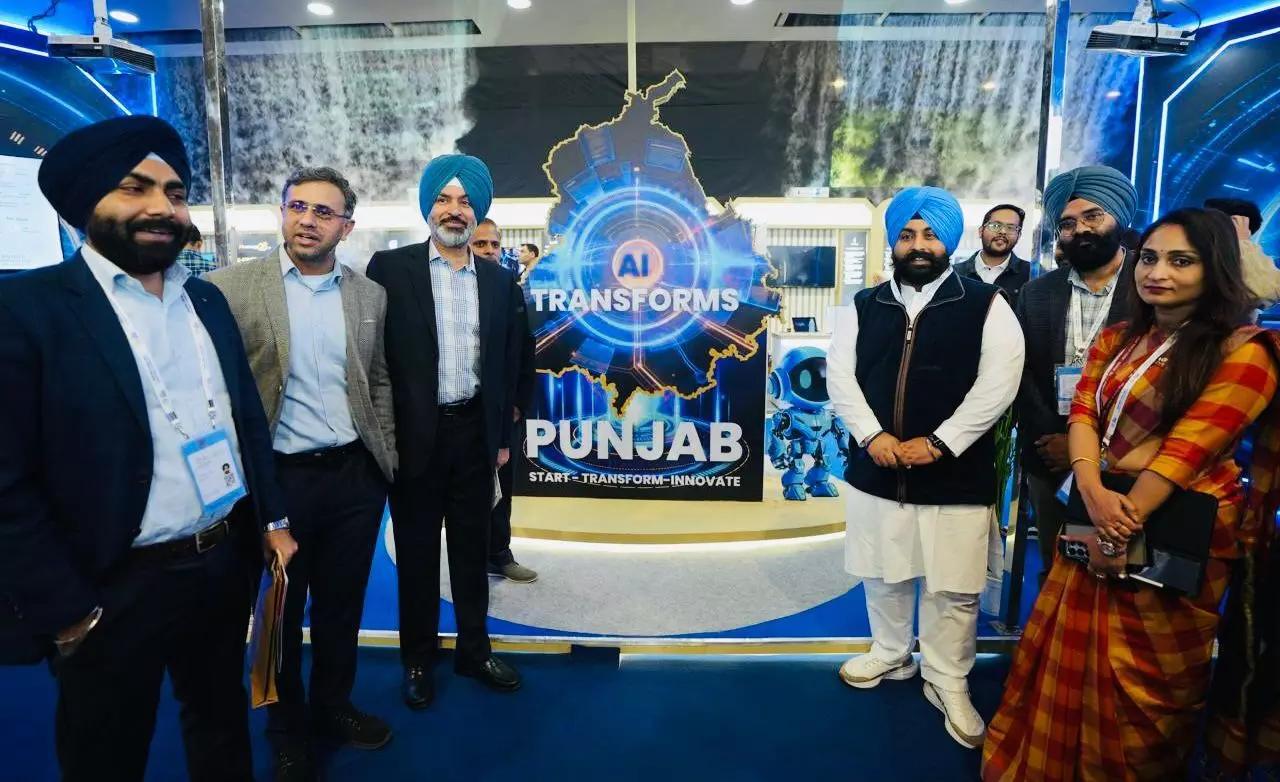
In a calibrated push to re-engineer Punjab’s public education system, School Education Minister S. Harjot Singh Bains on Thursday positioned the state at the centre of India’s emerging artificial intelligence (AI) in education discourse, holding back-to-back strategy meetings with global technology majors at the India AI Impact Expo 2026 in New Delhi.
The high-level visit to Bharat Mandapam was not a ceremonial walkthrough. It was a structured outreach to technology giants and policy architects to explore how AI can be deployed across Punjab’s government schools — from foundational literacy to real-time governance dashboards.
The delegation was spearheaded by S. Harjot Singh Bains, accompanied by Secretary School Education Sonali Giri, Punjab School Education Board (PSEB) Chairman Dr. Amarpal Singh, and Director General School Education (DGSE) Arvind.
Artificial Intelligence as a classroom tool — not a buzzword.
The minister engaged with senior representatives of Google, NVIDIA, OpenAI, Intel, Dell, and Deloitte to examine scalable AI-driven solutions for Punjab’s vast school network.
Discussions revolved around:
- Personalised Adaptive Learning (PAL) systems
- AI-assisted assessments
- Foundational Literacy and Numeracy (FLN) tools
- Multilingual learning interfaces
- Teacher-support chatbots and content generators
- Real-time school monitoring and analytics
Beyond corporate interactions, the delegation consulted with officials from the Ministry of Electronics and Information Technology and the Ministry of Education, seeking alignment with the Centre’s AI strategy and digital public infrastructure frameworks.
The engagements took place at the India AI Impact Expo 2026 hosted at Bharat Mandapam in New Delhi on February 20, 2026.
Punjab’s government school system caters to lakhs of students, many from rural and economically weaker backgrounds. Learning outcomes, particularly in early grades, remain a policy priority across India.
Officials indicated that AI is being evaluated not as a replacement for teachers but as a “force multiplier” — enabling customised lesson plans, instant performance feedback, and data-backed administrative oversight.
The delegation also held domain-focused interactions with Wadhwani AI, gnani.ai, and Bodh.ai, exploring AI-enabled classroom tools tailored to Indian linguistic and curricular realities.
While no formal MoUs were signed at the Expo, sources in the department indicated that pilot projects may be rolled out in selected districts before statewide adoption. The state is expected to examine:
Infrastructure readiness — device access and connectivity
Teacher training modules
- Data protection and student privacy safeguards
- Budgetary alignment under existing education schemes
Minister Bains also visited the Punjab Startup Pavilion, interacting with state-backed AI startups incubated under Punjab government programmes. Officials described it as an effort to combine global expertise with local innovation ecosystems.
“This is about equipping Punjab’s future generations with the tools of tomorrow,” Bains said, underlining a focus on personalised learning pathways and strengthening foundational literacy and numeracy outcomes through AI-enabled systems.
States across India are competing to integrate AI into governance and public service delivery. In education, the challenge lies in ensuring equity — preventing a digital divide where elite institutions surge ahead while rural schools lag behind.
Punjab’s outreach signals intent. The test will be execution — balancing ambition with classroom realities.
As policymakers debate the ethics and economics of AI, one question remains central: Can technology bridge learning gaps faster than traditional reforms?
Punjab appears ready to find out.