Army Displays Pakistani Kamikaze Drone Shot Down During Operation Sindoor
Turkish-origin UCAV targeting Jalandhar was neutralised within minutes; forensic analysis revealed Lahore launch and intended strike on Adampur airbase

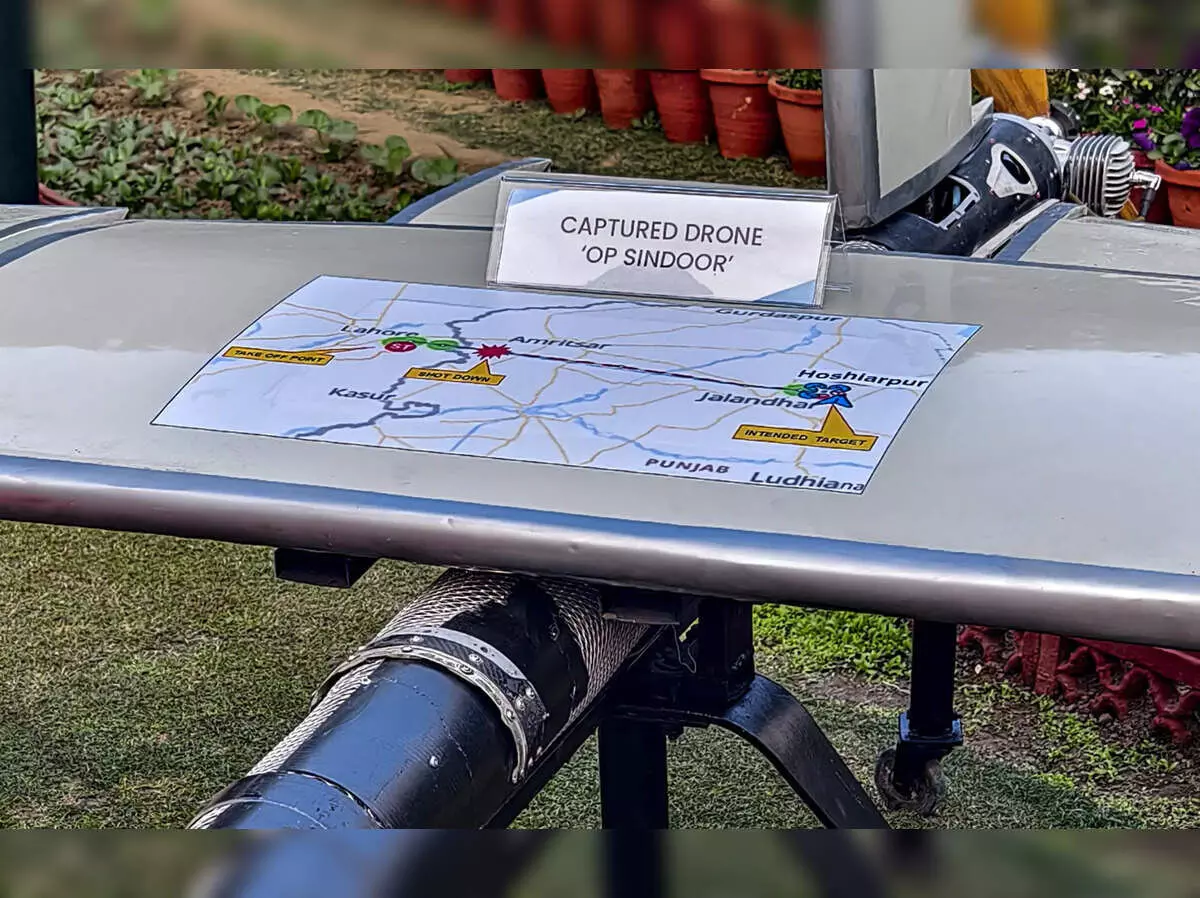
In a powerful reminder of India’s air defence preparedness, the army on Monday put on public display a Turkish-origin drone used by Pakistani forces to target Jalandhar during Operation Sindoor, after it was shot down by Indian defences.
The captured unmanned aerial vehicle was showcased at the Army House as part of the Vijay Diwas celebrations, marking the first public display of Pakistani military hardware by the army more than seven months after the ceasefire between the two countries.
Known in Turkey as the Baykar YIHA-III, the system is a Turkish–Pakistani co-developed unmanned combat aerial vehicle designed as a low-cost, precision strike platform.
Categorised as a kamikaze or loitering munition, the UCAV is built for asymmetric warfare, allowing it to hover over a designated area before homing in on its target.
Capable of carrying a high-explosive payload, the platform is intended to deliver accurate strikes against high-value objectives with minimal operational cost.
Giving the details, an army officer from the Army Cyber Group said that the drone was shot down on May 10 within minutes of taking off from Lahore.
“This drone was carrying a payload of 10 kgs of explosive. We at Army Cyber Group, did the forensic analysis. We have extracted the data and revealed the mission details of this drone, which revealed that it took off from Lahore International Airport,” the officer revealed.
Stating that the drone’s target was likely the Indian Air Force Station, Adampur, the officer said, “It was heading towards Jalandhar and was shot down near Amritsar as soon as it entered the Indian airspace. It was shot as soon as it entered the Indian air space.”
Housing Mig 21 and S 400, the air base is located barely 25 kilometres from Jalandhar. During the briefing of Op Sindoor, it was stated that the Adampur airbase was among the IAF bases, including Pathankot, Bathinda and Udhampur, that were targeted by Pakistan on the intervening night of May 9 and 10.
The Indian army used Skynet-Intel, an indigenous Drone Forensics Tool created under the iDEX DISC-9 programme in collaboration with the Army Cyber Group and Indian industry partners, to extract the details of the downed enemy drone.
The army spokesperson stated that the tool provides a dedicated capability to extract and analyse mission data from recovered drones, retrieving telemetry, GPS tracks, mission logs, RF signatures, sensor files and even encrypted or partially damaged data.
“Its analytics engine reconstructs flight paths, manoeuvre patterns and payload activity, offering clear insight into a drone’s mission profile. Designed for secure, air-gapped Army networks, the system features intuitive dashboards, fast reporting and a modular architecture scalable to new UAV technologies. Skynet-Intel transforms captured drones into valuable sources of operational intelligence for commanders,” the official said.
“This tool can extract data from badly damaged components also, through a technique which is known as chip-off extraction technique,” the officer added further.