Assam’s Borderland Politics: From Evictions to Ethno-Religious Realignment

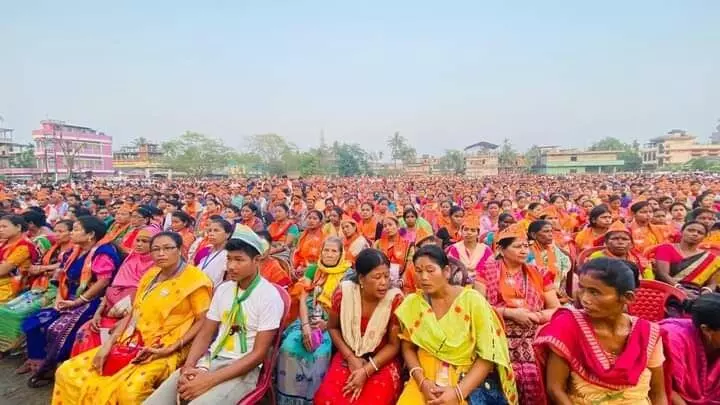
Assam today sits at the intersection of land, identity, and power, where state policy, demographic history, and political mobilisation have fused into a single, volatile equation. The eviction drives under Chief Minister Himanta Biswa Sarma are not just administrative actions; they have become a form of political theatre — a visible assertion that the state is “protecting” the Assamese jati. Each bulldozer and police cordon is both a legal act and a symbolic signal to an anxious ethnic majority that fears marginalisation in its own homeland.
The term miya — long a slur for Bengali-origin Muslims — has been repurposed as a political category. It compresses a century of migration, assimilation, and intermarriage into a single enemy image, one that can be easily mobilised against in public rallies, local resolutions, and social media campaigns. This labelling is reinforced by newly assertive groups like the Asom Lachit Sena and similar vigilante outfits, whose street-level activism converts state actions into mass movements. While AASU and older student bodies have moderated their tone, these smaller, agile groups are filling the gap with harder rhetoric and local enforcement energy.
Parallel to this is the expanding influence of the RSS-Sangh ecosystem, which brings a pan-Hindutva dimension into Assam’s historically ethno-linguistic nationalism. This alignment is strategic: Assamese cultural nationalism and Hindu majoritarianism are not identical, but they overlap in key areas — land protection, resistance to “illegal migration,” and promotion of a singular cultural identity. The Sangh provides the organisational muscle and ideological framing, while Assamese nationalism supplies the regional legitimacy.
Demographically, Assam is in a delicate balance. Assamese speakers are a plurality, not a majority, with significant Bengali-speaking populations — both Hindu and Muslim. The state’s politics is therefore a competition of narratives over numbers: “indigenous” Assamese versus “outsiders,” “Hindu refugees” versus “Muslim infiltrators,” “ethnic Assamese” versus “neo-Assamese.” Each framing has a constituency, and each is sharpened by the perception that the Assamese are a minority in their own land.
The assimilation vs. mixing debate lies at the heart of the matter. Assamese nationalism historically encouraged assimilation — the adoption of Assamese language and culture regardless of origin. Today, the fear is not of assimilation failing, but of being numerically and politically overwhelmed before assimilation can occur. This has created space for policies and rhetoric that emphasise exclusion over integration.
Looking ahead, Assam’s political trajectory resembles borderland conflict zones elsewhere — notably Mindanao in the Philippines and southern Thailand’s Pattani region — where state-backed demographic shifts, religious identity divides, and local insurgencies produced long cycles of tension. The difference is that Assam’s insurgent phase has largely subsided, replaced by a governance–mobilisation feedback loop: evictions and voter-roll measures trigger community protests, which justify further security measures, which in turn harden community identities ahead of elections.
Tripura offers a cautionary domestic parallel. There, tribal political dominance gave way to a Bengali-majority state, producing decades of political realignment and identity resentment. Assam is not yet at that stage, but the demographic anxiety is comparable — and the political uses of that anxiety are clear.
In the short term, eviction drives, land protection rhetoric, and arms-licensing for “indigenous” populations will dominate the state’s political messaging. In the medium term, unless there is transparent land adjudication, credible resettlement, and structured inter-community dialogue, the politics of protection will give way to the politics of permanent separation.
Bottom line: Assam’s present moment is not just about removing encroachment; it is about re-engineering the state’s demographic and political future. Every eviction site is also a campaign stage, every label a tool of mobilisation, and every land dispute a proxy for the larger question — Who will decide what it means to be Assamese tomorrow?