Assessing Arvind Panagariya’s “Big Shot in the Arm” Claim for an India–US Trade Deal
Arvind Panagariya believes a US-India trade deal will boost India's economy, but will it live up to the hype?

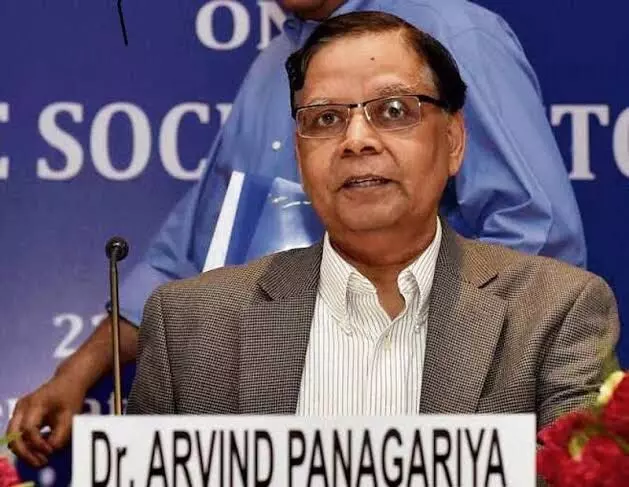
India and the United States are negotiating a comprehensive trade agreement that economists predict could reshape India’s growth trajectory. Arvind Panagariya, Chairman of the 16th Finance Commission, has described the deal as a “big shot in the arm” for India—one that would catalyze domestic liberalization, enhance market access, and significantly bolster foreign investment. As the two sides aim to conclude talks by early August under US President Donald Trump’s tariff deadline, it’s crucial to dissect whether Panagariya’s optimism is firmly rooted in economic fundamentals or risks overstating the agreement’s immediate impact.
India’s goods trade with the US in 2024 stood at USD 129.2 billion, comprising USD 41.8 billion in exports and USD 87.4 billion in imports, resulting in a trade deficit of USD 45.7 billion. Under the “Mission 500” initiative, Prime Minister Narendra Modi and President Trump have set an ambitious target of lifting bilateral trade to USD 500 billion by 2030. Such figures highlight both the depth of existing commercial ties and the scope for expansion. If the trade pact succeeds in systematically lowering Indian tariffs on key exports and dismantling US barriers on Indian goods and services, bilateral commerce could indeed accelerate beyond current growth trends.
Central to Panagariya’s argument is that any deal will compel India to liberalize its own trade regime. He points out that “when the agreement has to be signed with the United States, India will also be lowering its tariffs,” which in turn stimulates competitive pressures on domestic industries to innovate and upgrade productivity. Beyond tariff cuts, India may agree to streamline customs procedures, reduce non-tariff barriers in pharmaceuticals and information technology, and improve regulatory transparency—all measures that enhance overall economic efficiency. In theory, these reforms can spark a virtuous cycle: lower costs attract foreign direct investment (FDI), FDI funds technology transfer, and technology transfer boosts export competitiveness.
Panagariya further argues that securing open access to the two largest markets—the US and the EU—would make India “a very attractive location because effectively the friction that is there on the border will melt away, and that is going to be an absolute game changer”. Multinational companies often seek stable, predictable market access when choosing investment destinations. A US agreement, followed by an EU pact, could reposition India as a low-friction manufacturing hub, encouraging firms to diversify supply chains away from China. Heightened integration with Western markets also offers Indian exporters greater pricing power, improved quality standards, and stronger compliance ecosystems.
Yet the claim’s potency hinges on parallel domestic reforms that tackle India’s deeper structural constraints. Even if tariffs fall, foreign investors will weigh the ease of land acquisition, labor regulations, power reliability, and logistical connectivity. India’s manufacturing sector has long been bottlenecked by rigid labor laws and fragmented infrastructure. The pressing challenge is not only to sign trade pacts but to implement complementary measures—such as rationalizing labor codes, upgrading ports and highways, and digitizing customs—that translate market access into actual production growth.
Moreover, India’s negotiating bandwidth is limited by sensitive sectors. Agriculture, dairy, and certain service categories remain fiercely protected. US negotiators may press for greater market openness in these areas, forcing India to reconcile rural livelihoods with export ambitions. Data localization, intellectual-property protections, and visa regimes for professionals are additional thorny issues that could dilute initial liberalization gains. The final agreement may fall short of the textbook “gold-plated” FTA, instead resembling a series of phased tariff reductions and selective sectoral commitments.
Geopolitical dynamics add another layer of complexity. The US pursuit of decoupling from China offers India a unique window of opportunity, but Washington’s own trade uncertainty—reflected in tit-for-tat tariffs on allies—could blunt investor confidence. Trump’s aggressive timeline (an August 1 deadline) raises the specter of a rushed deal with unresolved technicalities. Panagariya himself acknowledges that “we’re very close to a deal with India, where they open it up,” yet history cautions that such projections often slip as detailed drafting and legislative approvals intervene.
In sum, Panagariya’s characterization of the India–US trade agreement as a “big shot in the arm” is grounded in salient economic data and the realistic prospect of mutual market opening. However, the ultimate payoff will depend on how comprehensively India aligns domestic reforms with external commitments, and how credibly both sides resolve contentious issues. If implemented earnestly—and followed by EU negotiations—the deal could indeed usher in a new era of liberalization and investment. But without structural overhauls and political resolve, the pact risks being a headline-grabbing milestone rather than a transformative catalyst.