Bihar achieves 24-hour power supply, boosts capacity from 700 MW to 8,000 MW since 2005: CM Nitish Kumar
Chief Minister highlights state’s turnaround from darkness to full electrification under ‘Har Ghar Bijli’ and solar power initiatives.
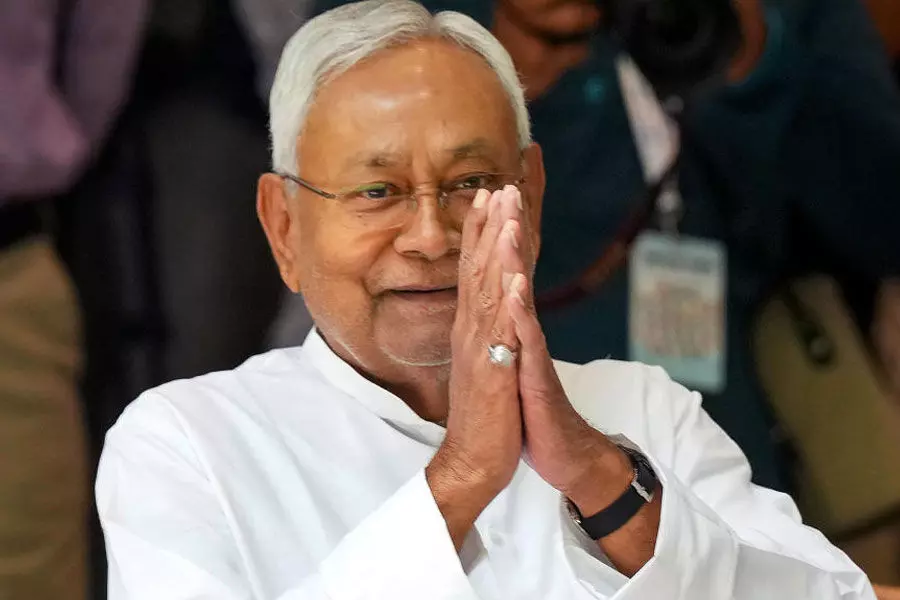
Chief Minister Nitish Kumar on Wednesday said that Bihar has achieved 24-hour power supply across both urban and rural areas, marking a complete transformation from the electricity crisis that once defined the state before 2005. He said the state’s maximum power supply has risen from 700 megawatts to over 8,000 MW, while generation capacity has expanded to more than 8,850 MW.
Recalling the grim scenario two decades ago, Kumar said Bihar once “lived in darkness,” with even the capital Patna receiving barely seven to eight hours of electricity a day. “Before 2005, transformers were often burnt, wires were in tatters, and even light bulbs barely glowed. In rural areas, electricity was so rare that people used the poles to dry clothes,” he said.
The Chief Minister said that in 2005, Bihar’s per capita power consumption was only 75 units, with just 1.73 million consumers across the state. “Today, that number has grown more than twelvefold to nearly 22 million consumers, while per capita consumption has surged five times to 363 units,” he added.
Structural Reforms in Power Sector
Kumar said the transformation began after his government took office in November 2005, with a focus on strengthening power generation, supply, and transmission systems. On October 31, 2012, the Bihar State Electricity Board (BSEB) was restructured into five separate companies, marking a major administrative reform.
“On Independence Day in 2012, I had promised that if we failed to improve the power situation, I would not return to the public to seek votes in 2015. That promise pushed us to deliver,” the Chief Minister said.
In 2015, the government launched the ‘Har Ghar Bijli’ (Every Home Electricity) scheme, under which electricity connections were provided to all eligible households by October 2018, two months ahead of schedule. The initiative involved extensive infrastructure expansion — including the construction of new grid substations, transformers, and high-capacity transmission lines.
Rural and Agricultural Electrification
Kumar said the government has built dedicated agricultural feeders to provide affordable electricity to farmers. Farmers now receive subsidised power at 55 paise per unit, and free connections have been provided for irrigation purposes. The state allocated ₹4,395 crore for agricultural electricity subsidies in 2024–25, he added.
The number of grid substations in Bihar has increased fourfold to 172, while power substations have tripled to 1,260. The number of distribution transformers has grown tenfold to 3.5 lakh, and the total transmission line network has expanded to over 20,000 km, with 33 kV distribution lines stretching nearly 19,000 km.
Subsidies and Renewable Push
To reduce citizens’ financial burden, Kumar said the state government is providing ₹15,343 crore in electricity subsidies this year and up to 125 units of free electricity per month for all domestic consumers. The government also plans to promote solar rooftop installations across homes and public spaces within the next three years, with consumer participation.
Solar power plants are being installed on government and private buildings across Bihar to boost renewable capacity and ensure sustainable energy generation.
“Bihar has fulfilled its pledge of becoming an ‘Energetic Bihar’ and is now self-reliant in the field of electricity. The lantern era is long gone. The future of Bihar is filled with light,” Kumar said, reaffirming his government’s commitment to further infrastructure and energy development.