Bihar Outpaces National Growth in Milk, Egg and Meat Production in 2024–25
Livestock and fisheries sectors register record gains as state nears self-reliance, says ACS Dr. N. Vijayalakshmi.
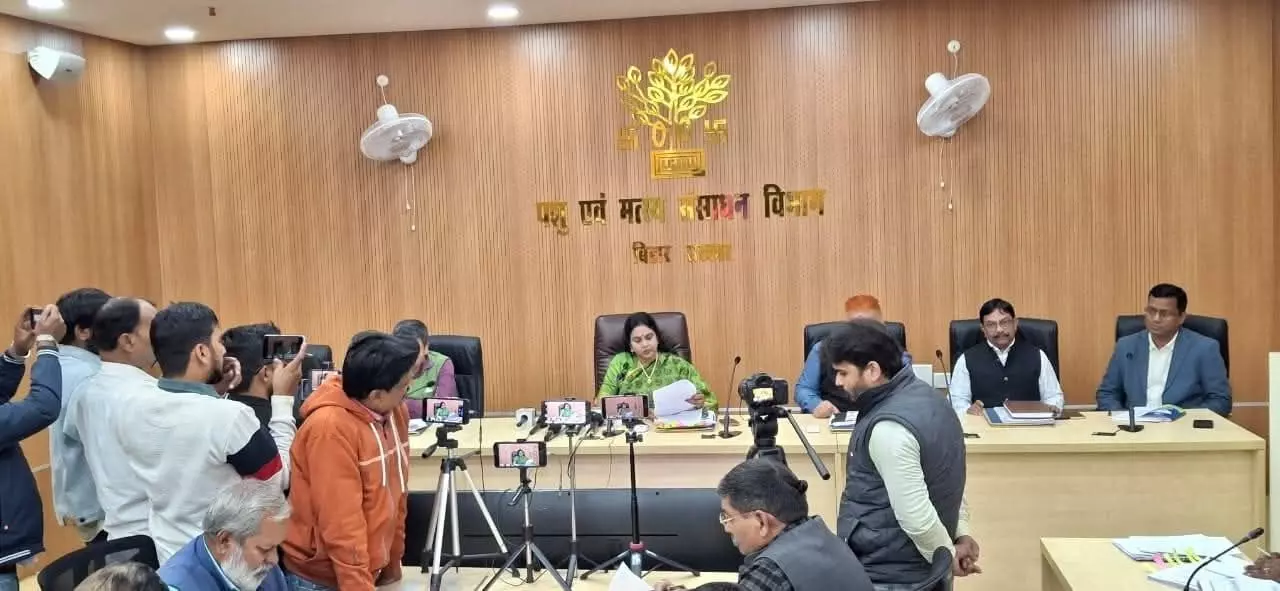
Bihar has achieved record growth in its livestock and fisheries sectors during the financial year 2024–25, surpassing the national average in milk, egg, and meat production, said Dr. N. Vijayalakshmi, Additional Chief Secretary, Department of Animal and Fisheries Resources, Government of Bihar.
Addressing a press conference at the department’s auditorium in Vikash Bhavan, Patna, Dr. Vijayalakshmi said the continuous expansion of departmental schemes, modern technology, and doorstep veterinary services have significantly strengthened rural livelihoods, nutrition, and economic resilience.
The press meet was attended by Ujjwal Kumar Singh, Director (Animal Husbandry); Abhishek Ranjan, Director (Fisheries); Kedar Nath Singh, Director (Gavy Vikas); and other senior officials.
Bihar Surpasses National Growth in Livestock Output
Dr. Vijayalakshmi said livestock contributes 31% to the Gross Value Added (GVA) of India’s agriculture sector and 5.5% to the national economy, with Bihar emerging as a key player in recent years.
According to data released by the Department of Animal Husbandry and Dairying, Government of India, Bihar’s production of milk, eggs, and meat grew at a faster pace than the national average in 2024–25.
| Product | 2023–24 Output | 2024–25 Output | Bihar Growth Rate | National Growth Rate |
|---|---|---|---|---|
| Milk (000 tonnes) | 12,852.99 | 13,397.69 | 4.24% | 3.58% |
| Eggs (lakh) | 34,400.5 | 37,838.75 | 9.99% | 4.44% |
| Meat (000 tonnes) | 404.3 | 420.59 | 4.03% | 2.46% |
-
Bihar ranks 1st in India in annual growth rate of egg production,
-
6th in milk production growth, and
-
9th in meat production growth.
Bihar achieved over 95% of its production targets for 2024–25 set under the Fourth Agriculture Road Map (2023–28) — a strong indicator of its agricultural strength.
Rising Per Capita Availability Reflects Rural Prosperity
Per capita availability of livestock products in Bihar also showed consistent improvement:
-
Milk: from 277 gm/day to 285 gm/day
-
Eggs: from 27 to 29 per year
-
Meat: from 3.19 kg/year to 3.27 kg/year
Dr. Vijayalakshmi said these figures reflect the growing role of livestock in enhancing rural nutrition and income.
Nationally, Bihar contributes:
-
5.41% of India’s total milk production (9th rank),
-
4% of total meat production (10th rank), and
-
2.54% of total egg production (11th rank).
24x7 Veterinary Access and Breed Improvement Driving Growth
She credited the surge in livestock production to the expansion of Mobile Veterinary Units (MVUs) offering 24x7 animal healthcare, poultry and goat development programs, and intensive breed improvement initiatives across districts.
Fisheries: Bihar Emerges as a Self-Reliant State
Highlighting Bihar’s rapid strides in the fisheries sector, Dr. Vijayalakshmi said that sustained government initiatives have made fisheries a key contributor to rural economy, nutrition, and employment.
Over the past decade (2014–15 to 2023–24), the state’s fish production grew by 81.98%, with the compound annual growth rate (CAGR) between 6% and 6.7%, close to the national average of 8.58%. Bihar’s national ranking improved from 9th to 4th place during the period.
| Parameter | 2023–24 | 2024–25 | Growth (%) |
|---|---|---|---|
| Fish Production | 8.73 lakh tonnes | 9.59 lakh tonnes | 9.85% |
| Fish Seed Production | 51,335 lakh | 74,156 lakh | 44.46% |
| Fingerling Production | 8,560 lakh | 10,679 lakh | 24.7% |
| Per Capita Availability | 8.73 kg | 9.50 kg | 9.85% |
| Revenue Collection | ₹1,752 lakh | ₹1,767 lakh | 0.85% |
Technology-Driven Growth in Fisheries
Key initiatives strengthening Bihar’s fisheries ecosystem include:
-
Construction of 7,575 ha of scientific fish ponds with modern aeration and water-quality systems.
-
Establishment of 70 fish feed mills to ensure high-quality feed supply.
-
Installation of 764 biofloc units to enable high-yield fish farming in limited space.
-
Setting up of 70 RAS (Recirculatory Aquaculture System) units, conserving 90% water while increasing productivity.
Dr. Vijayalakshmi said these results prove that Bihar’s fish farmers are adopting scientific management, quality seed use, and modern training, driving the state toward fisheries self-reliance.
Conclusion
“The impressive rise in livestock and fisheries output is a testament to Bihar’s rural resilience and scientific progress,” Dr. Vijayalakshmi said. “The state’s consistent performance shows that Bihar is rapidly moving toward self-reliance in animal and fisheries production, ensuring both nutritional security and rural prosperity.”