Bihar’s education overhaul: From collapse to near-universal schooling, literacy rate rises to 80%
Chief Minister Nitish Kumar highlights two decades of reforms — from free bicycles and teacher recruitment to world-class institutions.
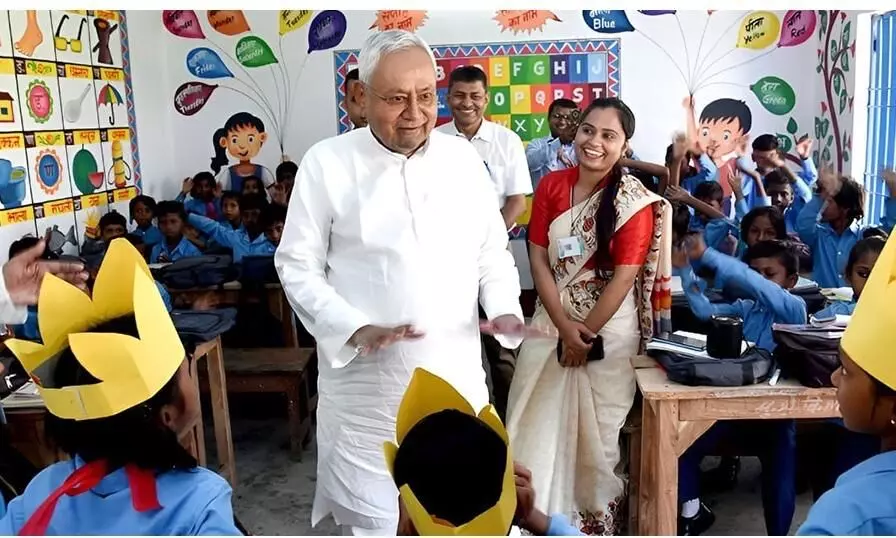
Bihar Chief Minister Nitish Kumar has said that the state has achieved a “historic transformation” in education since 2005, moving from a state of near collapse to one where almost every child now attends school, and literacy has climbed to nearly 80 percent.
Recalling the situation before his government took office in November 2005, Kumar said the education system then was “in complete disarray.” “Government schools were in ruins, there were no teachers, and 12.5 percent of children — mostly from Mahadalit and minority communities — were completely out of school,” he said.
At that time, there was only one teacher for every 65 students, and girls rarely studied beyond Class 5. “Education was treated as a mockery, and instead of building schools, those in power opened shepherd schools,” the Chief Minister said.
Education budget expands 14-fold
Kumar said the government’s first step after 2005 was to expand funding. The education budget, which was ₹4,366 crore in 2005, has now increased to ₹60,964.87 crore for 2025–26, accounting for 22 percent of the total state budget.
Massive expansion of schools and teachers
The number of schools has risen from 53,993 in 2005 to 75,812 in 2025, covering nearly 98 percent of the state’s hamlets. High schools have now been established in every panchayat, and education up to Class 12 is available within easy reach, particularly benefiting girls.
To address the acute teacher shortage, the government has appointed 2.38 lakh teachers through the Bihar Public Service Commission (BPSC) in 2024, followed by 36,947 head teachers and 5,971 headmasters in 2025. Additionally, 3.68 lakh teachers appointed through local bodies in 2006 are being regularised after competency tests — bringing the total number of government teachers close to six lakh.
“This scale of teacher recruitment is being discussed nationwide,” Kumar said.
Schemes for girls and marginalized students
The Chief Minister highlighted welfare schemes that changed enrolment patterns, particularly among girls. The Uniform Scheme (2006–07) and Bicycle Scheme (2008) for Class 9 girls — later extended to boys — drastically improved attendance and reduced dropout rates. “Today, girls outnumber boys in matriculation and intermediate examinations,” Kumar noted.
Special efforts were also made to bring children from marginalized communities to school. Tola Sevaks and Talimi Markaz workers, now known as Shiksha Sevaks, were appointed to mobilize children from Mahadalit and minority households. “As a result, nearly 100 percent of children are now enrolled in school,” Kumar said.
Modern classrooms and digital learning
The state government launched the ‘Unnayan Bihar Yojana’ to introduce high-tech education. Most 10+2 schools now have computer labs, e-libraries, and science laboratories. Public libraries equipped with study materials and high-speed internet have also been set up at the block and panchayat levels for students preparing for competitive exams.
Higher and technical education revival
Before 2005, Bihar had only 10 state universities. Today, the state has 21 state universities, 4 central universities, and 8 private universities. In addition, national-level institutions such as IIT Patna, AIIMS Patna, NIFT Patna, IIM Bodh Gaya, IIIT Bhagalpur, Chanakya National Law University, and the Chandragupta Institute of Management have been established.
The number of engineering colleges has expanded to all 38 districts, while polytechnic institutes have grown from 13 to 46, and ITI institutes from 23 to 152. Engineering seats have risen from 460 in 2005 to 14,469 today.
“Students who once had to leave Bihar for higher or technical education are now staying here — and students from other states are coming to Bihar to study,” Kumar said.
Medical education surge
In medical education, Bihar now has 12 functional government medical colleges, with 21 more under construction, including AIIMS Darbhanga. Once completed, the state will have 35 government medical colleges, besides nine private medical colleges.
Results and literacy gains
Institutional reforms such as the introduction of a fixed academic calendar have ensured timely examinations and results. These measures, the Chief Minister said, have helped push Bihar’s overall literacy rate to nearly 80 percent, while the female literacy rate has more than doubled — rising from 33.57 percent in 2001 to 73.91 percent in 2025.
“This radical change in education is not just about statistics; it reflects our priority, commitment, and belief that education is a right for every child,” Kumar said. “We have delivered what we promised — and we will continue to do so.”