BSF on High Alert Over Rising Fundamentalism in Bangladesh, Steps Up Border Security in Meghalaya
Inspector General O.P. Upadhyay says intensified surveillance, coordination with intelligence agencies, and accelerated fencing work aim to prevent extremist infiltration along the vulnerable India–Bangladesh frontier.

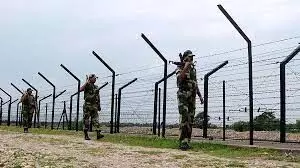
The Border Security Force (BSF) is on high alert due to the rise of fundamentalism in neighbouring Bangladesh.
"We are taking all precautions and alive on this issue (fundamentalism in Bangladesh). All preventive measures have been taken so that fundamentalists from Bangladesh don't sneak into India," Inspector General of BSF, Meghalaya Frontier, O.P. Upadhyay told reporters on the occasion of the 61st BSF Raising Day.
The BSF is coordinating with several intelligence agencies to foil any sinister attempt of the fundamentalists, he informed.
Upadhyay said some of the areas vulnerable to fundamentalist activities include regions in Garo Hills bordering Assam, particularly South West Garo Hills district and East Jaintia Hills district.
South West Garo Hills shares a border with sensitive areas such as Mankachar in Assam and other such areas of Bangladesh.
Bangladesh has a long history of religious fundamentalism right after its independence in 1971, when Sheikh Mujibur Rahman was assassinated in 1975 and an ordinance was passed to remove the constitutional ban on religion-based political parties.
In the 1980s military dictator Hussain Muhammad Ershad amended the Constitution and declared Islam as the state religion and that gave rise to religion-based political parties like Jaamat-e-Islami and its violent students' wing, Islami Chhatra Shibir.
Moreover, the fundamentalist Hefazat-e- Islam Bangladesh is another concern.
With political Islam and religious mobilisation, attacks on Hindu minorities have increased in Bangladesh and currently such violence is at its peak under the interim government led by Muhammad Yunus.
Upadhyay said efforts are on to fence the entire stretch of Meghalaya's 443-km-long border with Bangladesh.
As of now, 49 km of the border remains unfenced which has remained vulnerable due to objection from the local population, litigation and also Border Guard Bangladesh.
Upadhyay said that in the past one year the BSF was able to construct and operationalise around 20 km of fencing, thereby reducing the gaps along the border with Bangladesh.
"There were some impediments in the form of court cases, objections from the BGB and local civilian population," the BSF official said.
Upadhyay expressed optimism that by the end of 2026, the BSF will be able to completely fill the gaps in the India-Bangladesh border fence. He said advanced surveillance equipment has been inducted for better patrolling of the international border.
"I am hopeful that with the induction of such apparatus, we will be able to dominate, monitor and review our border security in a very effective manner," the BSF official added.