Gaurav Gogoi Hits Back at Modi in Lok Sabha, Defends Congress on Vande Mataram Legacy
Congress Deputy Leader accuses PM of politicising the national song, highlights Congress leaders’ role in freedom struggle, and criticises BJP’s governance and historical record.

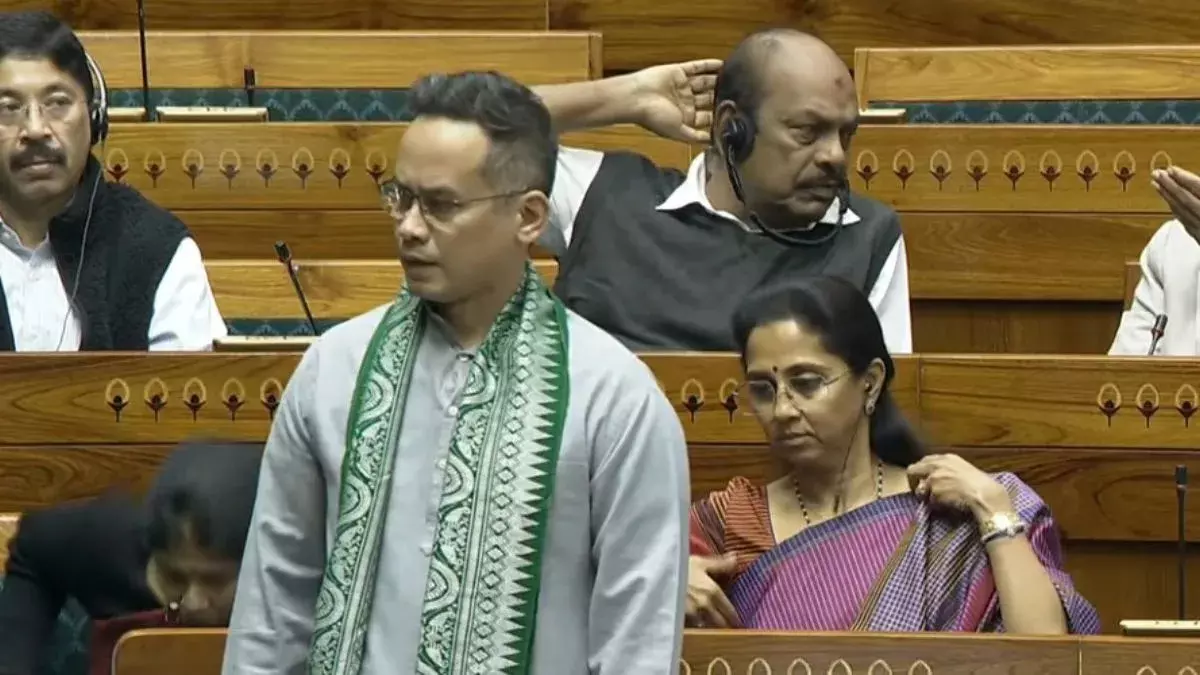
In a fiery rebuttal during the Lok Sabha debate marking the 150th anniversary of the national song Vande Mataram on Monday, Congress Deputy Leader in the Lok Sabha Gaurav Gogoi launched a sharp attack on Prime Minister Narendra Modi’s allegations against the Congress party. Gogoi accused the Prime Minister of attempting to “rewrite history” and politicise a unifying national symbol for narrow political gains.
Earlier, the Prime Minister Modi, while initiating the Vande Mataram debate in the Lok Sabha, launched a pointed critique of the Congress party of betraying Vande Mataram in 1937 and sparking partition debate.
Addressing the House, Gogoi defended the Congress party’s legacy and the central role played by leaders like Jawaharlal Nehru and Maulana Abul Kalam Azad in upholding the true spirit of Vande Mataram. “You cannot malign Nehru, you don’t understand Bengal, and you don’t understand the nation,” Gogoi declared, responding directly to PM Modi’s claims that Congress had betrayed the song in 1937, leading to the eventual Partition of India.
Gogoi highlighted the historical significance of Congress’s role in popularising Vande Mataram, referencing the 1896 and 1905 sessions where the song was embraced as a symbol of India’s freedom struggle. He questioned the BJP’s own historical record, asking pointedly, “Where were your political ancestors during the 1942 Quit India Movement?”—a reference to the BJP’s ideological forebears who, according to Gogoi, largely stayed away from the mass civil disobedience movement.
The Congress leader also took aim at the Modi government’s current record on governance and security. Citing recent events such as the “bomb explosion in Delhi,” the depreciation of the rupee, escalating air pollution, and border tensions, Gogoi asserted, “This Government is afraid of questions, afraid of debates, and it wants these organisations to be captured.” He accused the government of attempting to undermine democratic institutions including the judiciary and the Election Commission, and warned of growing monopolies and voter insecurity under BJP rule.
In a poignant conclusion, Gogoi invoked the spirit of Rabindranath Tagore’s iconic poem 'Where the Mind is Without Fear', reciting lines that called for a nation free from fear and division. He framed the opposition’s stance as a defense of India’s foundational ideals against what he described as “modern-day divide and rule tactics” propagated by the ruling party.
The debate in the Lok Sabha thus underscored the deep political and historical contestations surrounding Vande Mataram, reflecting broader clashes over India’s past and present. Gogoi’s speech stood as a firm rebuttal to PM Modi’s narrative, affirming Congress’s commitment to preserving the inclusive spirit of the national anthem and the legacy of India’s freedom struggle.