Hagrama: The Catalyst or the Inhibitor?
Once BTC chief, now catalyst and kingmaker, his limited reach masks disproportionate leverage in Assam’s political arithmetic

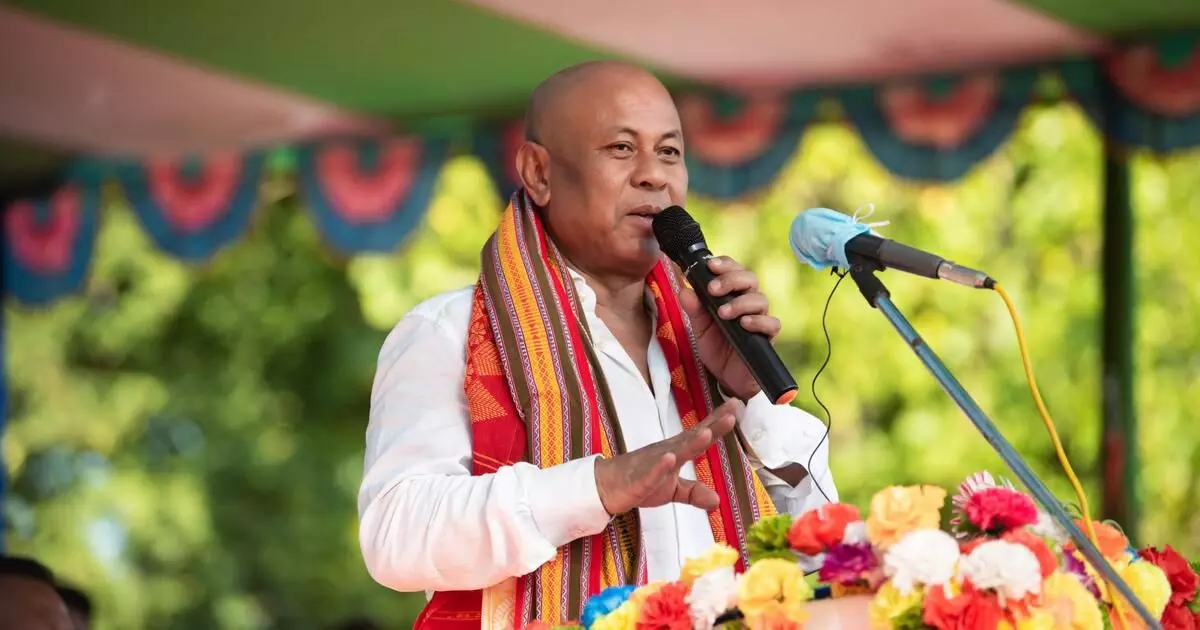
The Bodoland Territorial Region (BTR)—Kokrajhar, Chirang, Baksa, and Udalguri—remains a contested political laboratory. At its centre stands Hagrama Mohilary, the former BTC chief and veteran of Bodo politics. Though no longer dominant, his role is still unavoidable. The paradox is simple: Hagrama is at once marginal in Assam’s mainstream politics yet indispensable in Assam’s political arithmetic.
Political Survival as an Ecosystem
Hagrama’s survival is not accidental. He has engineered a political ecosystem that blends institutional memory, loyal cadres, and networks rooted in Bodo society. This ecosystem shields him against total political erasure. Leaders with stronger ideological bases have collapsed in Assam; Hagrama, however, thrives through adaptive politics, repositioning himself whenever tides shift.
Catalyst without Mainstream Exposure
From Tarun Gogoi to Himanta Biswa Sarma, every Assam chief minister has had to factor in Hagrama. Yet his influence has rarely spilled beyond the BTR. This duality—limited reach but high leverage—makes him the outsider-insider of Assam politics. His presence acts as a catalyst in situations where mainstream parties must stitch alliances or maintain balance among Bodo groups.
BTC as Political Dress Rehearsal
The BTC elections are never isolated local contests; they are dress rehearsals for Assam’s broader electoral strategies.
For the BJP, they are a test of tribal consolidation and expansion.
For the Congress, they are a rare opportunity to reclaim lost ground.
For Hagrama, they are a stage to prove continued relevance, where even limited seats can translate into disproportionate bargaining power.
Plan B as Strategic Doctrine
Hagrama’s Plan B is not an afterthought; it is a strategic doctrine. Recognising that monopoly politics is over, he now practices power-balancing politics. His recalibrated base includes:
Old comrades and loyalists, who give him structural resilience.
Traditional supporters, ensuring continuity in rural Bodo belts.
A Miya base, offering him a new dimension of negotiation leverage.
This triad equips Hagrama with the ability to tip the scale in either direction. He no longer seeks absolute control but aims to be the decisive minority whose support no one can ignore.
The Axis of Mutual Dependence
Himanta Biswa Sarma needs Hagrama as a stabiliser in Bodo politics, ensuring that rival groups do not weaken BJP’s western flank.
Congress views Hagrama as a bridge into the BTC, knowing it cannot penetrate without him.
Hagrama himself depends on both: he needs BJP for access to state power and Congress as a fallback for political survival.
This triangular dependence makes Hagrama less a king and more a kingmaker, wielding leverage disproportionate to his electoral numbers.
Hagrama’s politics defies binaries. He is both catalyst and inhibitor:
A catalyst, because he keeps BTC relevant in Assam’s political imagination.
An inhibitor, because he prevents either BJP or Congress from enjoying monopoly dominance.
As the BTC election unfolds, it will once again act as a barometer for Assam’s larger political choreography. And at its centre, Hagrama Mohilary continues to play the dual role—never fully in power, never fully out of it, but always indispensable.