India Strengthens Naval Communication With Successful Launch of GSAT-7R Military Satellite
ISRO’s LVM3 rocket places the 4.4-ton satellite into orbit, boosting the Indian Navy’s secure maritime connectivity and marking a major stride in India’s space-based defense capabilities.

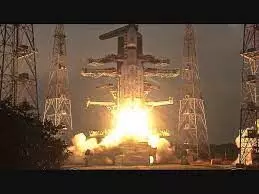
India on Sunday evening beefed up its security with the successful launch of its latest military satellite the 4.4 ton GSAT-7R or CMS-03 for use of Indian Navy.
The satellite was launched by Indian Space Research Organisation’s (ISRO) rocket LVM3 in a copybook style.
“GSAT-7R will provide robust telecommunication coverage across the Indian Ocean Region. Its payload includes transponders capable
of supporting voice, data, and video links over multiple communication bands,” said the Indian Ministry of Defence.
“This satellite will significantly enhance connectivity with high-capacity bandwidth, enabling seamless and secure communication links between ships, aircraft, submarines, and Maritime Operations Centres of the Indian Navy,” the Ministry added.
In an era of complex security challenges, GSAT-7R represents Indian Navy's determination to protect the nation’s maritime interests leveraging advanced technology through Aatmanirbharta or self reliance.
The most advanced communication satellite thus far for the Indian Navy, the GSAT-7R would strengthen Indian Navy’s space-based communications and maritime domain awareness capabilities.
The GSAT-7R satellite will replace the 2.65 ton GSAT-7 or Rukmini that was launched in 2013 by Arianespace’s rocket Ariane.
At 5.26 pm, the LVM3 rocket lifted off from the second launch pad at the rocket port here in Andhra Pradesh.
About 16 minutes after the lift off, the rocket ejected the GSAT-7R into its intended orbit.
Speaking after the launch Indian Space Research Organisation (ISRO) Chairman and Secretary Department of Space Dr.V.Narayanan said: "I am happy to announce LVM3 successfully injected the CMS-03 satellite in the intended orbit."
Congratulating the ISRO team members and the industry partners Narayanan said this is the eighth successive mission of the LVM3 rocket.
Citing the satellite's weight of about 4.4 ton, Narayanan said the rocket's carrying capacity was increased by 10%.
He said the satellite will provide its services for 15 years.
Another technological milestone achieved was the reignition of the first chamber of the rocket's cryogenic stage which will enable to launch rockets in multiple orbits, Narayanan said.
M.Mohan, Director, Liquid Propulsion Systems Centre added that the cryogenic engine was restarted successfully in hard vacuum to have flexible satellite launch missions in the future.
Mohan also said the satellite has the biggest propellant tank.
Looking forward, Narayanan said ISRO is gearing up to have seven more launches before the end of this fiscal.
He said the next mission will be to orbit a customer satellite with an LVM3 rocket during the second week of December. This will be followed by other space missions involving Polar Satellite Launch Vehicle (PSLV), Small Satellite Launch Vehicle (SSLV) and Geosynchronous Satellite Launch Vehicle (GSLV) to launch geoimaging satellite GISAT.
The ISRO Chairman also said a PSLV rocket will be launching a technology demonstration satellite where 34 new space technologies will be tested.
Narayanan also said the HAL-L&T built PSLV rocket is being assembled and will fly this fiscal.
As regards India's human space mission Gaganyaan, Narayanan said out of the three uncrewed missions one will happen this fiscal.
The robot Vyommitra will be flown in that mission.
Narayanan said most of the hardware has reached the rocket port and assembly activities are on.
For ISRO the successful space mission on Sunday is a morale booster as it comes after a string of costly failures in orbiting India’s strategic satellites like the EOS-09 on 18.5.2025 (loss of about Rs.850 crore) and the navigation satellite NVS-02 on 29.1.2025 (Rs.300 crore).
The loss of these two critical satellites this year— especially NVS-02, which was meant to replace the ageing IRNSS-1E in India’s regional navigation system — represents not just a technical failure but a strategic one.
Narayanan said the valve issue faced in the NVS-02 has been sorted out and the valve in the CMS-03 satellite has opened.
The financial cost of the failed launches, including replacements and lost opportunities, could run into hundreds of crores and one must also factor the opportunity cost as well.
In 2021, India lost another strategic satellite GISAT-1 as its rocket GSLV-F10's cryogenic stage failed to ignite.
The 2017 another satellite-navigation satellite IRNSS-1H- was lost as the Polar Satellite Launch Vehicle’s (PSLV) heat shield did not separate, trapping the satellite inside. ISRO later attributed the problem to a malfunction in the pyro separation system.
Be that as it may, on Sunday evening around 5.26 p.m. the three staged LVM3 rocket standing 43.5 metres tall and weighing 642 ton
rose up into the skies breaking free of the earth’s gravitational pull the rocket went up and up with a bright orange fire at its tail that lit
up the evening skies.
As the LVM3 rocket ascended towards the skies, its engine roar reverberated over the rocket port like a rolling thunder much to the thrill of the people there.
The GSAT-7R satellite is the heaviest communication satellite to be launched by an Indian rocket from Sriharikota rocket port.
One of the interesting aspects of the mission is that ISRO by slightly tweaking the satellite ejection orbit has enabled LVM3 to carry a strategic satellite weighing slightly more than its rated capacity of about 4 ton to the geosynchronous transfer orbit (GTO).
Communication satellites are inserted into GTO by the rockets at about 36,000 km apogee -the farthest point in the orbit from earth. The satellite will then be taken up further to the final orbit, that is geostationary orbit (GSO) by firing the onboard motors.
So how did LVM3 with a carrying capacity of about 4 ton to GTO carry the 4.4 ton GSAT-7R to GTO?
The answer is ISRO has slightly tweaked the satellite ejection point.
According to ISRO, the GTO apogee for the launch was 29,970 km with a margin of 3,700 km plus or minus.
Explaining further, former ISRO Chairman Dr.S.Somanath said the apogee is lower instead of the typical 36,000 km for GTO. The satellite will be raised using the spacecraft’s propulsion, which is more efficient.
However, the burning of the satellite fuel to take it up will effectively reduce the satellite’s overall life, said a retired senior official of ISRO.
The Indian space agency has also orbited GSAT-7A for the Indian Air Force (IAF) earlier.
The GSAT-7 and GSAT-7A are the two dedicated military communication satellites while all other earth observation and communication satellites launched earlier were of dual use -- civilian and defence.