Kiren Rijiju’s Bhutan Visit: A Journey Through the Geopolitics of the Eastern Himalayas

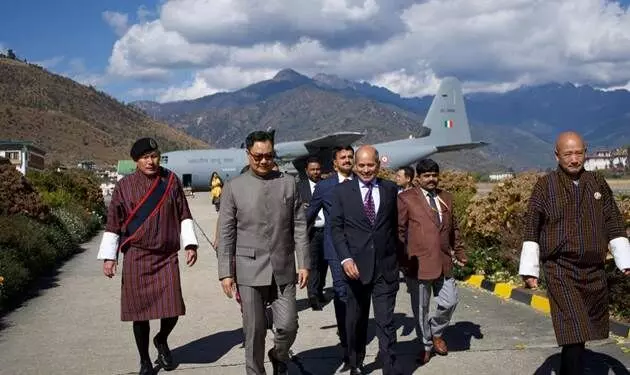
In the quiet, disciplined rhythm of Bhutan’s mountains, diplomacy often unfolds not with fanfare but with symbolism. Kiren Rijiju’s recent journey to Thimphu belongs to this tradition — calibrated, understated, yet deeply strategic. It is the kind of visit that matters not for what is said in public, but for what it signals across a fragile Himalayan frontier increasingly shaped by global currents.
The Himalayas as a Strategic Crossroads
Few places illustrate 21st-century geopolitics as sharply as the eastern Himalayas. Here, Bhutan stands as a slender but decisive buffer — a kingdom that absorbs pressures from India and China while maintaining an almost graceful neutrality.
To travel to Bhutan as an Indian minister is to enter a geopolitical corridor where diplomacy is tethered to geography, and every gesture is interpreted through strategic lenses.
India’s Diplomatic Map Begins in Bhutan
Rijiju arrives at a time when Bhutan is negotiating its space in a world marked by great-power rivalry. For India, Bhutan is not merely a neighbour; it is:
A clean-energy partner in a region critical for sustainable development
A security ally that has helped stabilize India’s Northeast
A geopolitical anchor preventing China from gaining strategic depth south of the Tibetan plateau
The journey, therefore, is as much about reaffirming an old friendship as it is about reinforcing the architecture that keeps India’s eastern frontier secure.
A Visit Following the Prime Minister’s Footsteps
In diplomatic sequencing, timing is often the message. Rijiju’s trip follows the Indian Prime Minister’s visit earlier this month, creating a rhythm of high-level engagement unusual even in traditionally warm India-Bhutan relations.
The choreography is deliberate:
1. The PM sets the political direction.
2. Rijiju, a senior minister from Arunachal Pradesh — a state central to India-China contestation — reinforces the regional and security dimensions.
In international affairs language, this is a layered signalling exercise: steady, quiet, and unmistakable.
Bhutan’s Balancing Canvas
Bhutan’s foreign policy is a masterclass in equilibrium. Without military alliances, economic overdependence, or diplomatic theatrics, it has preserved its sovereignty through:
Measured dialogue with China
Deep developmental partnership with India
Strict control of external influences
Rijiju’s visit is, therefore, both a reassurance and a recognition — that India respects Bhutan’s balancing act, and stands ready to strengthen its choices rather than dictate them.
The Clean-Energy Horizon
One of the strongest currents shaping Bhutan’s diplomacy today is the emerging clean-energy axis with India.
Hydropower has long been the artery of Bhutan’s economy. Now, with India’s rising energy needs and climate goals, it is becoming a pan-regional strategic sector. For India, the Northeast’s industrial expansion and national green-energy commitments are tied to Bhutan’s rivers. For Bhutan, India remains the only reliable long-term partner that can develop, distribute, and purchase this energy at scale.
Rijiju’s journey underlines this new chapter — where ecology, economy, and geopolitics converge.
Security Through Quiet Cooperation
For two decades, Indo-Bhutan security cooperation has been defined by discretion and trust. From Operation All Clear (2003) to continuing border intelligence coordination, Bhutan remains a stabilizer in India’s internal security calculus.
As insurgent movements in the Northeast evolve and new cross-border pressures appear around the India-China frontier, Rijiju’s visit helps update this shared security vocabulary.
A Subtle Message Across the Himalayas
Beyond bilateral warmth, the visit sends a quiet message across the mountains:
Bhutan remains central to India’s eastern Himalayan posture.
India is attentive to Bhutan’s negotiations with China.
The political geography from Bhutan to Arunachal Pradesh is interconnected and indivisible.
In international affairs language, it is preventive diplomacy — strengthening ties before vulnerabilities emerge.
A Journey That Speaks Softly but Strategically
Kiren Rijiju’s Bhutan journey is testimony to the subtle power of Himalayan diplomacy.
No dramatic statements, no confrontational rhetoric — just steady engagement in a region where silence often carries more weight than words.
In an increasingly contested Indo-Pacific world, such visits are not symbolic routines. They are strategic journeys — shaping alignments, reinforcing trust, and ensuring that the Himalayas remain a zone of stability rather than confrontation.