Modi in Assam: Loud in Blame, Silent in Vision
Eleven years in power, yet Nehru remains the scapegoat while Assam’s floods, jobs, and tea industry await answers

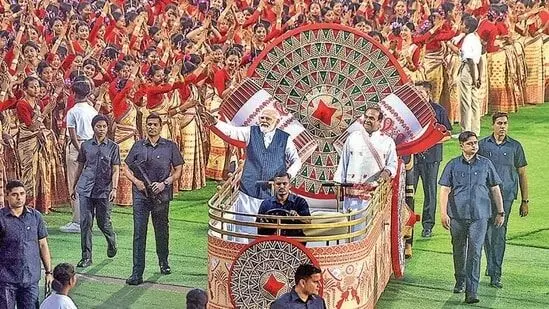
Narendra Modi’s recent rally in Darrang, Assam, was billed as a moment of national leadership. After eleven years of uninterrupted BJP rule in Assam and more than a decade of Modi himself at the helm of India, people expected a speech that would project confidence, maturity, and vision. Instead, they got another performance of ritualistic rhetoric — a thunderous blame-game aimed at Congress and Nehru, but a silence on the burning issues of Assam and the Northeast. The crowd heard volume, not vision.
The Shrinking Aura of the Prime Minister
The post of Prime Minister is not a party podium; it is the highest pulpit of the Republic. It should carry the voice of a statesman, not the slogan of a campaigner.
When Modi still frames Nehru as the villain in 2025, it reveals a shrinking political imagination. The people of Assam, like the rest of India, are not blind to this erosion. After eleven years, if the BJP’s narrative is still chained to the past, then the promise of a “New India” begins to sound like yesterday’s echo, not tomorrow’s anthem.
In a democracy, every Prime Minister inherits history but is judged on the future they create. Modi’s overuse of Nehru is a diversionary tactic that weakens the dignity of his own office. The Prime Minister should be charting a roadmap for the next decade, not endlessly prosecuting the mistakes of leaders long gone.
A Tale of Three Voices in the Northeast
The Northeast has become the stage where Modi’s political voice reveals its deepest contradictions. His tone changes with the terrain:Manipur (Sept 13, 2025): “I urge all organisations to move forward on the path of peace to secure your children’s future.”Mizoram (Sept 13, 2025): “Northeast suffered heavily due to vote bank politics.”Assam (Sept 18, 2025): Loud denunciations of Congress and Nehru, but no concrete answers on jobs, floods, or Assam’s tea economy.
The contrasts are telling. In Manipur, amid ongoing ethnic strife, Modi’s words were soft, almost meek — an appeal without authority. In Mizoram, he wrapped new development promises in familiar blame against Congress. And in Assam, his speech was full of noise, but devoid of solutions. He whispered where courage was needed, lectured where empathy was expected, and shouted where vision was demanded.
Ritual Without Remedy
Modi’s Assam visits have developed into a ritual. Each time, the stage is grand, the visuals carefully choreographed, the soundbites designed for television. Each time, the promises are monumental: new projects, fresh foundations, billion-rupee announcements. And each time, the script is identical — Congress is blamed, Nehru is attacked, BJP is projected as saviour.
But what about Assam’s real problems?
Every monsoon, floods devastate the Brahmaputra valley. Youth unemployment continues to haunt families, pushing the talented away from the state. The tea industry, once Assam’s pride, is now caught between declining prices and rising costs. Ethnic aspirations — from ST status demands to cultural anxieties — remain unresolved. These are the issues people expect the Prime Minister to address, not the ghosts of 1962.The danger is that ritual replaces remedy. Rhetoric becomes governance. Slogans substitute solutions.
Safety Valve Politics
Political observers call this tactic safety valve politics — the deliberate redirection of public frustration onto a symbolic enemy. For Modi, Nehru is the eternal safety valve.
The BJP hopes that by invoking historical betrayal, it can keep public anger away from current failures. But after more than a decade in power, this excuse rings hollow.
The public has begun asking the uncomfortable but obvious question: If Nehru was the problem, why has the BJP not delivered the solution in eleven years of power in Assam and Delhi? The past cannot be an alibi for the present forever.
The Larger MessageIn the end, Modi’s speech in Assam tells us more about his political limits than about Nehru’s historical role. It exposes the distance between what people expect and what the Prime Minister delivers.
Citizens came expecting to hear about the future of their state, their children, their livelihoods. What they got was a campaign rerun of 2014, recycled in 2025.This is the erosion of statesmanship.
Modi is still the most powerful politician in India, but power without vision loses its shine. The measure of leadership is not how loud you can speak about yesterday’s enemies, but how clearly you can chart tomorrow’s path.
In Assam, Modi roared against Nehru and Congress, but failed to whisper a single fresh idea for the future. The Northeast expected the voice of a statesman. What it heard instead was the ritual chant of a campaigner.