NCR Air Quality Plunges to ‘Severe Plus’ as Smog Chokes Region
Noida tops pollution charts with AQI 466, Delhi and surrounding cities breach 400 mark, forcing CAQM to invoke GRAP Stage 4 restrictions

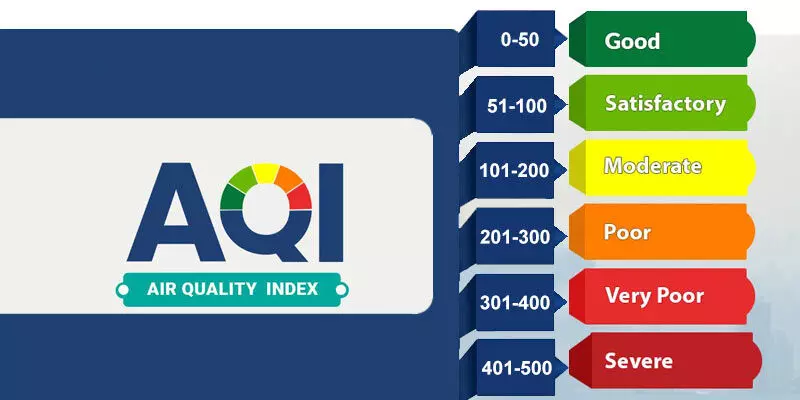
A thick blanket of smog continued to worsen the air quality in the National Capital Region on Sunday, with six cities from the region recording ‘severe’ air quality index (AQI), breaching the 400 mark. Noida fared worst in the national pollution listings with AQI readings of 466, surging from a previous day’s readings that stood at 455, both falling in the “severe plus” category.
Unlike Saturday, three other cities in the NCR region crossed the “severe plus” mark, including Bahadurgarh (463), Delhi (461), and Ghaziabad (459) on Sunday, with Bahadurgarh registering the highest surge. According to Central Pollution Control Board Data, Bahadurgarh’s air quality stood at 353 on Saturday in the ‘very poor’ category and shot by over 100 points in 24 hours, figuring in the “severe plus” category.
Greater Noida and Baghpat were among the other NCR cities shrouded in severe smog, recording AQI readings of 435 and 429, respectively.
Experts attributed the spike in pollution to slow wind speeds and unfavourable meteorological conditions that hindered the dispersal of pollutants.
Meanwhile, the Commission for Air Quality Management (CAQM) in NCR, in a meeting on Saturday, conducted to review the status of sector-specific enforcement by NCR governments, surprisingly noted that the NCR districts of Uttar Pradesh (UP) fared relatively better.
“NCR Districts of Uttar Pradesh exhibited comparatively satisfactory performance towards abatement of air pollution in the region. However, it must establish and comply with the timelines committed for focused action(s), especially for the vehicular sector,” the CAQM said.
The agency directed the NCR districts of Uttar Pradesh and Rajasthan to develop a web portal for vehicle aggregators, delivery service providers, and e-commerce entities by December 31.
While in Delhi, all 39 monitoring stations in Delhi are marked ‘red’, indicating ‘Severe’ air. Rohini, with an AQI of 499, was the worst affected, followed closely by Vivek Vihar (495), Jahangirpuri (494), Wazirpur (493) and Ashok Vihar (493), and Anand Vihar (490). Of the remaining 33 stations, 20 breached or hovered near the ‘severe plus’ category.
Forecasts by the Air Quality Early Warning System for Delhi (AQEWS) suggest the air quality is expected to improve on Monday, shifting to the “very poor” category.
Weather experts noted that the minimum temperatures are likely to fall by about 2°C during the next 48 hours, hovering between 7°C and 9°C on Monday, while the maximum temperatures are likely to be normal, falling between 22 °C and 24 °C.
Several areas in Delhi also reported low visibility as the smog cloaked several parts of Delhi, with visibility dropping to 350m at 8 AM on Sunday, from 1000 m reported on 9 PM Saturday, according to the data from the India Meteorological Department (IMD). The weather department also reported poorer visibility at the Safardarjung due to calm winds, with visibility deteriorating to 200m at 8 am.
Meanwhile, amid rapidly deteriorating air quality in the national capital, the Commission for Air Quality Management (CAQM) invoked Stage 4 of the Graded Response Action Plan (GRAP) on Saturday, just hours after imposing Stage 3 measures across Delhi and the NCR.
Under the stricter pollution-curbing measures, schools in the region have been directed to shift to a hybrid mode of classes until classes, while government offices have been urged to operate at 50 per cent capacity to reduce vehicular emissions, a major contributor to the city’s PM2.5 load.