PM Modi Defends Bill Allowing Removal of Jailed Ministers, Says 'Why Should Rules Be Different for Politicians?'
Speaking at a rally in Gayaji, Bihar, Prime Minister Narendra Modi pointed out that government employees are suspended from their jobs if they are jailed for just 50 hours.

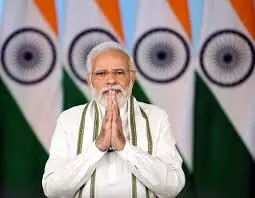
Prime Minister Narendra Modi on Friday defended the recently introduced Constitution amendment bill that empowers the Centre to remove any minister, including the Prime Minister or Chief Ministers, if they remain in jail for an extended period. Addressing a rally in Gayaji, Bihar, Modi questioned why elected leaders should be treated differently from ordinary government employees.
“If a government employee—be it a driver, a clerk, or a peon—is jailed for 50 hours, they are automatically suspended from their job. Then why should a CM, a Minister, or even the PM continue to enjoy power from behind bars?” Modi asked.
He went on to say that the NDA government is committed to fighting corruption and that no one is above the law—not even the Prime Minister.
“We’ve all seen instances where files were signed from jail and government orders were issued from prison. If this is the mindset of some leaders, how can we claim to be serious about ending corruption? That’s why this law is necessary—and it applies to everyone, including the Prime Minister,” he added.
Controversial Bill Sparks Political Debate
On Tuesday, Union Home Minister Amit Shah introduced three major bills in the Lok Sabha, including the Constitution (One Hundred and Thirtieth Amendment) Bill, 2025. The proposed law allows for the removal of the Prime Minister, Chief Ministers, or any other ministers if they are in custody for 30 consecutive days on charges related to corruption or serious offences.
Shah also introduced the Government of Union Territories (Amendment) Bill, 2025, and the Jammu and Kashmir Reorganisation (Amendment) Bill, 2025.
However, the bills have sparked strong opposition. Critics argue that the law allows the government to act on mere allegations without a conviction, raising concerns that it could be misused to remove elected leaders by using central investigative agencies like the ED or CBI.
The move triggered a major uproar in the Lok Sabha, with Opposition MPs demanding wider scrutiny. As a result, the government agreed to refer the bills to a Joint Parliamentary Committee (JPC)—a step that had already been on the agenda.
The JPC has been directed to submit its report by the end of the first week of the next Parliament session, expected to begin in the third week of November. This effectively delays any immediate passage of the bills by around three months.