Punjab’s Sehat Model vs Ayushman Bharat: A Tale of Two Healthcare Approaches
With nearly 10x higher per capita spending, Punjab pushes universal ₹10 lakh cover against Centre’s targeted scheme

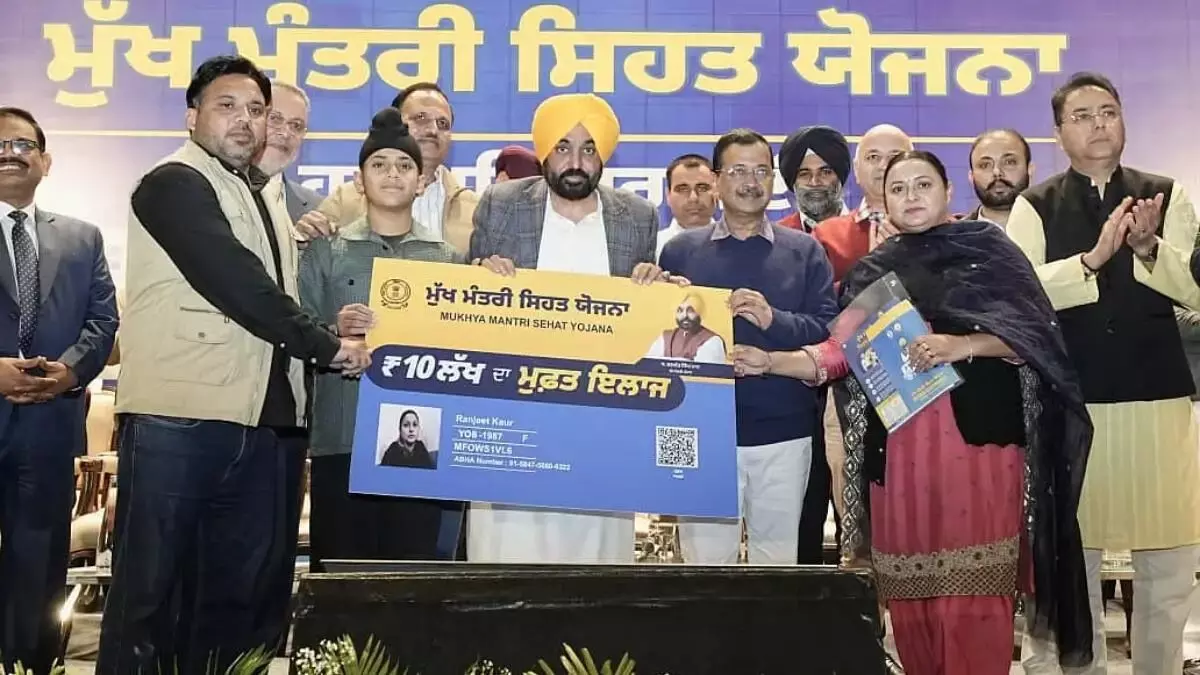
At a time when rising medical costs continue to push Indian families into financial distress, a stark contrast is emerging in how healthcare is being funded and delivered. While the Centre’s Ayushman Bharat allocates ₹9,500 crore for a population of 140 crore, Punjab’s Mukh Mantri Sehat Yojna commits ₹2,000 crore for just 3 crore residents, translating into nearly ten times higher investment per person.
The difference is not just financial, but structural. Where the national scheme limits both eligibility and coverage at ₹5 lakh, Punjab’s model extends ₹10 lakh cashless healthcare to every resident without conditions. Under the leadership of Chief Minister Bhagwant Singh Mann, the Punjab Government has positioned universal healthcare not as a targeted benefit, but as a guaranteed right, ensuring that access to treatment is determined by need, not by inclusion in a government list.
For most Indian families, a medical emergency brings two immediate worries: how quickly treatment can begin, and how the cost will be managed. Addressing both concerns through a universal approach, the Punjab Government under the leadership of CM Bhagwant Singh Mann has allocated ₹2,000 crore in the 2026–27 Budget for the Mukh Mantri Sehat Yojna (MMSY), extending cashless health coverage of up to ₹10 lakh per family to nearly 3 crore residents across 65 lakh families.
Unlike targeted schemes such as Ayushman Bharat, the Punjab model is built on universal coverage, ensuring that every resident is included without eligibility barriers.
The difference between the two approaches is fundamental. MMSY does not ask who qualifies. Every resident of Punjab is covered, regardless of income. Ayushman Bharat, launched in 2018, is limited to families identified as economically vulnerable through the SECC database. A large section of the population, particularly the lower and middle-income groups not captured in that database, continues to remain outside its ambit.
The extent of coverage further highlights this gap. Ayushman Bharat has offered ₹5 lakh per family per year since its launch, a limit that has remained unchanged despite rising healthcare costs. MMSY doubles this coverage to ₹10 lakh, while also extending protection to families who were previously excluded from government-backed healthcare altogether.
The difference is equally visible in financial commitment. The Central Government’s allocation of ₹9,500 crore for a population of 140 crore contrasts with Punjab’s ₹2,000 crore for 3 crore residents. On a per capita basis, Punjab’s investment is significantly higher, reflecting a clear prioritisation of accessible and comprehensive healthcare.
MMSY also expands the scope of treatment. Beneficiaries can access cashless care for a wide range of serious conditions, including heart disease, cancer, kidney ailments, orthopaedic procedures, and accident-related injuries, across 2,300 treatment packages. In comparison, Ayushman Bharat covers around 1,900 packages. The underlying principle is clear: treatment decisions are driven by medical need, not financial capacity.
The process of accessing the scheme marks another shift. Under Ayushman Bharat, families must first verify whether they are listed in the SECC database, and those excluded must navigate additional documentation to establish eligibility. In contrast, MMSY simplifies access. Residents can enrol at Seva Kendras or Common Service Centres, or apply online using Aadhaar or Voter ID, without the need for income certificates or occupation proof. To ensure wider reach, trained youth club members are conducting door-to-door campaigns, helping families register and receive their Sehat Cards at home.
For families previously outside the scope of government healthcare, the impact is already visible. In Moga, a 98-year-old woman, Mukhtiar Kaur, received specialised treatment, including chemotherapy-related care, fully covered under the scheme. At an age where continuity of care is critical, access through the Sehat Card ensured that treatment began without delay or financial stress.
Minister of Health and Family Welfare Dr. Balbir Singh said the scheme reflects a deliberate shift in policy direction. “Under the leadership of Chief Minister Bhagwant Singh Mann, the Mukh Mantri Sehat Yojna is built on a clear approach, that healthcare coverage should extend to every resident, not just a selected few. With higher per-person investment, Punjab is ensuring that access to treatment is defined by need, not eligibility or income,” he said.
With more than 9 lakh Sehat Cards already issued, beneficiaries are accessing treatment across a growing network of 900 empanelled hospitals, expanding the reach of healthcare across Punjab.
In a country where a single hospital bill can push families into debt, the contrast is no longer just administrative, it is philosophical. One model limits care through eligibility lists; the other guarantees it as a public right.