Rishikesh Unrest: Forest Land, Protest, and the Politics of Eviction

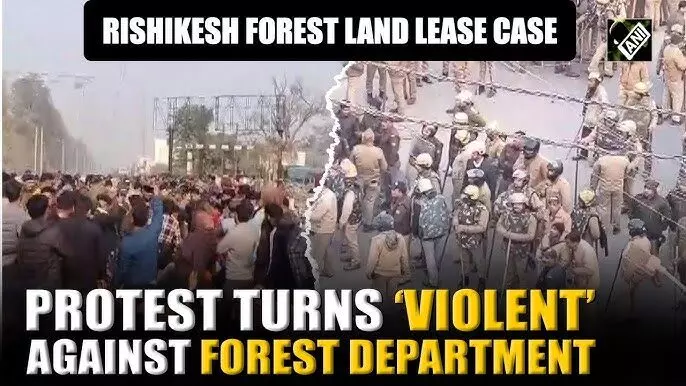
Images Credit -Ani
Dehradun:Uttarakhand today stands at a crossroads where governance, public trust, and the fragile balance between environment and human settlement collide. The state has already been shaken by the Ankita Bhandari case, which continues to haunt the Chief Minister and the administration as a ghost of accountability. Yet what has unfolded in Rishikesh in recent days appears even more perilous, both for the government and for the public, because it touches the sensitive nerve of land, livelihood, and legitimacy. The controversy began when the forest department initiated fencing on land that has long been occupied by a residential colony. Officials claim that the land legally belongs to the department and falls under forest jurisdiction, while residents insist they have lived there for decades with all necessary documents, permissions, and civic facilities provided by the government itself. The sudden move to fence off the area has triggered protests, dharnas, and widespread speculation about the real motives behind the action.
Protesters argue that if the government had allowed settlement, provided electricity, water, and voter registration in the past, then the claim of illegality now is contradictory. “We have ration cards, voter IDs, electricity bills, and municipal records. If this land was not recognized, why did the government issue these documents?” asked one resident during the sit in. For them, the eviction drive is not about environmental protection but about political manoeuvrings. Many believe that the rhetoric of demographic change is being used as a justification to target specific communities or to clear land for future projects. The suspicion is that the government is less concerned about forest conservation and more interested in reshaping the social fabric of Rishikesh, a city already under pressure from tourism, migration, and real estate speculation.
The forest department maintains that its action is based on legal inquiry and that encroachment cannot be tolerated. Officials cite records showing the land belongs to the department and that unauthorized colonies have mushroomed over time. Yet the timing of the move raises questions. Why now, after decades of silence? Why fence off land without first resolving ownership disputes in court? Protesters claim that the government is using administrative power to bypass due process, effectively punishing citizens who trusted the state’s own approvals. “If the government gave us permission to build, if the municipality collected taxes, then how can they suddenly say we are illegal? This is injustice,” said another protester.
The local legislator of Rishikesh, once a minister of state, has distanced himself from the agitation, stating only that the government has acted after proper inquiry. His silence has further fueled anger among residents, who expected their representative to defend them. Critics argue that the political class is unwilling to confront the administration because the issue is tied to larger strategies of land control and demographic management. The government has openly spoken of identifying areas where population settlement overlaps with forest land, and the Rishikesh colony appears to be one of those identified zones. For citizens, however, this policy translates into displacement and uncertainty.
The protests have highlighted a deeper tension in Uttarakhand: the clash between environmental regulation and human habitation. The state has long struggled with encroachment on forest land, but it has also failed to provide adequate housing and rehabilitation for its growing population. When people settle with tacit government approval, only to be branded illegal years later, the credibility of governance itself is undermined. Protesters argue that the government cannot wash its hands of responsibility. “We are not outsiders. We are citizens of this state. If there was a mistake, it was the government’s mistake. Why should we pay the price?” one activist declared.
Speculation abounds about the real reasons behind the eviction drive. Some believe it is linked to upcoming development projects that require land clearance. Others see it as a political tool to unsettle communities perceived as demographically altering the region. Still others argue that the forest department is under pressure to show results in curbing encroachment, and Rishikesh has become a convenient target. Whatever the reason, the lack of transparency has created mistrust. Without clear communication, the government risks being seen as arbitrary and vindictive.
The broader implication is that Uttarakhand is becoming a battleground not only of politics but of identity and survival. The Ankita Bhandari case exposed failures of law and order, while the Rishikesh land dispute exposes failures of governance and planning. Together, they paint a picture of a state struggling to balance development, environment, and democracy. For the public, the fear is that eviction today could mean displacement tomorrow, that the security of home and livelihood is no longer guaranteed. For the government, the challenge is to assert authority without alienating citizens, to enforce law without appearing unjust.
The truth is that both sides have valid points. Encroachment on forest land is a genuine issue, but so is the right of citizens who have lived with government recognition for decades. The argument of protesters—that the state cannot suddenly invalidate its own approvals—is compelling. The government’s defense—that forest land must be protected—is also legitimate. The real failure lies in the absence of a transparent, participatory process that could reconcile these claims. Instead of fencing off land overnight, the administration could have initiated dialogue, offered rehabilitation, or sought judicial clarity. By choosing confrontation, it has created a crisis that threatens both public trust and political stability.
As the protests continue, the government faces a test of credibility. Will it listen to the voices of citizens who demand justice, or will it persist in a policy that appears arbitrary? The answer will shape not only the future of Rishikesh but the future of Uttarakhand itself. In a state where land, environment, and demography are deeply intertwined, the handling of this issue will determine whether governance is seen as protector or predator. For now, the streets of Rishikesh echo with the chants of protest, and the fences erected by the forest department stand as symbols of division. The battle is not just over land; it is over trust, identity, and the meaning of citizenship in a fragile Himalayan state.