RSS in Washington: Lobbying for Culture or Power?
RSS signs $330,000 contract with Squire Patton Boggs, entering U.S. lobbying arena. Critics question transparency, foreign influence, and democratic accountability.

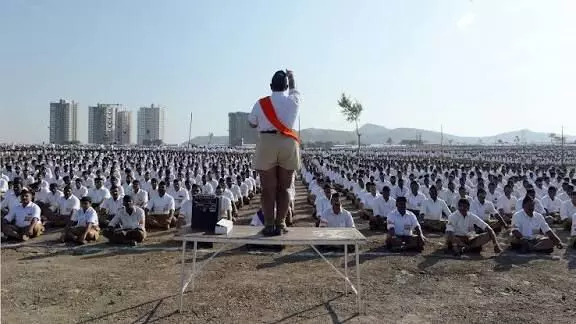
When the Rashtriya Swayamsevak Sangh (RSS) quietly signed a $330,000 contract with Squire Patton Boggs, one of Washington’s most powerful lobbying firms, it did more than hire lawyers. It crossed a Rubicon. For the first time, India’s most influential cultural outfit has formally entered the American lobbying arena, a space traditionally reserved for governments, corporations, or registered political entities.
The paradox is glaring. The RSS insists it is not a political party, not a government body, not even a tax-paying organization. It calls itself a “cultural movement.” Yet here it is, operating in the corridors of U.S. power as if it were a transnational political actor. What does it mean when a self-styled cultural organization begins to play shadow diplomat in Washington?
Lobbying in Washington is not unusual; nations and corporations do it to shape policy. But when a domestic cultural outfit, deeply embedded in India’s political bloodstream, seeks influence abroad, the line between civil society and statecraft dissolves. The RSS’s move is not just about U.S.-India relations. It is about bypassing traditional diplomacy and directly shaping American perceptions of India’s political and cultural trajectory.
The Congress party has already accused the RSS of “betraying national interest.” Critics point to history: the RSS’s opposition to Gandhi, Ambedkar, and the Constitution, its ideological project that privileges exclusion over pluralism. If such an organization now spends lavishly to influence U.S. lawmakers, the question is unavoidable: is this lobbying for India’s national interest, or for the RSS’s ideological interest?
There is also the matter of law. The Foreign Agents Registration Act (FARA) demands strict transparency from entities representing foreign interests. Yet the RSS filed under the Lobbying Disclosure Act (LDA), a far less stringent regime. This loophole raises troubling questions about foreign influence operations and the opacity of RSS’s role. If a cultural outfit can slip into Washington’s lobbying machinery without full disclosure, what does that say about accountability?
The implications for Indian democracy are profound. If a non-governmental, non-taxpaying organization can act as a de facto foreign policy player, who answers when its lobbying leads to outcomes that conflict with India’s constitutional values? Who bears the cost if minority rights or democratic principles are sidelined in favor of ideological narratives? How can a cultural organization, without formal state authority, represent India abroad? If its lobbying succeeds, who benefits—the Indian nation or the RSS’s ideological project? If it fails, who pays the price—the government, the people, or the RSS itself? What does it mean for democracy if unelected, unregistered organizations wield influence in foreign capitals?
This episode is not a bureaucratic footnote. It is a geopolitical signal. It tells us that in the age of lobbying and influence operations, even cultural outfits can become power brokers. The challenge for India is stark: how to ensure that such moves do not compromise democratic accountability or the pluralist spirit of the nation. The RSS’s foray into Washington is not just about bilateral relations. It is about redefining the boundaries of power in Indian politics. It forces us to ask whether national interest is being safeguarded—or privatized.
In the end, the RSS’s lobbying effort is a reminder that geopolitics is no longer confined to governments alone. In the shadowy world of influence operations, even cultural organizations can wield disproportionate power. The question for India is whether it can afford to let unelected, unregistered movements act as shadow diplomats, reshaping perceptions abroad while escaping accountability at home.