SC Begins Hearing on Voter List Revision in Bihar, Says Aadhaar Not Proof of Citizenship
The Supreme Court has started hearing petitions challenging the Election Commission's revision of electoral rolls in Bihar.

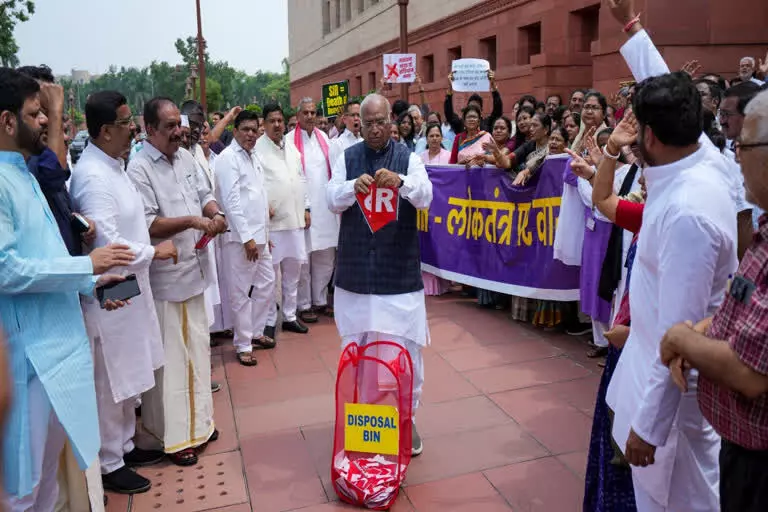
The Supreme Court on Tuesday began hearing a series of petitions challenging the Election Commission’s (EC) special intensive revision (SIR) of electoral rolls in poll-bound Bihar. During the proceedings, the bench — comprising Justices Surya Kant and Joymalya Bagchi — made it clear that Aadhaar cannot be considered proof of citizenship.
Justice Surya Kant noted that the task of including or excluding individuals from the electoral rolls lies squarely within the Election Commission’s jurisdiction. “Is anyone saying Aadhaar is proof of citizenship? The Aadhaar Act itself says it is not conclusive,” he remarked, referencing Section 9 of the Act.
However, the court appeared unconvinced by claims that most people in Bihar lack the necessary documents sought during the verification process. “This is a case of trust deficiency, that’s all,” Justice Kant observed.
The bench emphasized that the core issue to be resolved was whether the EC has the authority to conduct such a verification. “If they don’t have the power, the matter ends there. But if they do, there’s no problem,” Justice Kant said, as quoted by India Today.
### Concerns Over Voter Exclusion
Senior advocate Kapil Sibal, representing RJD MP Manoj Jha, argued that the EC’s process could lead to mass voter exclusion, especially of those unable to submit the required forms. He pointed out that even voters listed in the 2003 rolls were being asked to reapply, with the risk of deletion despite no changes in their residency status.
Sibal also flagged instances of voters being wrongly declared dead, while some deceased individuals remained on the rolls.
Countering these claims, senior advocate Rakesh Dwivedi, representing the EC, said that such issues were minor and correctable, as the process was still at the draft stage. He stated that 6.5 crore voters didn’t need to resubmit documents since they — or their parents — were already listed in the 2003 rolls.
The bench further noted that if 7.24 crore out of 7.9 crore voters had already responded to the revision, it significantly undermines the claim that 1 crore people were missing. The court asked the EC to come prepared with complete data, including the number of voters before and after the revision, the number of deceased voters removed, and other relevant figures.
### Widespread Criticism from Opposition, Activists
The SIR has sparked major political and civil society backlash. Activist Yogendra Yadav described it as “the largest exercise of disenfranchisement in the world,” alleging that 65 lakh names had already been deleted — more than 31 lakh of them women. He also claimed that procedural delays meant appeals against deletions might be decided only after the final list is frozen, making re-enrolment difficult before elections.
Yadav questioned the legal foundation of the EC’s move and accused it of assuming inflated rolls without evidence. “This is an exercise in intensive deletion,” he said.
Advocate Vrinda Grover also criticized the revision, calling it “an unlawful exercise” that should fall within Parliament’s domain, not the EC's administrative purview.
The draft electoral roll was released on August 1, with the final version due on September 30.
### Political Opposition Mounts
Several opposition leaders — including Congress’ KC Venugopal, TMC’s Mahua Moitra, NCP’s Supriya Sule, CPI’s D Raja, SP’s Harinder Singh Malik, Shiv Sena (UBT)’s Arvind Sawant, JMM’s Sarfraz Ahmed, and CPI(ML)’s Dipankar Bhattacharya — have challenged the EC’s move in court, warning it could disenfranchise crores of eligible voters.
Civil society organisations like PUCL, ADR, and other rights groups have also joined the legal challenge, citing serious concerns over transparency, legality, and the potential impact on voter rights.
The case continues in the Supreme Court.