SHANTI Bill Passed: India's Nuclear Energy Sector Opens to Private Players Amidst Controversy
India's nuclear energy sector gets a boost as President approves SHANTI Bill, allowing private companies to build and operate nuclear power plants

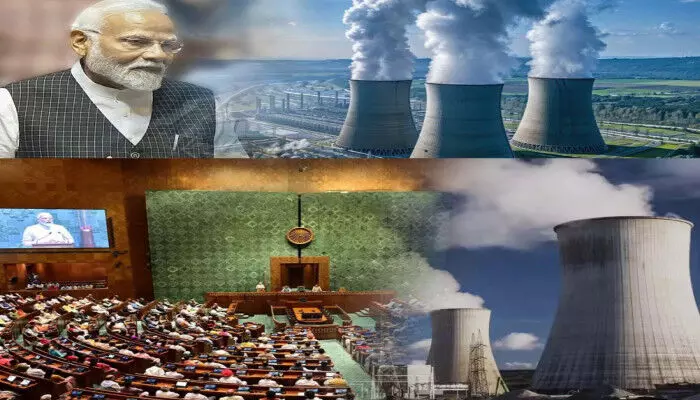
The passage of the Sustainable Harnessing and Advancement of Nuclear Energy for Transforming India (SHANTI) Bill in the winter session of Parliament has raised questions that go far beyond the technicalities of nuclear energy. It has opened a debate about sovereignty, accountability, and the dangerous ease with which the government has bulldozed through legislation of long-term national importance. The Congress has alleged, citing a provision in the United States’ National Defence Authorisation Act (NDAA) for Fiscal Year 2026, signed by President Donald Trump, that changes in India’s nuclear liability framework were not born in Delhi but scripted in Washington. Page 1,912 of the NDAA refers to a “joint assessment between the United States and India on nuclear liability rules,” a clause that Jairam Ramesh has highlighted to argue that the SHANTI Bill is less about India’s energy future and more about aligning domestic law with US interests.
The charge is serious because nuclear liability has historically been the stumbling block in the US–India civil nuclear deal. The Civil Liability for Nuclear Damage Act, 2010, was passed unanimously by Parliament to ensure that victims of nuclear accidents would have recourse, and that suppliers could not escape responsibility. That law was one of the reasons the much-touted 2008 nuclear agreement did not fructify, as American companies balked at the prospect of supplier liability. By dismantling key provisions of the 2010 Act, the SHANTI Bill effectively removes the very safeguards that Parliament once insisted upon. The government claims that the new law will reduce dependence on fossil fuels and expand atomic energy capacity, but the deeper reality is that it opens India’s nuclear sector to private participation under a liability regime that privileges vendors over citizens.
The government’s haste in pushing the Bill through both Houses without adequate consultation is telling. Nuclear energy is not a matter of short-term policy but of generational consequence. The risks of radiation, the costs of decommissioning plants, the burden of waste management, and the potential for catastrophic accidents demand the highest standards of transparency and accountability. Yet the SHANTI Bill caps liability, restricts victims’ rights to file complaints, and places the burden on taxpayers rather than suppliers. Shashi Tharoor, speaking in the Lok Sabha, called it a “dangerous leap into privatised nuclear energy,” warning that broad exemption powers undermine safeguards and invite profiteering at the expense of public safety. His critique is not rhetorical; it is grounded in the reality that nuclear accidents, from Chernobyl to Fukushima, have shown how devastating the consequences can be when liability is diluted.
Data from the International Atomic Energy Agency (IAEA) indicates that the average cost of nuclear accidents runs into hundreds of billions of dollars. Fukushima alone is estimated to have cost Japan over $200 billion in clean-up, compensation, and decommissioning. In such a context, India’s decision to cap liability and exclude genuine victims from filing complaints is not merely a policy choice but a moral abdication. The government’s argument that aligning with “international norms” will attract foreign investment ignores the fact that those norms often reflect the lobbying power of nuclear suppliers rather than the rights of citizens. The NDAA provision mandating a joint consultative mechanism with India to align liability rules is evidence of this external pressure.
The irony is that India is already self-reliant in 700 MW nuclear reactor technology. Ramesh has rightly pointed out that standardising indigenous reactors would be a safer and more strategic path than importing designs from multiple foreign vendors. Indigenous capacity ensures not only technological sovereignty but also accountability within domestic frameworks. By contrast, a vendor-driven Bill risks repeating the fate of the three farm laws, which were repealed after widespread protests. The nuclear sector, however, is far less forgiving; a misstep here cannot be rolled back with protests alone, for accidents leave scars that last generations.
The government’s abandonment of its own earlier position is striking. Senior BJP leaders had supported the 2010 Civil Liability Act, recognising the need for supplier accountability. To now dismantle those provisions is to betray both Parliament’s consensus and the principle of democratic responsibility. The absence of enforceable public participation mechanisms in the SHANTI Bill further compounds the problem. There is no provision for regular public reporting of safety inspections, radiation monitoring, or mandatory tabling in Parliament. In effect, the Bill centralises power in the executive while marginalising both Parliament and the public.
The broader context is equally troubling. India’s nuclear energy capacity currently stands at around 7,480 MW, contributing less than 3 percent to the national electricity mix. The government’s target of expanding this to 22,480 MW by 2031 is ambitious, but nuclear energy remains one of the most expensive sources of power when full lifecycle costs are considered. According to the World Nuclear Industry Status Report, the levelised cost of electricity from nuclear plants is higher than that from solar and wind, both of which have seen dramatic cost reductions in recent years. In India, solar tariffs have fallen to below ₹2 per unit, while nuclear tariffs remain above ₹4. The government’s insistence on opening the nuclear sector to private players under a diluted liability regime therefore raises the question: whose interests are being served?
The answer, critics argue, lies in the alignment with US strategic interests. The NDAA’s language about “bilateral and multilateral diplomatic engagement” around liability changes suggests that the SHANTI Bill is part of a larger geopolitical bargain. Modi’s public bonhomie with Trump, referenced by Ramesh, adds a political dimension to what should be a purely national policy decision. By privileging foreign vendors and private players, the government risks turning India’s nuclear future into a marketplace rather than a sovereign project.
The dangers of such a path are not abstract. India has witnessed the Bhopal gas tragedy, where victims struggled for decades to secure compensation. Diluting liability in the nuclear sector risks repeating that injustice on an even larger scale. The government’s claim that the Bill will accelerate the energy transition ignores the fact that renewable energy has already outpaced nuclear in both capacity addition and cost efficiency. India added over 13 GW of solar capacity in 2023 alone, compared to negligible additions in nuclear. To prioritise nuclear under a compromised liability regime is to ignore both economic data and ethical responsibility.
The SHANTI Bill, therefore, is not a step towards sustainable energy but a retreat from accountability. It represents a dangerous convergence of external pressure, executive haste, and legislative abdication. By dismantling the safeguards of the 2010 Act, the government has chosen to privilege vendors over victims, foreign interests over domestic capacity, and secrecy over transparency. In doing so, it has not only undermined Parliament’s role but also jeopardised public trust. Nuclear energy may indeed be part of India’s future, but it cannot be built on the foundations of diluted liability and compromised sovereignty. The night of colonialism once taught us that laws written elsewhere could bind us in chains. The SHANTI Bill risks repeating that lesson in a new form, reminding us that when liability is surrendered, sovereignty is not far behind.