Tamil Nadu 2026 Polls: DMK May Deploy Karunas Strategy in South, Testing Edappadi K. Palaniswami's AIADMK Base

With the countdown to the 2026 Tamil Nadu Assembly elections slowly beginning to shape the political landscape, quiet but intense manoeuvring has already begun in the state’s southern districts — a region that many political observers believe could determine the path to power.
Political circles in Chennai are increasingly discussing the significance of nearly 58 Assembly constituencies across the southern belt. Party strategists across the spectrum believe these seats could prove decisive in the battle for Fort St. George in 2026.
For the opposition All India Anna Dravida Munnetra Kazhagam, leader Edappadi K. Palaniswami is attempting to recalibrate the party’s strategy to correct the setbacks it faced in the 2021 Assembly election. But even as the former Chief Minister works to rebuild the party’s organisational strength, the ruling Dravida Munnetra Kazhagam appears to be quietly crafting a counter-strategy in the same region.
The southern districts once formed the bedrock of the AIADMK’s political dominance during the tenure of former Chief Minister J. Jayalalithaa. However, the current political climate in the region has shifted, with caste-based grievances and internal rivalries altering the electoral equation.
Against this backdrop, the DMK is believed to be making careful political calculations to attract key community votes in the region. One element of this strategy, political insiders say, involves leveraging the growing distance between Palaniswami and former Chief Minister O. Panneerselvam.
Whether or not Panneerselvam retains significant electoral influence, analysts say the ruling party’s larger objective may be to reinforce a political narrative that Palaniswami has sidelined leaders from the southern districts within the AIADMK. In that sense, Panneerselvam’s discontent could become a political tool in shaping voter perception in the region.
There is also speculation that the DMK may revisit a political template that proved effective in the past. In the 2016 Assembly election, the AIADMK under Jayalalithaa fielded actor-politician Karunas, a leader associated with the Mukkulathor community, on the party’s ‘Two Leaves’ symbol — a move that helped consolidate a key segment of votes.
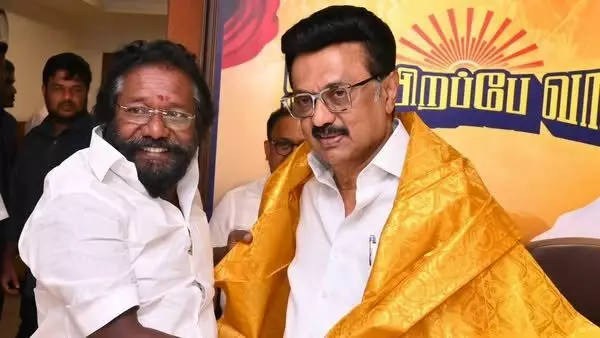
Nearly a decade later, there is talk in political circles that the DMK could consider deploying a similar strategy, possibly fielding Karunas under its ‘Rising Sun’ symbol in a southern constituency. The aim, observers suggest, would be to send a message that the ruling party remains open to accommodating leaders representing influential social blocs.
For Palaniswami, however, the southern districts remain central to his political calculations. Even as the AIADMK faces pressure from the Bharatiya Janata Party to expand the alliance framework, the party leadership has so far allowed the entry of T. T. V. Dhinakaran while resisting the return of figures such as V. K. Sasikala and Panneerselvam into the fold.
While this decision has been viewed by some within the party as a firm assertion of leadership, it has also opened new political challenges.
Sasikala, according to AIADMK insiders, is believed to be focusing her efforts in the southern districts with a singular political objective: weakening Palaniswami’s hold over the party’s traditional vote base. Meetings with community organisations and attempts to consolidate sections of the Mukkulathor electorate are reportedly part of this effort.
As the political temperature begins to rise, the interplay of personal rivalries, caste equations and strategic alliances in the southern districts could become one of the defining subplots of the 2026 Tamil Nadu election.
Whether Palaniswami’s organisational consolidation or the DMK’s quiet social engineering ultimately shapes the electoral outcome remains to be seen. But one thing is clear: the battle for the South may well decide who governs Tamil Nadu next.