Telangana Explores Cost-Efficient, Eco-Friendly Revival of Pranahita–Chevella Project: Uttam Kumar Reddy
Irrigation Minister Capt. N. Uttam Kumar Reddy says the revised Sundilla Link alignment could save ₹1,500–1,600 crore, cut land acquisition by half, and bypass coal-bearing zones, ensuring a technically sound and financially sustainable redesign of the long-pending irrigation project.

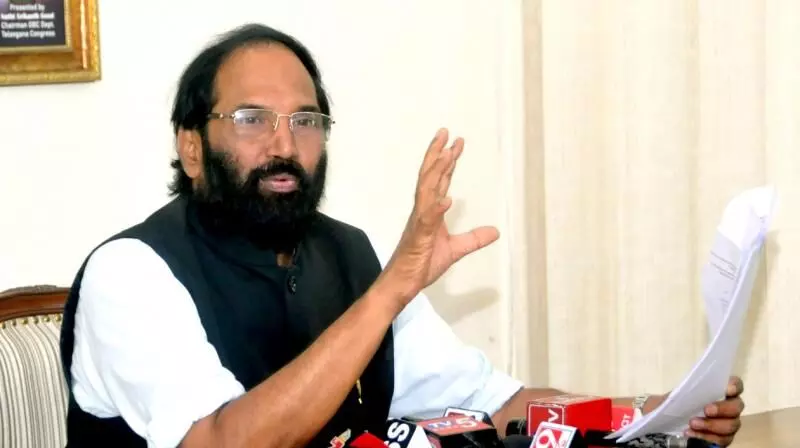
Irrigation Minister Capt. N. Uttam Kumar Reddy today said that the Congress Government in Telangana had examined cost-efficient alternatives to revive the Dr. B. R. Ambedkar Pranahita–Chevella Sujala Sravanthi Project in a technically and financially sustainable manner.
Chairing a detailed review meeting on irrigation projects at the Dr Ambedkar Telangana Secretariat, Uttam said the Government had studied the feasibility of a revised alignment through the Sundilla Link, which could lower project expenditure by around 10 to 12 percent, reduce land acquisition by nearly half, and save around Rs 1,500 to 1,600 crore when compared to earlier plans.
He said the revised alignment also avoided coal-bearing geological zones that had stalled work on the previous route.
The Government’s broader intention was to restructure the long-pending project in a way that ensured technical soundness, fiscal prudence, and environmental responsibility, while fulfilling its original goal of bringing Godavari waters to Telangana’s upland and drought-prone regions, he said..
“The revised Sundilla Link was examined as a practical and environment-friendly alternative, he said .the Government would take a well-informed decision once the technical and financial evaluations were complete.”
In the original plan, water was to be drawn from the Pranahita River at Tummidihatti barrage and carried to Yellampalli barrage through a 71-kilometre canal system. However, the project encountered major obstacles when coal seams were detected along the alignment, making tunnelling risky and costly, he said..
The new proposal suggested a direct link between Tummidihatti and Sundilla barrages, bypassing the coal zones entirely. Departmental studies found that this route could prove technically feasible and economically stronger, though a detailed DPR and ground verification were still underway, said the Minister..
“By shifting the alignment toward Sundilla, several geological difficulties could be avoided. The route might shorten canal and tunnel lengths, simplifying construction and reducing the extent of environmental clearances required,” Uttam said.
Officials informed the Minister that the revised alignment could yield savings of around Rs 1,500 to 1,600 crore, primarily due to shorter structures, reduced excavation, and reuse of existing pumping infrastructure. They also indicated that land acquisition could come down by nearly 50 percent, bringing substantial savings in compensation and environmental mitigation.
The redesign involved reassessing the number of pump houses, tunnel lengths, and lift components to integrate them with existing Sundilla installations.
Officials said that the revised gradient could reduce the gravity-canal length from about 30 kilometres to 13 kilometres and the tunnel length from nearly 14 kilometres to around 10 kilometres. The number of pump houses was expected to fall from 15 to 10 main and two auxiliary stations, each of 30 MW capacity.
The Minister directed officials to carry out a corrected and comprehensive survey to prepare an updated Detailed Project Report (DPR) covering hydraulic modelling, environmental assessments, cost–benefit analysis, and energy requirements. The revised DPR, once completed, would be placed before the State Cabinet for deliberation.
The Government of Maharashtra would be approached regarding the Tummidihatti barrage height, since maintaining an optimal level was essential for adequate water flow into Telangana’s canal system. Earlier reductions in height had limited drawal capacity.
“Consultations with Maharashtra would be taken up at the appropriate stage to ensure technical concurrence and balanced use of Godavari waters,” the Minister said.
The Dr. B. R. Ambedkar Pranahita–Chevella Sujala Sravanthi Project, conceived in 2008–09, was designed to utilise around 160 TMC of Godavari water to irrigate nearly 12 lakh acres across Adilabad, Nizamabad, Karimnagar, Medak, and Ranga Reddy districts, while also providing drinking water to Hyderabad and neighbouring areas.
The main objective of the project was to carry Godavari water from Tummidihatti to Chevella, ensuring irrigation and drinking-water security for Telangana’s upland regions.
The Minister said the Department would continue technical consultations and inter-departmental coordination.
After completion of surveys and DPR preparation, the findings would be submitted to the Cabinet for consideration, he said that phased execution and concurrent tendering could be adopted after technical and financial clearances.
The approach, he said, was to expedite work while ensuring transparency and accountability.
“We were proceeding step by step - survey first, design validation next, and execution after due review. Our aim was to make the project both economical and farmer-friendly,” he added.
In addition to the Pranahita-Chevella review, the Minister also discussed several other key irrigation and administrative matters listed on the agenda.
The meeting also reviewed promotion vacancies, court cases, NGT issues, and budget utilisation status for the Irrigation Department.
The meeting was attended by senior officials, including Advisor to the Government Adityanath Das, Principal Secretary Rahul Bojja, Special Secretary Prashanth Jeevan Patil, Engineer-in-Chief Mohd Amjed Hussain and other officials.