Th. Muivah: The Patriarch of Power and the Politics of Persistence

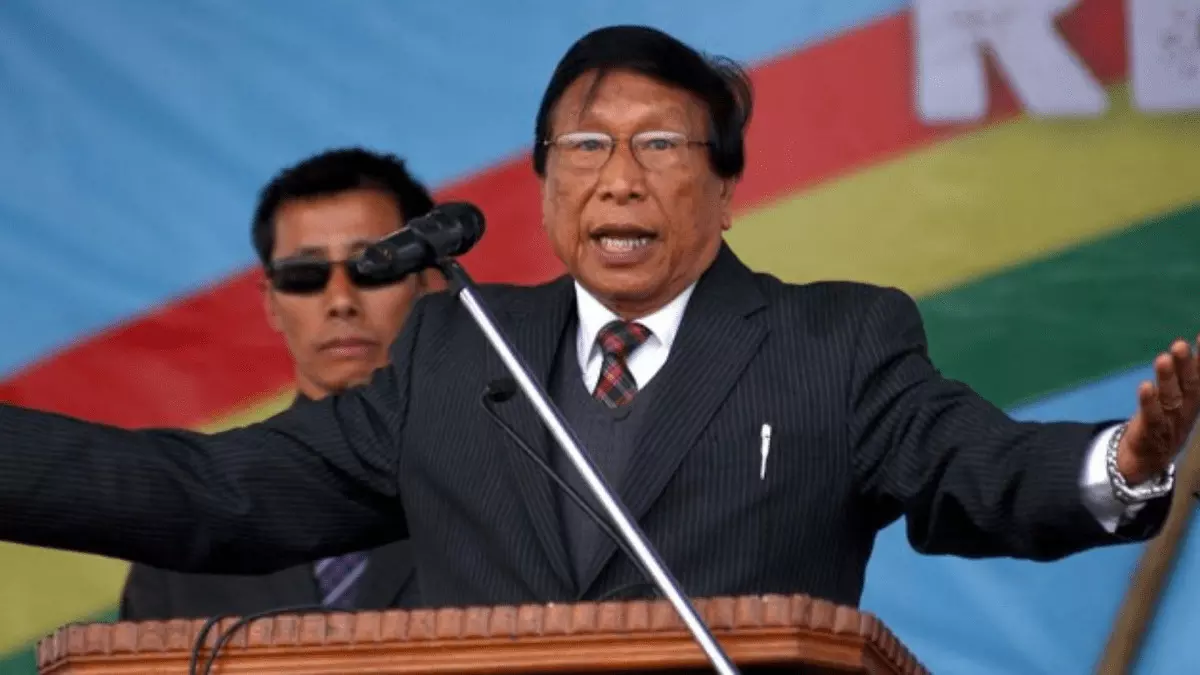
Thuingaleng Muivah, the patriarch of the National Socialist Council of Nagalim (Isak-Muivah), remains one of the most enigmatic political figures in the Northeast. A man of strategy, deep patience, and iron conviction, Muivah has spent over five decades navigating the turbulent waters of Naga nationalism — from the jungles of Myanmar to the corridors of Delhi. His journey is a saga of ideology, survival, and the art of negotiation.
From NNC to NSCN: The Birth of a New Political Order
Muivah began his political journey in the Naga National Council (NNC) under the spiritual leadership of A.Z. Phizo. But ideological differences over the Shillong Accord of 1975 fractured the Naga movement. Muivah, along with Isak Chishi Swu and S.S. Khaplang, rejected the Accord, seeing it as a betrayal of Naga sovereignty. Thus, in 1980, the NSCN was born — symbolizing a rebirth of the Naga dream under a more militant and organized leadership.
The later split into NSCN (IM) and NSCN (K) in 1988 only deepened the complexities, but it also gave Muivah an undisputed command over the most influential Naga faction.
The Global Journey: From the Hills to the World Stage
Muivah’s path was not confined to the Naga hills. From Shamdol (his birthplace in Ukhrul) to Shillong, Guwahati, Delhi, and beyond — Myanmar, China, and even Europe — he built networks that blended diplomacy and insurgency. His prolonged exile shaped him into a political philosopher of sorts — part guerrilla commander, part statesman.
China provided ideological exposure, Myanmar gave sanctuary, and India became the ultimate negotiating table.
Ceasefire and the Framework: The Politics of Hope
The 1997 ceasefire marked a turning point — a cautious peace that opened the door to negotiation. For the first time, Delhi recognized the NSCN (IM) as a political entity rather than a mere insurgent group. The Framework Agreement of 2015 — signed in the presence of Prime Minister Narendra Modi — was hailed as a “historic breakthrough.” Muivah declared it as a step towards realizing the “unique history and position of the Nagas.”
Yet, the optimism faded. Years passed, and the framework remained a document of ambiguity. The talk of shared sovereignty gradually dissolved into mutual suspicion and mistrust.
From Peace to Confrontation
By the third decade of the 21st century, Muivah’s patience seemed to thin. The NSCN (IM) began to view the Government of India’s approach as diluting the Naga identity. Delhi’s attempts to bypass Hebron and engage directly with NNPGs (Naga National Political Groups) reignited old suspicions.
Today, the situation teeters between peaceful dialogue and renewed confrontation. Muivah’s sharp statements — often couched in the language of political philosophy — remind Delhi that the Naga question is not a law-and-order issue but a matter of history and dignity.
The Patriarch Returns Home
In a symbolic full circle, Muivah’s return to Shamdol after 50 years was more than a personal pilgrimage — it was a political statement. The old revolutionary revisited his roots not as a rebel on the run, but as the patriarch of a movement that refuses to die.
Behind the aging frame lies a strategist who has seen betrayal, alliance, war, and diplomacy. His friendships span rebel leaders, church elders, and Indian interlocutors; his enemies — both within and outside — have respected his consistency.
Legacy of a Negotiator
Th. Muivah’s life is the chronicle of a man who never surrendered, but strategically adapted. He turned the language of insurgency into a grammar of negotiation. Whether seen as a revolutionary or as a politician, his influence on Naga and Northeast politics is undeniable.
In the twilight of his life, Muivah stands not just as a rebel patriarch but as a symbol of unyielding identity politics — a man who transformed the Naga struggle into a dialogue that still defines India’s unfinished frontier.