The Cry of India’s Gig Workers: Rights Beyond Rations

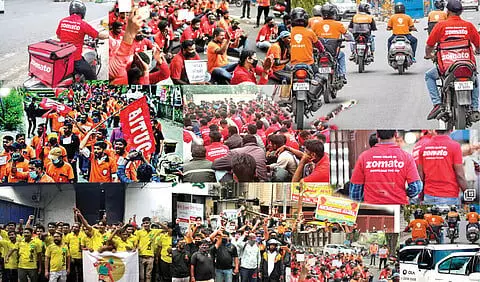
Summary : The nationwide strike of gig workers in India on December 31, 2025, was a landmark protest demanding fair wages, social security, and recognition of rights. Over two lakh workers participated, coordinated by unions like IFAT and GIPSWU, highlighting the gap between government promises of social justice and the lived reality of precarious work .
It was a defining day in India’s democratic journey when gig workers, the invisible backbone of urban convenience, took to the streets in a nationwide protest. On December 31, 2025, more than two lakh delivery partners from platforms like Swiggy, Zomato, Blinkit, and Amazon logged off their apps, disrupting services across Delhi, Bengaluru, Hyderabad, and other cities. Their demands were not extravagant but fundamental: fair wages, safe working conditions, and social security. The strike was coordinated by unions such as the Indian Federation of App-Based Transport Workers (IFAT) and the Gig and Platform Service Workers Union (GIPSWU), who presented a six-point charter including a guaranteed minimum monthly wage of ₹40,000, maternity protection, emergency leave, and workplace safety for women.
The protest raises two profound questions. First, if social justice is a moral responsibility of the government—as repeatedly assured—why did workers feel compelled to demonstrate en masse? Second, in a democracy, social security is not charity but a treaty between the ruler and the ruled. Philosophers like Hobbes, Locke, and Rousseau envisioned this contract centuries ago, where the state guarantees protection and dignity in exchange for obedience and labor. Yet, India’s gig workers are offered ration subsidies of 5 kg rice or wheat under the Food Security Act, while their rightful entitlements—health insurance, pension, and minimum wage—remain elusive. This substitution of rights with philanthropy undermines the very philosophy of democracy.
The All India Congress recently registered a union for gig workers, signalling political recognition of their plight. But the ruling BJP’s leaders have been accused of exploiting the situation, offering temporary relief rather than structural reforms. The government’s narrative of empowerment clashes with the lived reality of millions bound to meagre incomes, often below subsistence levels. According to union estimates, gig workers earn between ₹15,000–₹20,000 monthly, far below the demanded ₹40,000, with no guarantee of stability. The absence of social security leaves them vulnerable to accidents, illness, and exploitation, while companies thrive on their labor without accountability.
This crisis is not isolated but systemic. India’s gig economy employs nearly 7.7 million workers, projected to reach 23.5 million by 2030. Yet, regulation remains weak. The Code on Social Security, passed in 2020, promised inclusion of gig and platform workers, but its implementation has stalled. Workers continue to be classified as “partners” rather than employees, stripping them of legal entitlements. The December strikes disrupted deliveries during one of the busiest periods of the year, forcing the public to confront the human cost behind instant convenience .
The debate, therefore, is not about whether workers deserve rights—they unquestionably do—but about the government’s failure to translate promises into policy. Social justice cannot be reduced to ration distribution; it must encompass dignity, opportunity, and protection. The social contract demands that rulers stand behind their people with opportunities, not handouts. Gig workers’ protests are a reminder that democracy falters when rights are replaced by charity, and when economic growth is celebrated without securing the lives of those who sustain it.
India’s future depends on whether it can redefine prosperity to include its most vulnerable. The gig workers’ cry is not just for wages but for recognition as citizens entitled to the same protections as any formal worker. Their strike is a dirge against exploitation and a call for renewal. If the government listens, this moment could mark the beginning of a new social philosophy—where rights are honoured, justice is lived, and democracy breathes through the dignity of labour.