The Emperor of Discomfort: Himanta Biswa Sarma, Delhi’s Ace in Assam—and His Quiet Crisis

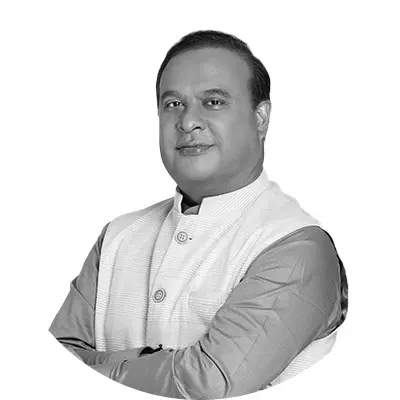
Assam Chief Minister Himanta Biswa Sarma (HBS) has made Delhi a second capital of sorts. The frequency of his visits has not gone unnoticed—not in Dispur, not in Lutyens’ Delhi. While official briefings term them “routine discussions,” insiders hint at something deeper: a man negotiating with power, not reporting to it.
With the 2026 Assam assembly elections around the corner, Sarma’s dominance remains, at least superficially, absolute.
Yet, behind the curtain of control lies an unspoken unease—about image, legacy, and the very nature of power.
All is Well… On Paper
There is no visible opposition in Assam.
The Congress (I) has reduced itself to a logo and a legacy.
Regional parties like AGP are vestigial.
Akhil Gogoi, once a household name in resistance politics, is now a side note in headlines.
Government machinery is functional.
Schemes like Orunodoi, free health insurance, and eviction-cum-reclamation drives have reached saturation.
Student unions and youth bodies, traditionally firebrands of Assamese politics, have either been co-opted or calmed.
Internally, BJP cadre remains loyal, the Sangh is supportive, and the numbers? Solid: 60–70 seats expected comfortably.
In political arithmetic, HBS is already the next CM.
But politics is not just numbers. It is also narrative.
The Real Delhi Drama: Power, Paranoia, and Parallel Lines
HBS’s visits to Delhi aren’t just about updates. They’re power recalibrations.
A soft warning: “Assam is secure as long as I’m secure.”
A reminder: “I have delivered, I expect acknowledgment.”
And a subtle shield: “If you’re planning a Plan B in Assam, remember, there is no Plan B without me.”
In return, Delhi plays along, fully aware that:
Himanta is their most effective manager in the Northeast,
Yet, he plays his own game—ideologically flexible, institutionally autonomous.
It’s an uneasy alliance held together by electoral need rather than ideological bonding.
The Gaurav Gogoi Wild Card: Legacy vs. Efficiency
Enter Gaurav Gogoi.
Polished, poised, still politically underweight—but dangerously symbolic.
He carries with him two ghosts Himanta can’t exorcise:
Hiteswar Saikia – the master tactician.
Tarun Gogoi – the people’s gentleman.
Both were HBS’s mentors. Both now represent what he desperately lacks: an emotional legacy.
Gaurav may not win seats. But he wins attention, especially among urban, liberal, and sentimental voters—the kind that don’t shout but quietly shape long-term narratives.
For HBS, this is less a political threat and more a psychological one.
Welfare Saturation and the Fatigue of Efficiency
The BJP in Assam has delivered. But it has also hit the ceiling.
Every possible beneficiary has received a scheme.
Every polarizing issue—from love jihad to madarsa shutdowns, from conversion laws to cultural debates on beef and pork—has been politically exhausted.
What remains?
A growing sense that efficiency has replaced emotional connection.
In the long run, people forget subsidies, but they remember how a leader made them feel.
This is the gap HBS cannot bridge—not with governance, nor with Delhi’s blessings.
Himantaism: Between Myth and Machinery
Himanta Biswa Sarma is a political technician, not a mass myth-maker.
He controls, but doesn’t charm.
He implements, but doesn’t inspire.
He wins, but doesn’t linger in memory.
This has made him indispensable—but not irreplaceable in imagination.
Delhi sees him as an asset, but also a variable. Assam sees him as efficient, but not emotionally eternal.
He knows it. And that’s why, despite towering control, his eyes still look towards something Delhi can’t give and elections can’t ensure—legacy.
Conclusion: The Winning Man Who Still Searches
Barring a political miracle or scandal, Himanta Biswa Sarma will likely return as CM in 2026.
His command over Assam’s political landscape is unprecedented.
But his recent movements, worried posture, and tightened grip on public narrative suggest this is no longer about winning power—it’s about winning permanence.
The Delhi visits, the control over dissent, the media blitz, the hyper-visibility—they are not tactics of a confident man.
They are signs of someone building a monument while still alive—afraid history might forget him.
Postscript: In Assam politics, power is transient, but legacy is folklore.
And folklore, unfortunately for HBS, cannot be drafted, passed, or policed