The Fall of the Red Corridor: India Declares Maoist Insurgency Wiped Out Across Bastar and Gadchiroli
From Bastar to Gadchiroli, a 24-year campaign culminates in mass surrenders — 303 Maoists lay down arms in two days, marking the end of a movement once feared across central India.
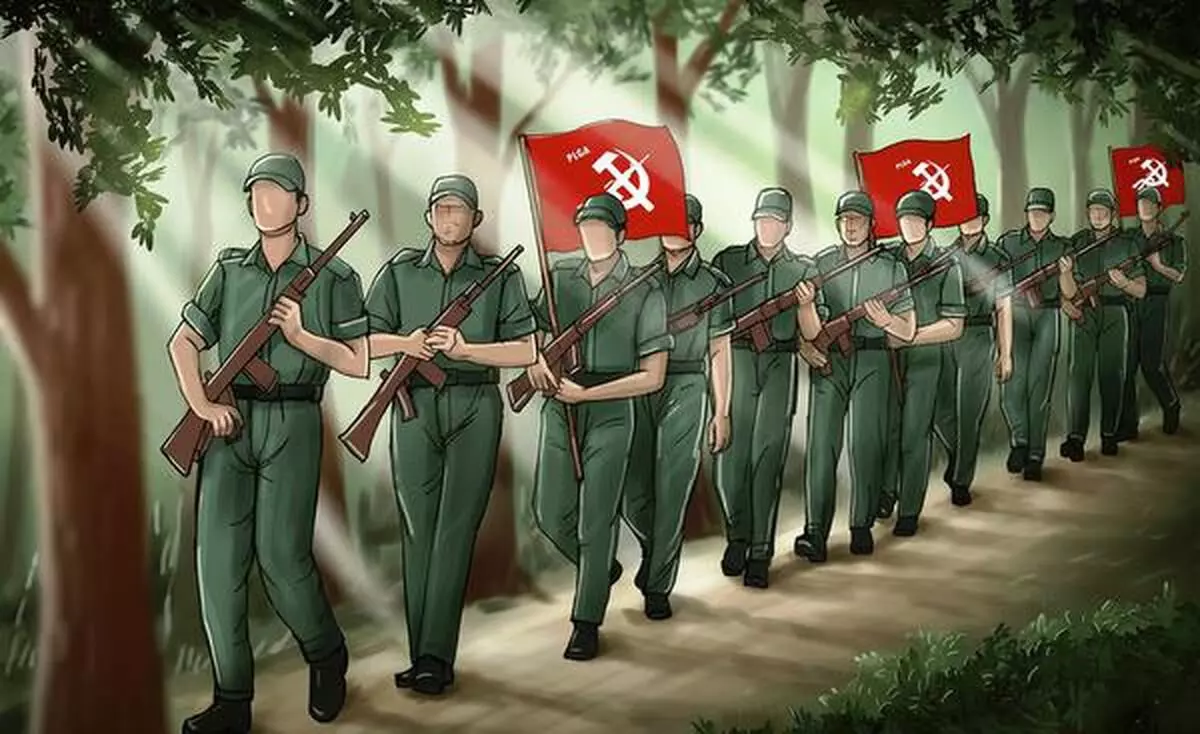
Union Home Minister Amit Shah had claimed that Maoist insurgents in Bastar would be eliminated by March 2026. Twenty-four years ago, Chhattisgarh's then Director General of Police, R.L.S. Yadav, declared, "Communism has ended in Russia; now Maoism will end in Chhattisgarh too."
But Naxalism has been eradicated in Chhattisgarh and Maharashtra well before this deadline.
Prime Minister Narendra Modi stated in his address that 303 hardcore Naxalites had surrendered in just two days. 210 Maoist leaders surrendered unconditionally at the feet of Chhattisgarh Chief Minister Vishnudev Sai, and 98, including supreme commander Bhupati, who carried a reward of ₹1 crore, surrendered unconditionally before Maharashtra Chief Minister Devendra Fadnavis.
The Naxalites, including 110 women, surrendered with highly sophisticated weapons (153), including AK-47s and INSAS rifles.
The most successful event was that this was the first in the world where armed resistance was absent, and there was a massive surrender.
This is due to the security forces killing 477 Maoists in encounters over the past two years and destroying their hideouts in the forests.
The Naxalite corridor from Pashupati (Nepal) to Tirupati (Andhra Pradesh) has now been eliminated. Not a single Naxalite demand was met, and mass surrenders took place in Gadchiroli and Jagdalpur.
Those Maoists who did not believe in the Indian Constitution laid down their arms that day, holding a copy of the Indian Constitution and a rose. The Indian government's surrender policy, launched in 2025, called Rehabilitation through Rehabilitation (Punar Margemam), attracted the Maoists to surrender.
I moved to Chhattisgarh from Jammu and Kashmir, a highly insurgency- and terror-ridden state, to the Maoist-affected state of Chhattisgarh. Bastar has changed significantly between then and now. Bastar district is now divided into several fragments, which were once blocks that have now become districts.
Twenty years ago, 32,000 officers and soldiers from the State Police, Border Security Force, Central Reserve Police Force, and Punjab Police were posted in Bastar. After sunset, no civilians or policemen were seen on the streets. Markets opened only during the day. Voter turnout in the general elections was 8%.
I had the opportunity to visit Konta, Sukma, and Bijapur several times. One could only travel with a press sticker. Once, in Bijapur, which was a block at the time, a block officer was killed. As we approached a small drain, two young men on a motorcycle approached and asked the reason for their visit. They told me that Dada had informed me of their arrival from Jagdalpur, and I should return. I found out they were Naxalite messengers. They told me, "We receive all the magazines and newspapers published in Delhi and Mumbai. We take notes on what you write."
The Naxalites of Bastar also had several printing presses in the forest, from where they issued their press releases.
Following his instructions, we returned to Dantewada and the next morning bathed in the Sabri River on the Malkangiri border of Chhattisgarh and Odisha. When Biju Patnaik was the Chief Minister of Odisha, he had divided Koraput to form the Malkangiri district and appointed Gagan Kumar Dhal, a young officer of the 1986 batch, as its first District Magistrate. Opposition leaders alleged in the Legislative Assembly that the Collector was a Maoist sympathizer. Responding to this, the Chief Minister said, "Yes, he is reflecting my will."
I did not see a police gypsy anywhere from Kondagaon to Konta. At that time, Mohammad Wazir Ansari, the 1984 batch Inspector General of Police, also traveled around in Dantewada in a Tata Sumo, without uniform, beacon lights, or siren. The vehicle also carried a red and yellow sash of Dantevashari Devi, instead of a police flag. Police officers and soldiers also wore sheets instead of coats.
Police stations were also highly secure. Armed soldiers were stationed on high towers. Barbed wire surrounded the station, with colorful liquor bottles hanging from them.
Ansari explained, "There were many attacks on the police. Policemen were being killed while patrolling, so the use of police uniforms was prohibited due to tactical strategy. Road opening parties were also attacked. Instead of jeeps, patrolling was carried out on motorcycles and then on foot."
The highly fortified Geedam police station, located on the highway between Bastar and Dantewada, was looted by a Naxalite squad in broad daylight. The station officer was killed and weapons were taken. Rajnandgaon's District Superintendent of Police, Mr. Choubey, was also killed along with 19 other personnel. They were in uniform. Police stations remain highly secure. Security has been increased at all police stations from Narayanpur to Antagarh. Abu Jamad, which the Maoists had declared a liberated zone, is now under the control of the Bastar police.
The Red Terror has been encountered in India.