The Mirage of Mobilisation and the Crisis of Credibility in Assam

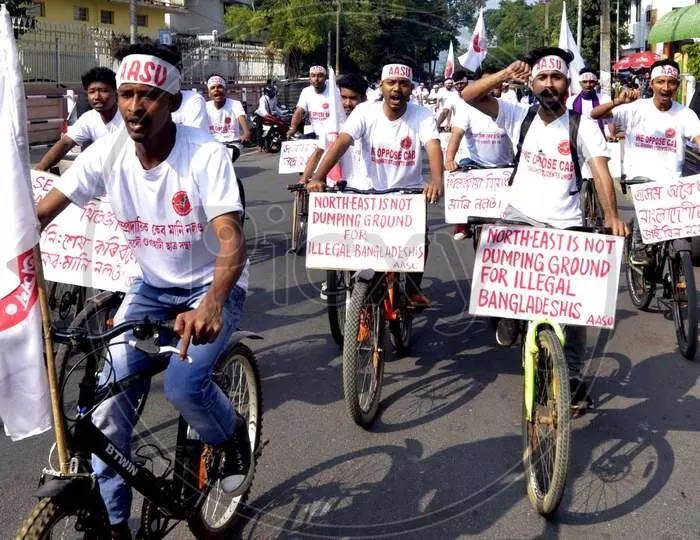
The Return of a Familiar Drama, Assam’s political stage is once again ablaze with the rhetoric of “illegal Bangladeshis.” Students’ organisations such as the All Assam Students’ Union (AASU) and the North East Students’ Organisation (NESO), backed by civil society leaders like Akhil Gogoi, have reignited agitation over deportation and demographic survival.
Chief Minister Himanta Biswa Sarma’s government has amplified the narrative — warning of “unknown people,” invoking the National Register of Citizens (NRC), and stoking fears of cultural erosion.
The mood echoes 1979–85, when student-led protests culminated in the Assam Accord. The symbolism is powerful, the mobilisation emotional, and once again the public imagination is being directed toward the politics of identity.
The Contradiction at the Core
Behind the rhetoric lies a contradiction no political force addresses. There exists no treaty, accord, or diplomatic mechanism between India and Bangladesh that allows deportation or pushback of so-called illegal migrants.
Meanwhile, Assam’s lived crises mount:
Agrarian distress deepens with repeated crop failures and poor irrigation.
Tea tribes, a crucial vote bank, remain trapped in poverty despite promises.
Climate disasters — floods, erosion, displacement — devastate rural lives annually.
Yet, these burning issues are sidelined. What dominates rallies and headlines is the “Bangladeshi” question.
Electoral Polarisation
The migrant debate is carefully reframed into a Hindu–Muslim binary.
Hindu migrants are projected as Partition victims and beneficiaries of the Citizenship (Amendment) Act (CAA), while Muslim migrants are portrayed as “illegal infiltrators.”
This duality enables the BJP to consolidate its Hindu vote bank — caste Assamese, tea tribes, adivasis — under a two-pronged “divert and rule” strategy. It allows the government to appear nationalist while avoiding accountability for governance failures.
The Erosion of Credibility
But the strategy has limits. Assam is sliding into a credibility crisis.
Memory of Broken Promises: The Assam Accord (1985) promised a solution; the NRC (2013–2019) was billed as final settlement; the CAA (2019) marketed as a corrective. None delivered closure. Each revival of the issue now underlines unfulfilled promises, eroding the government’s moral authority.
Civil Society Pushback: Leaders like Akhil Gogoi link the foreigner debate with indigenous rights, agrarian distress, and governance failures. While he invokes Clause 6 and ST status, his framing exposes the government’s reliance on diversion.
Voter Fatigue: Assam’s youth, in particular, show frustration with endless agitation. For them, jobs, education, and livelihood matter more than recycled promises. Without results, mobilisation risks breeding resentment rather than consolidation.
The Political Risk of Overuse
In the short run, the foreigner issue will continue to serve electoral purposes. It energises rallies, stirs emotions, and shapes the 2026 discourse. But overuse carries risks:
The insider–outsider narrative may collapse into a demand for accountability from those in power.
Polarisation may alienate moderate voters seeking stability and development.
Recycled rhetoric may render both government and student unions irrelevant, if people conclude all are complicit in sustaining a non-issue.
A Paradox at the Heart of Assam
Assam is trapped in a paradox. Its most potent political issue — the foreigner question — is also its most unsolvable. Governments exploit it for power, student bodies for relevance, civil society for mobilisation. Yet, every cycle of agitation ends in disappointment, because there is no policy solution.
The issue has become not just a debate about outsiders, but a mirror reflecting the failures of insiders. Overreliance on diversion risks corroding legitimacy itself, as public anger shifts from “illegal migrants” to politicians who survive by keeping the problem alive.
As one observer put it: “In Assam, the foreigner issue is not a solution but a strategy — revived to divert, reused to rule, but destined to erode the very credibility of those who thrive on it.”