The Northeast’s New Fireline: Why Old Conflicts Are Returning in a Smarter Form
From drone warfare to digital networks, the frontier’s old insurgencies are evolving into adaptive, cross-border systems — blurring the lines between ideology, technology, and geopolitics.

The northeastern frontier of India has always been an uneasy landscape — a mosaic of identities, borders, and unfinished histories. For decades, it has been one of South Asia’s oldest battlegrounds, yet paradoxically, its violence remained limited and ritualistic — an equilibrium of tension rather than total war. But the recent chain of events, from the July drone attacks on insurgent camps in Myanmar to the retaliatory “Ops Vengeance” operation and the subsequent counterstrikes on NSCN(K) bases, signals the birth of something far more dangerous. The region appears to be entering a new age of coordinated and technological conflict, where the violence may come not in isolated outbursts, but as a calculated sequence of events.
1. The End of Containment
For nearly two decades, the Indian state managed to contain insurgency in the Northeast through a mixture of ceasefires, peace accords, and tactical intelligence operations. Violence was cyclical, predictable, and largely confined to certain pockets — a form of managed conflict.
But containment is now collapsing. The Myanmar coup in 2021 tore open the border’s fragile balance, creating ungoverned territories that insurgent groups quickly reoccupied. In these anarchic spaces, ULFA(I), NSCN(K), and several lesser-known outfits rebuilt their camps, supply chains, and alliances. The frontier that once acted as a buffer has turned into a corridor of coordination.
2. From Camps to Networks
What once were jungle-bound guerrilla groups are now part of digitally connected insurgent ecosystems. The July 2025 drone attacks on ULFA(I)–NSCN(K) camps marked a turning point. It was the first known use of unmanned aerial systems in the Northeast’s insurgent theatre — a leap from bush warfare to remote, precision-driven conflict.
The subsequent retaliatory operations, including the “Ops Vengeance” ambush on Indian security forces, demonstrated not only retaliatory capacity but also psychological synchronization — each attack responding to another in rhythm, echoing through propaganda networks and social media.
This evolving “sequence warfare” — one strike triggering another in rapid cycles — suggests the return of violence in a more intelligent, adaptive form.
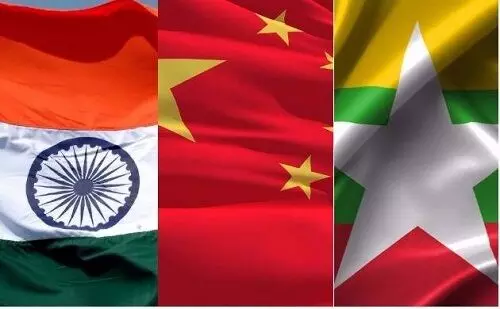
3. The Shadow Triangle: India, Myanmar, and China
The deeper anatomy of the current unrest reveals a transnational triangle.
In India, insurgent-linked “business fronts” — from transport companies to trade syndicates — launder money into the movement. Across the border, Myanmar provides the operational base, its fractured political order allowing rebel groups to thrive in semi-permissive zones.
And behind it all lies what analysts often call the “northern shadow” — China’s silent oversight.
China’s role isn’t overtly interventionist; it doesn’t arm rebels directly. Instead, through black-market trade routes, intelligence intermediaries, and selective tolerance of arms flows from Yunnan and Mandalay, Beijing helps sustain a grey ecosystem that undermines India’s strategic depth in the region. The formula is simple yet effective: business in India, base in Myanmar, and brain in China.
4. Peace Fatigue and the Return of the Young Guns
The social dimension of this revival is equally troubling. The generations that grew up during the peace process now see a deadlock of promises. Development remains patchy, unemployment rampant, and governance opaque.
This “peace fatigue” has bred disillusionment — especially among the young — who see the old leaders of rebel groups as corrupt or co-opted, and the state as indifferent. A new generation of militants is emerging, less ideological and more pragmatic, driven by identity anxiety and digital radicalization rather than classical separatist dreams.
The danger lies in their fluid loyalties: they operate through encrypted networks, cross ethnic boundaries, and connect with external actors — from arms smugglers to cryptocurrency handlers. The line between insurgent and mercenary is blurring fast.
5. Sequences, Not Outbursts
Unlike the past, where violence erupted in sporadic explosions — a bomb here, an ambush there — the coming pattern seems to be one of successive, modular incidents.
A drone strike on a camp leads to an ambush on a convoy; that, in turn, prompts a retaliatory air or artillery response. Each side learns, adapts, and strikes again.
This is no longer a localized insurgency; it’s a system of calibrated instability, where actors across borders respond to the same pulse.
6. Implications for India’s Policy
For India, the new phase of violence poses a multidimensional challenge. Militarily, the Army and paramilitary forces will have to adapt to hybrid warfare, combining counter-insurgency with counter-drone and cyber operations.
Diplomatically, India must navigate a fragile relationship with Myanmar’s junta, balancing operational cooperation with human rights optics. Strategically, it needs to counter China’s “grey-zone influence” without escalating regional confrontation.
But above all, the Indian government must address the political vacuum within the Northeast itself. Economic packages and peace accords cannot replace genuine political trust or cultural respect. The state’s legitimacy in frontier societies must be rebuilt — not through fear, but through faith.
7. The Fireline Ahead
The Northeast stands today at a crossroads — between integration and fragmentation, between silence and resurgence. The old battlefield of insurgency has not died; it has simply shifted form, modernized, and connected itself to global currents of instability.
The recent incidents — from drones to digital propaganda — are not isolated sparks. They are signals from a system awakening. If this trajectory continues unchecked, the region may once again turn into a low-intensity war corridor, fueled not by ideology, but by networks of profit, revenge, and external manipulation.
The challenge before India is not just to fight the violence, but to decode the ecosystem that sustains it — and to realize that in the age of invisible borders, peace cannot be imposed; it must be built, shared, and renewed.
In short: The Northeast’s new fireline is no longer lit by ideology alone — it burns with technology, frustration, and foreign strategy. And once again, it is asking India the oldest question it has always posed: Can peace survive without justice, and can justice exist without trust?