Transforming Bihar: Two decades of inclusive growth and social justice under development with equity
From political exclusion to social empowerment — how welfare initiatives since 2005 reshaped opportunities for backward, most backward, Scheduled Caste, Scheduled Tribe, and Mahadalit communities.
Before 2005, Bihar’s marginalized and deprived sections — including the backward, most backward, Scheduled Castes, Scheduled Tribes, Dalits, Mahadalits, and economically weaker sections — were left out of the state’s development process. Governance was confined to select families, and social justice remained a slogan rather than a policy. Educational deprivation, unemployment, and poverty among these communities deepened over the years, while those in power focused more on political gain than on social progress.
When a new government was formed on November 24, 2005, it pledged to reverse this trend by following the principle of “development with justice.” Every community was treated as part of one large Bihar family, and targeted welfare and empowerment initiatives were launched to ensure equal opportunities in education, employment, and representation.
Empowerment through representation and reform
In 2006, Bihar became the first state in India to implement 20% reservation for Extremely Backward Classes (EBCs) in Panchayati Raj Institutions and municipal bodies. This was followed by 21% reservation for EBCs and 12% for Backward Classes in the state judicial service.
To institutionalize this progress, the Backward and Extremely Backward Classes Welfare Department was created in 2007–08. Its budget, just ₹42 crore in 2008–09, has risen to ₹1,900 crore in 2025–26, reflecting the government’s growing commitment to social equity.
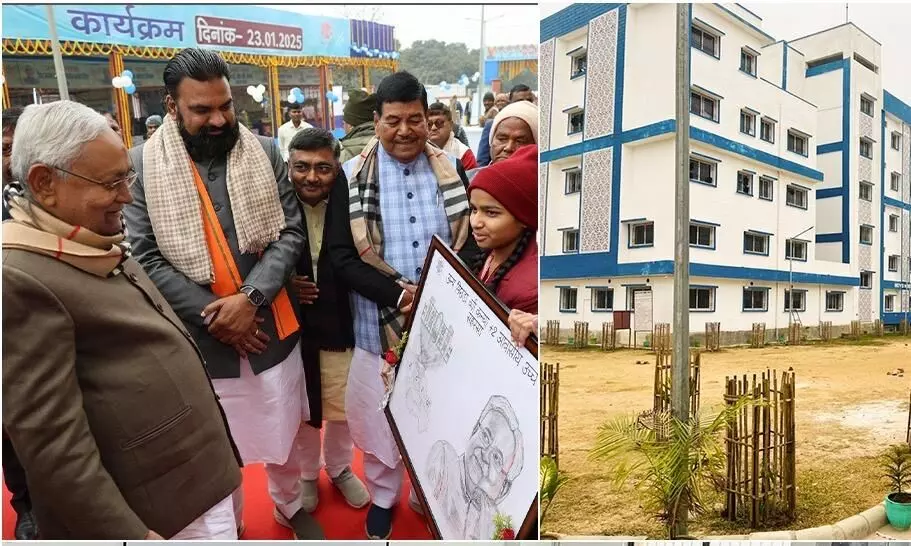
Residential hostels named after Jananayak Karpuri Thakur were constructed across all districts for EBC students. Over 4,500 students currently benefit from free accommodation and education under this program.
Employment and entrepreneurship for youth
To address unemployment among marginalized communities, the government introduced multiple livelihood and entrepreneurship schemes.
Under the Chief Minister’s Village Transport Scheme, assistance was provided to 33,644 youth from Scheduled Castes and Tribes and 11,360 youth from EBCs to purchase vehicles for self-employment.
Since 2018, the Civil Services Incentive Scheme has supported candidates from Scheduled Castes, Tribes, and EBCs appearing for competitive exams, offering incentives of ₹50,000 for BPSC prelims and ₹1,00,000 for UPSC prelims. So far, over 10,000 candidates have benefited.
The Chief Minister’s Entrepreneur Scheme, launched in 2018 and expanded in 2020, provides up to ₹10 lakh assistance — ₹5 lakh as a grant and ₹5 lakh as an interest-free loan — to help youth start small enterprises. Over 40,000 entrepreneurs have been supported, including 13,664 from SC/ST, 9,855 from EBC, and 8,324 from backward and upper castes.
Education and residential infrastructure
Before 2005, Bihar had only 66 poorly equipped residential schools for Scheduled Castes and Tribes. All have since been upgraded to 10+2 standard, and 70 new schools have been constructed, expanding residential capacity to 84,240 students.
In 2021, the government also established separate residential schools for girls from backward and extremely backward classes in every district to promote girls’ education and reduce dropout rates.
Caste survey and targeted welfare
The 2023 caste-based economic survey identified 9.4 million poor families across castes and communities. Based on the findings, a Small Entrepreneur Scheme was launched to provide ₹2 lakh assistance for self-employment to poor families, including upper-caste poor households.
Scholarships and education incentives
To promote education among Scheduled Castes, Scheduled Tribes, and backward communities, multiple scholarship schemes are being implemented.
Post-Graduation Scholarship Scheme: Students from EBCs receive ₹2,000–₹4 lakh annually; female students from grades 1–10 receive ₹7,200 per year.
Hostel Students’ Allowance: Raised from ₹1,000 to ₹2,000 per month in 2025.
SC/ST Merit Incentives: Students scoring first division in matriculation receive ₹10,000; those with second division receive ₹8,000.
For FY 2024–25, ₹19,648 crore has been allocated for Scheduled Caste welfare and ₹1,735 crore for Scheduled Tribes.
Mahadalit and Tribal Development
The Mahadalit Vikas Mission, established in 2008, continues to deliver development benefits through 10,000 Vikas Mitras working at the grassroots level. Their monthly honorarium has been raised to ₹25,000, and they now receive allowances for tablets, transport, and stationery to enhance efficiency.
The Integrated Tharuhat Development Programme (2009) focuses on tribal empowerment through residential schools, skill training, and self-employment. In 2014, the Swabhiman Battalion, comprising women from Scheduled Tribes, was established in West Champaran — a symbol of social and gender empowerment.
“Development with Justice” — a continuing commitment
Over the last two decades, Bihar has witnessed a transformation — from exclusion to empowerment. Through structural reforms, inclusive policies, and dedicated welfare schemes, the state has ensured that social justice is not merely a slogan, but a lived reality.
We have always worked for every section of society — the backward, the deprived, the Dalits, the Mahadalits, and the poor. The journey of inclusive growth will continue. We have fulfilled what we promised, and we will continue to do so, said the Chief Minister.