ULFA (I): Reclaiming Relevance in a Fractured Assam

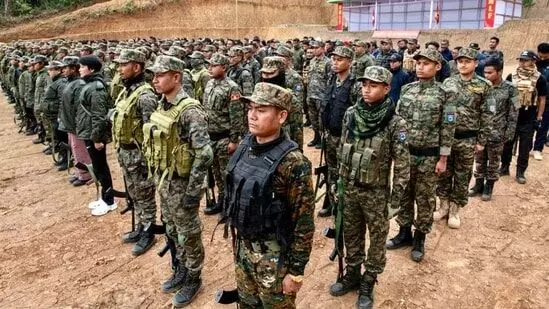
Assam’s internal political crisis has deepened. Corruption charges against power holders, the erosion of governance standards, and the ruling establishment’s obsession with non-issues have hollowed out the state’s political credibility. In this atmosphere of disillusionment and drift, a dormant force finds space to reassert itself — the United Liberation Front of Asom (Independent), or ULFA (I).
This resurgence is not driven by firepower but by political opportunity. ULFA (I) no longer operates merely as an insurgent formation — it is attempting to redefine itself as a political stakeholder. Its core demand — sovereignty or self-determination — has been reframed as a political question, not a law-and-order problem.
For years, ULFA (I) appeared to be on the margins of Assam’s history. The ceasefire with its pro-talk faction, mass surrenders, intelligence penetrations, and the collapse of its Myanmar sanctuary had nearly erased its footprint. But geopolitical tremors across the region are altering the equation.
The Myanmar crisis — where Beijing-backed truces and shifting alliances have weakened the junta — has opened new operational corridors for ethnic armed groups along India’s frontier. ULFA (I) has exploited this fluidity to regroup and reassert presence. Its recent drone operations, including the much-publicized Operation Vengeance, are not random acts of violence but strategic communications — calibrated moves to announce that ULFA (I) remains alive, relevant, and adaptive in a changing war theatre.
Militarily, ULFA (I) remains fragile — its cadre base thin, its supply chain fractured, and its sanctuary unstable. Yet, the organisation’s real strength lies not in weaponry but in leadership. Paresh Baruah, its elusive commander-in-chief, embodies the continuity of the Assam insurgency’s ideological thread. Over the decades, Baruah has transcended the image of a guerrilla leader; he has become a regional connector — a symbolic axis in the West–East–South East Asia (WESEA) insurgent grid.
In the clandestine geography of insurgency stretching from India’s Northeast to Myanmar, Yunnan, and northern Thailand, Baruah remains a unifier and negotiator. His voice commands attention among Naga, Manipuri, and even Kachin insurgent circles. That network — though informal — gives him strategic depth even as his ground power weakens.
For Baruah, the return to aggression is political theatre — an attempt to re-enter Assam’s volatile political script at a moment when the state’s ruling class is divided and discredited. Every drone strike, every message from ULFA (I)’s media arm is less a declaration of war and more a demand for recognition.
The state, preoccupied with symbolic politics and populist diversions, risks underestimating the political intelligence of insurgency. What appears to be a fading rebellion may, in fact, be a recalibrated negotiation — where weakness is weaponized, and absence turned into influence.
ULFA (I)’s re-emergence is thus not a return to the jungle but a return to relevance. It seeks to insert itself once again into the conversation about identity, autonomy, and dignity in Assam — issues the mainstream has failed to resolve. Whether Paresh Baruah succeeds in transforming military symbolism into political leverage will depend on how deeply Assam’s ruling elite continues to mistake discontent for peace.