When an NIA IG Rescued a Young Woman from Drowning in a Pit
NIA IG Sanjeev Kumar Singh rescued a woman from a concealed water-filled pit in Delhi. Now, similar incidents claim lives due to civic negligence. Is accountability the answer?

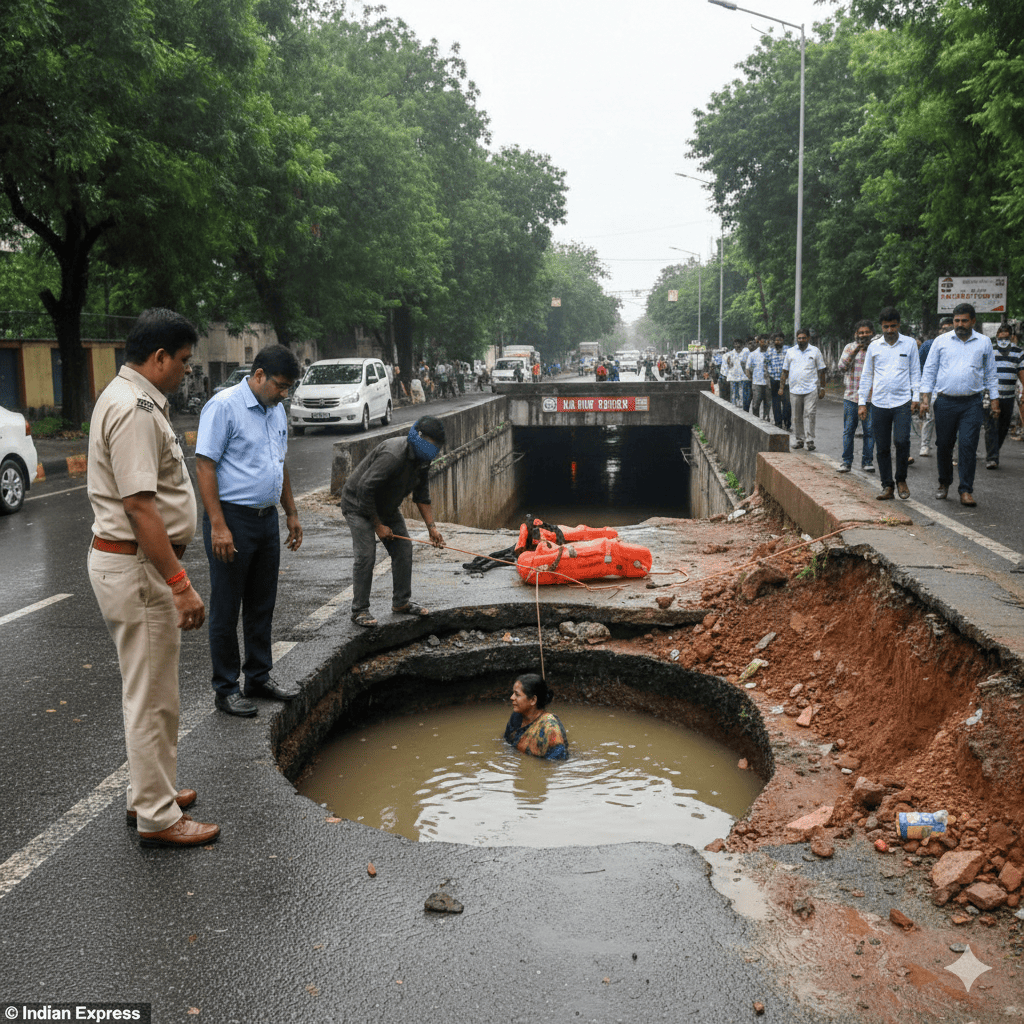
Images Credit - Indian Express
The recent deaths of two young men who fell into water-filled pits in New Delhi and Noida have once again exposed the lethal consequences of unchecked civic negligence. In one case, a youth plunged into a rain-filled excavation along with his car near an under-construction apartment complex and was found dead the following morning. In another, a 26-year-old bank employee in Rohini lost his life after his motorcycle skidded into a pit dug by the Delhi Jal Board.
While these tragedies have ended in loss, a similar incident nearly fifteen years ago had a different outcome—because timely intervention saved a life.
In September 2011, Sanjeev Kumar Singh, then Inspector General with the National Investigation Agency (NIA) and a 1987-batch IPS officer of the Madhya Pradesh cadre, rescued a young woman who had fallen into a concealed, water-filled excavation in South Delhi. Singh, who later passed away during the COVID-19 period, was at that time posted in Delhi when the NIA was operating from a temporary office in Okhla.
Recalling the incident, his wife Jyoti Singh expressed shock and anger over the recurrence of such preventable deaths. “I am stunned and deeply disturbed by the negligence behind the recent incidents in New Delhi and Noida,” she said. “These tragedies are not new. The question is when governments will begin holding agencies accountable so that human lives are not reduced to mere statistics.”
According to Jyoti Singh, the incident occurred on September 10, 2011, near Jia Sarai in the Hauz Khas area. Following heavy rainfall, the locality had been flooded. Large sections of the road had been excavated for civic work, though the pits were neither barricaded nor marked. Visibility was extremely poor due to continuous rain.
“That morning, Sanjeev was unusually alert while on his way to office,” she recalled. “He sensed that the conditions were dangerous. The road had turned into slush, forcing the driver to slow down.”
As the vehicle approached Jia Sarai, Singh noticed a faint figure ahead—a young woman holding a black umbrella. Moments later, the figure appeared to disappear, leaving only the umbrella floating on the water’s surface.
Realising something was wrong, Singh immediately stepped out of the car and rushed towards the spot. Plunging his hands into the muddy water, he managed to grab the woman, later identified as Mamta Pant, who had already slipped into the pit and was struggling to stay afloat. An accomplished swimmer, Singh was prepared to jump in if required, but managed to pull her up before it became necessary.
Crucially, the pit was completely concealed. The rainwater had risen to road level, creating the illusion of routine waterlogging. Neither Singh nor the victim initially realised that the road had collapsed into a deep excavation.
Mamta Pant later recounted her ordeal on several television channels, describing how she had suddenly lost footing and been pulled underwater without warning.
Official estimates in Delhi acknowledge the presence of nearly 3,400 open pits or incomplete excavation sites across the city. Despite repeated fatalities, the city’s drainage infrastructure—largely unchanged since 1978—remains inadequate. Hazardous excavation sites continue to dot major corridors, including National Highway-44, and residential areas such as Mundka, Janakpuri, and Mayur Vihar.
During the previous monsoon, multiple underpasses and tunnels in Gurugram were flooded, with water levels concealing road depth and allowing vehicles to be submerged without warning.
The deaths in New Delhi and Noida are not isolated accidents. They are the consequence of systemic neglect—one that continues to claim lives unless account
ability replaces apathy.