Aadhaar Losing Its Own Aadhaar ( आधार ) ?
.Aadhaar Losing Its Own Aadhaar: SC Says Not Proof of Citizenship, Yet Pushes Voter Inclusion. Experts warn this paradox risks blurring residency and citizenship?

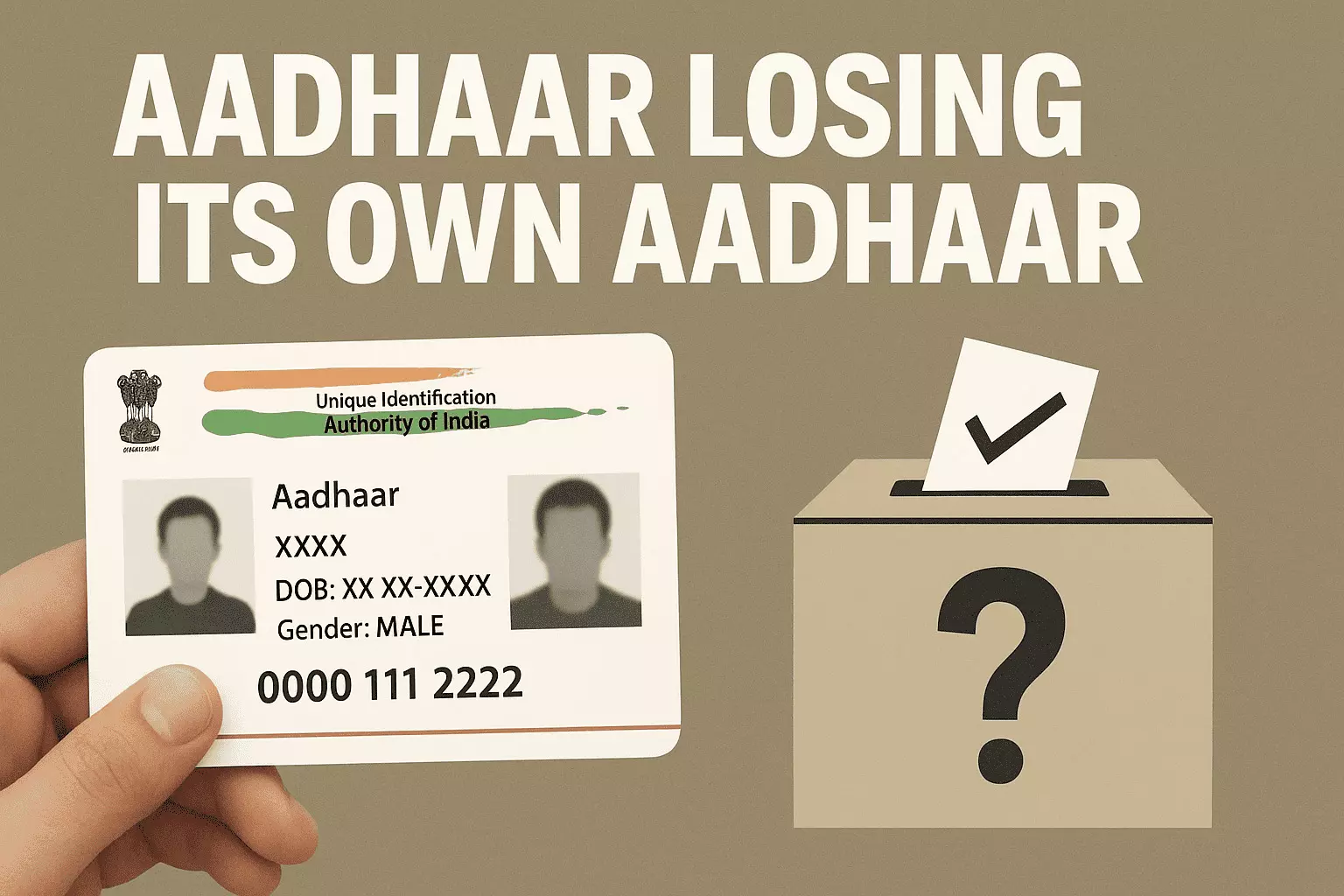
The seed of Aadhaar — world’s largest biometric-based identification system — was first sown in 2006, when the Planning Commission of India envisioned the need for a robust system to provide every resident with a unique identification number of twelve digits to provide credible proof of existence.
The underlying objective was to ensure efficient delivery of welfare schemes, eliminate duplication, and strengthen governance through a reliable identity framework. To give concrete shape to this vision, the Government of India formally set up the Unique Identification Authority of India (UIDAI) in 2009.
The UIDAI was entrusted with the responsibility of designing, implementing, and managing the ambitious project that would eventually touch the lives of over a billion people. To provide statutory backing and legislative legitimacy, the Indian Parliament enacted the Aadhaar (Targeted Delivery of Financial and Other Subsidies, Benefits and Services) Act, 2016.
This Act transformed Aadhaar from a policy initiative into a legal instrument, making it the cornerstone for transparent delivery of subsidies, benefits, and services across the nation. It was envisioned not merely as a number, but as a transformative tool to cleanse the system of duplication and eliminate the menace of fictitious beneficiaries who had long plagued welfare schemes. Aadhaar sought to ensure that entitlements such as LPG subsidies, pensions, and scholarships reached the rightful hands without leakage or diversion.
*Purpose*
Beyond welfare, Aadhaar gradually assumed a wider role. By linking Aadhaar to bank accounts, it opened the doors of the formal financial system to millions who had hitherto remained on its margins.
In time, this unique identity transcended its welfare-centric origins to emerge as a universal proof of identity, seamlessly fulfilling the Know Your Customer (KYC) requirements across banking, telecommunications, and other service sectors. Thus, Aadhaar evolved into an instrument not only of governance reform but also of social and economic empowerment.
*Obtaining Aadhaar Card*
The journey of obtaining an Aadhaar number begins with an individual presenting themselves at an authorized enrolment centre, where the process is designed to be both accessible and uniform across the country.
At this stage, the resident is required to furnish proof of identity and proof of address, documents that serve to establish their legitimacy within the system. What makes Aadhaar distinctive, however, is the capture of biometric markers — iris scans, fingerprints, and a facial photograph — ensuring that each person’s identity is anchored in something truly unique and irreplaceable.
On successful validation, the resident is issued a 12-digit Aadhaar number, a digital identity that becomes their key to a wide array of services.
*Aadhaar Linked to Bank Account*
The story of linking Aadhaar with bank accounts finds its roots in the larger vision with which Aadhaar itself was conceived. Introduced in 2009 during the UPA era, Aadhaar was not merely a number but a carefully designed biometric identity system intended to streamline the distribution of welfare benefits.
As the project evolved, its potential for plugging leakages and curbing corruption became evident. This gave rise to the idea of integrating Aadhaar with the Direct Benefit Transfer (DBT) scheme, wherein subsidies — whether for LPG, MNREGA wages, pensions, or other welfare entitlements — would be deposited directly into the beneficiary’s bank account.
The reform sought to bypass intermediaries, reduce pilferage, and ensure that assistance reached those for whom it was meant, without delay or diversion.
*Complexities*
“The Court emphasized that conflating Aadhaar with proof of citizenship could disenfranchise genuine citizens or, conversely, wrongly enfranchise non-citizens.”
Meaning hereby is that Aadhaar is not citizenship proof. Aadhaar is issued based on residency, not citizenship. Even a non-citizen who has legally resided in India for 182+ days can get an Aadhaar. Therefore, it cannot automatically prove that someone is an Indian citizen.
Disenfranchising genuine citizens: If Aadhaar were treated as the only proof of citizenship, then a person who is a citizen but does not have Aadhaar (e.g., poor, rural, marginalised, or excluded due to biometric mismatch) could lose their rights like voting or government entitlements.
Wrongly enfranchising non-citizens: Since non-citizens (like long-term foreign residents) may also obtain Aadhaar, if Aadhaar were taken as proof of citizenship, they could wrongly gain rights reserved for citizens like voting, contesting elections, or holding certain public offices.
Under Section 9 of the Aadhaar Act, 2016, Aadhaar is explicitly stated not to be proof of citizenship or domicile. It is merely a unique identity number based on biometrics and demographics.
Incidentally, one of the 11 documents must have been placed as proof of identity and address. Aadhaar may be used for identity verification during electoral roll revisions or for accessing welfare schemes. However, where citizenship is in question, independent verification is mandatory (through other admissible documents or inquiries).
Final Position (as of 25 August 2025): Supreme Court Directives to the Election Commission
a. Aadhaar is Not Conclusive Proof of Citizenship — the Court upheld the ECI’s position that Aadhaar cannot be treated as conclusive proof of citizenship; rather, it must be independently verified if submitted.
b. Focus on “Mass Inclusion, Not Mass Exclusion” — The Supreme Court urged the ECI to prioritize mass inclusion ensuring as many legitimate voters remain on the rolls as opposed to excluding them over documentation deficiencies.
c. Accept Aadhaar, EPIC, and Ration Card as Valid Documents — In the interest of inclusivity, the Court directed the ECI to accept Aadhaar cards, EPIC (Voter ID), and ration cards as valid documents for verification during the SIR process.
d. Publish Omitted Voters & Reason for Exclusion.
e. Allow Online or Offline Claims for Re-inclusion — The Court mandated that deleted voters be allowed to submit claims for re-inclusion, either online or physically—using Aadhaar or any of the 11 accepted documents.
f. Political Parties Must Assist at Booth Level — Petitioning parties were instructed to ensure that their Booth Level Agents (BLAs) assist voters in filing inclusion claims, enhancing accessibility and outreach.
Aadhaar’s Paradox: Losing Its Own Aadhaar
It is a bitter irony that the Supreme Court of India — the apex guardian of constitutional principles — has itself contributed to Aadhaar’s ambivalent status.
On one hand, the Court has repeatedly reaffirmed that Aadhaar is not proof of citizenship, a position explicitly underlined in Section 9 of the Aadhaar Act, 2016. On the other, in the ongoing Special Intensive Revision (SIR), the Court has donned the robe of a welfare-oriented administrator, directing the Election Commission to discourage exclusion and instead adopt Aadhaar (along with other documents) to widen inclusion.
This duality raises profound concerns. What if long-term foreign nationals — say from Bangladesh, Myanmar, or Nepal — who may lawfully possess Aadhaar as “residents,” submit it as proof before EC officials? Can the card of residence thus be converted into a certificate of citizenship, opening the backdoor to electoral rolls?
The Court’s insistence on “mass inclusion, not exclusion” risks diluting the fundamental distinction between residents and citizens.
The statistics themselves illustrate the scale of the problem. Out of nearly 65 lakh deletions in Bihar’s rolls, around 28 lakh names were of the dead. That still leaves a large number of exclusions to be accounted for.
In this climate of political opportunism, as opposition parties weave sentimental narratives against “exclusion,” the judiciary’s collective wisdom appears swayed into embracing Aadhaar as an instrument of inclusion, contradicting its own earlier jurisprudence.
The contradiction is stark: only citizens can vote, but any Aadhaar holder can now potentially enter the rolls.
This is the crux of Aadhaar’s loss of its own Aadhaar (foundation). A card envisioned to eliminate duplication and leakages in welfare delivery has now acquired an ambivalent, unstable identity caught between the competing pulls of welfare imperatives, political expediency, and constitutional limits.
Unless the boundary between residency and citizenship is restored with clarity, Aadhaar will remain a fractured instrument — efficient for subsidies, but dangerously unreliable for sovereignty-linked processes like elections.
Dr (Lt Col) Atul Tyagi, Practicing Advocate, NCR | atultyagi100@gmail.com | 9540652090