Bengal at the Crossroads: Identity, Incumbency, and the Invisible Voter.
West Bengal elections 2026: Trinamool Congress vs BJP - identity politics, incumbency, and the invisible voter. The battle for Bengal's future hinges on emotional narratives and electoral roll revisions.

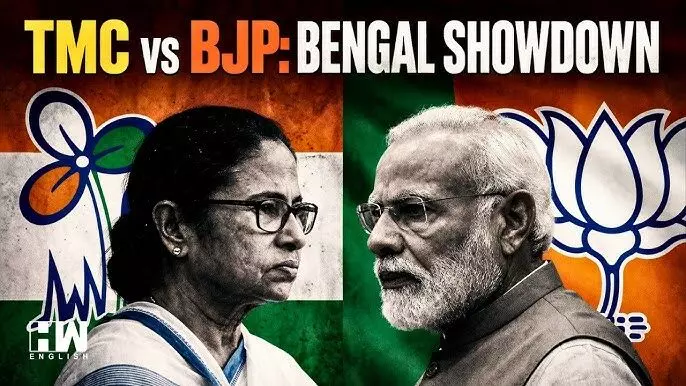
As West Bengal prepares to go to polls, the electoral contest shaping up is unlike any the state has witnessed in recent memory. On the surface, it looks like a familiar battle between a ruling party navigating the fatigue of three consecutive terms and an opposition hungry to convert momentum into majority. Beneath the surface, however, something far more consequential is unfolding, one that strikes at the very architecture of democratic participation.
The Trinamool Congress enters this election carrying the full weight of incumbency. Three terms in power is a long time in any democracy, and in Indian state politics, it is an eternity. Voter fatigue is not an abstraction here. It accumulates in the unaddressed pothole, the delayed pension, the unanswered complaint at the block office. The ruling dispensation in Nabanna knows this well, which is why the dominant political frame being offered to the Bengali electorate is not one of governance achievement but of civilisational threat. The message from the chief minister is unambiguous: Bengal is under siege, and the real contest is not between two political parties but between Bengali identity and the ambitions of a distant, intrusive Centre.
Whether or not one finds this framing convincing, its political logic is sound. Identity-based consolidation has historically allowed incumbents across India to neutralise anti-incumbency by elevating the stakes of the election beyond the mundane ledger of governance. The question is whether it will work in a state where the BJP, after a determined campaign in 2021, had secured 77 seats and established itself as a credible alternative. That result was not a flash in the pan. It reflected genuine voter willingness to consider a change. For the ruling party to successfully reframe this as a fight for Bengali pride rather than a verdict on its performance, it must make enough voters feel that what is at stake is not merely who governs Bengal, but who speaks for it.
The BJP, for its part, has pursued a dual strategy. Its anti-migrant posturing is a calculated attempt to polarise the electorate along lines of community and belonging, an approach that carries significant risk in a state with deep traditions of syncretic coexistence, but also, in certain constituencies, a demonstrable track record of electoral dividend. Alongside this, the party has pressed hard on corruption and misgovernance, citing recruitment scams, political violence, and the alleged capture of state institutions. These are legitimate lines of political attack and resonate with a constituency frustrated by the sense that the state machinery has been turned into an instrument of party power. The challenge for the BJP, however, is that voters can simultaneously believe both things: that the ruling party has governed poorly and that the alternative is not necessarily better for Bengal.
Into this already charged environment enters a third actor that ordinarily operates in the background: the Election Commission. What has happened with the Special Intensive Revision of electoral rolls is not a footnote. It is a headline, and its implications for the outcome cannot be overstated.
The deletion of over sixty lakh voters from the rolls is a number that demands scrutiny rather than acceptance. Electoral roll revision is a routine and necessary exercise. But scale, speed, and context matter enormously. When the magnitude of deletions in numerous constituencies exceeds the margin of victory from previous elections, the revision ceases to be a clerical exercise and becomes a potential determinant of electoral outcomes. This is not a theoretical concern. In assembly politics, where contests are often decided by a few thousand votes, the removal of even ten to fifteen thousand voters in a single constituency, if concentrated in particular localities, can flip a result entirely.
The critical question is who was deleted. Legitimate revision removes deceased voters, duplicate entries, and those who have genuinely shifted residence. But roll revision has historically also been used, with varying degrees of subtlety, to disenfranchise specific communities. If the deletions disproportionately affect Muslim-majority areas, migrant labour communities, or urban slums where documentation is sparse, the impact will not be neutral. It will systematically disadvantage certain parties and favour others. Ground reports from several constituencies already suggest that deletions have not been distributed evenly, and that the communities most affected are those least equipped to navigate the grievance redressal mechanisms that are nominally available to them.
The mass transfers in the state bureaucracy add another layer of complexity. An administrative apparatus that has functioned under one political alignment for over a decade does not transform overnight through transfers. The TMC’s legal challenge to these transfers reflects its awareness that the composition of the administrative machinery at the polling booth, the block, and the district level can shape electoral conditions on the ground as much as any campaign speech. Courts will adjudicate on the legality; voters will feel the consequences.
What, then, is the likely trajectory? Mamata Banerjee’s narrative of Bengali asmita under threat has real emotional purchase, particularly in rural south Bengal and among communities that have historically felt aligned with the idea of a Bengal-first politics. However, narratives require a delivery vehicle, and that vehicle is an organisation. If the ruling party’s local-level machinery has been weakened by three terms of factional conflict and the attrition that accompanies prolonged power, the emotional resonance of a central message may not translate reliably into votes.
The BJP’s consolidation of its 2021 gains is not assured. Sustaining opposition momentum without being in power requires discipline and coherent messaging at the constituency level. The party has struggled in West Bengal with exactly this challenge before.
What is clear is that the election will be decided as much by who gets to vote as by who votes for whom. In that sense, the real story of Bengal 2026 is not only the contest between two competing narratives. It is the quieter, less visible contest over the electoral roll itself. And in a democracy that takes itself seriously, that should be the most unsettling story of all.