Cinema Without Dharma – Remembering Dharmendra, The He-Man of Bollywood
Tribute to Dharmendra, iconic Bollywood actor whose films spanned decades. His versatility & charisma captivated audiences, leaving a legacy in Indian cinema.
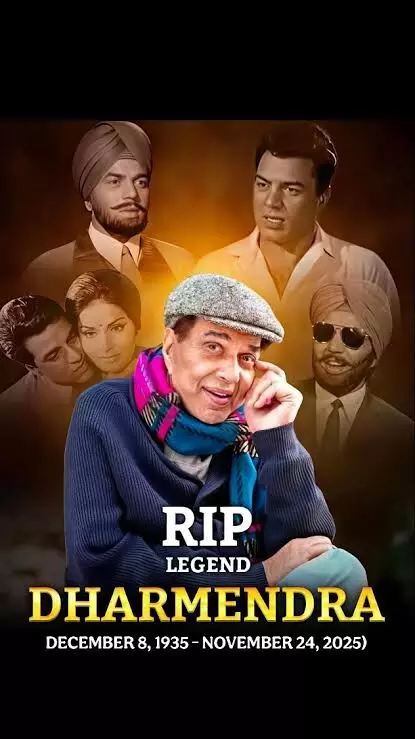
Dharmendra—the prince of countless dreams; a presence that made millions of buds bloom; a departure that has engraved pain into millions of hearts.
The beloved 'He-Man' of our childhoods, the shy romantic hero of India’s youth, the first love of the masses—his radiant smile shimmered like the first ray of the rising sun. His very name carried divinity in the film industry. People did not go to watch cinema; they went to watch him.
The moment he was paired with Hema Malini, a fairytale—unforgettable, ethereal, and shimmering—swept across the silver screen for decades. If one were to separate Dev Anand and Dharmendra from the Indian film industry, that golden era would instantly lose its lustre. They were complete heroes—gifts of nature, nurtured by the cultural milieu of their times, elevated by the devotion of millions. Dilip Kumar, Rajesh Khanna, and Amitabh Bachchan were giants, no doubt. But Dharmendra stood apart—more wholesome, more content, more universally loved.
As a child, I adored the Dharmendra whose strength resembled Dara Singh’s. Mere Gaon Mera Desh reigned supreme in that stage of life. Growing older, I was drawn to Kahani Kismat Ki, Aaya Saavan Jhoom Ke, Dost, Ankhen, and Sholay. And in maturity, Satyakam, Anupama, Kajal, and Chupke Chupke touched the heart with their artistic subtlety.
Dharmendra’s cinema embraced astonishing diversity—in story, tone, and performance. He belonged to every age group, every class. His gallery of characters is astonishing: quiet, intense, rebellious, ordinary, aristocratic, poor, wealthy, patriotic, humorous; a brother, friend, lover, detective, and more.
He was not only an actor atop the industry for decades—he was an industry unto himself. He created work for thousands, uplifted them, and shared every success with his team. He gave more to society than to his own home. As a friend, a star, a leader, and a Member of Parliament, his contributions were unique and unforgettable. That is why not just the film fraternity or the city of Bikaner—but every soul touched by him—now weeps at his departure from this earthly world.
The First Meeting: When Dreams Turned to Reality
In the 1980s, I met him for the first time in the then-Bombay, thanks to his close friend and co-star from Dost, Shatrughan Sinha. That moment was when dream and reality merged. The hero of Haqeeqat stood before me as a living haqeeqat—a truth. His simplicity and sincerity were breathtaking.
Journalist and writer Avadhesh Preet from Patna’s Hindustan newspaper, along with a young film journalist from Mumbai, laid the foundation for that meeting. Shatrughan Sinha played the perfect catalyst. Through him, I also met Dharmveer Bharti at the Dharmyug office, and later, on film sets, I met Shatrughan Sinha once again.
Back then, the respect offered to film journalists from Navbharat Times, Madhuri, and other publications was extraordinary. And among the stars, Shatrughan Sinha was the most beloved—generous, open-hearted, and always ready to help. I still remember how—thanks to one film journalist—Shatrughan Sinha arranged three extraordinary meetings in a single day: Dharmendra on the set of Nakaabandi, Sridevi during Sherni, and Jackie Shroff during another shoot.
That day planted the seeds for my second meeting with Dharmendra—a meeting that bloomed at the Centaur Hotel during an event for the film Paap Ki Duniya.
More than half the film industry—heroes, heroines, comedians, villains—mingled in that all-night gathering. There, I witnessed the generosity of two friends: Dharmendra and Shatrughan Sinha. If one truly misses Shatrughan Sinha’s presence in Sholay, it is because their friendship had a magic of its own. At that event, a young generation was rising: Sunny Deol, Chunky Pandey, and Neelam; Shekhar Suman was then struggling.
Only a handful of media people were invited. Dharmendra was paving the way—not for himself, but for his son and for many others.
A Yuga Ends—Yet It Also Remains
Whenever a great soul leaves the world, we instinctively say, "An era has ended." But eras do not vanish. They merely pause—astonished, shaken, grieving.
After Dharmendra’s passing, that same stillness hangs in the air. For he was not just a star—he was a yuga-maker, a creator of an era. He has left behind a complete epoch for future artists and human beings to learn from, emulate, and surpass.
Dharmendra encouraged every young actor—from Salman Khan to today’s rising talents. That is why, today, when a star has slipped away from us, both the earth and the sky feel heavy.
The weather is not treacherous today—it is simply mourning.