Close Your Eyes and Whisper Kashi” — The Silent Vision of Prof. Uttama
Discover Prof. Uttama's captivating paintings that echo Kashi's spiritual essence and the beauty of nature.

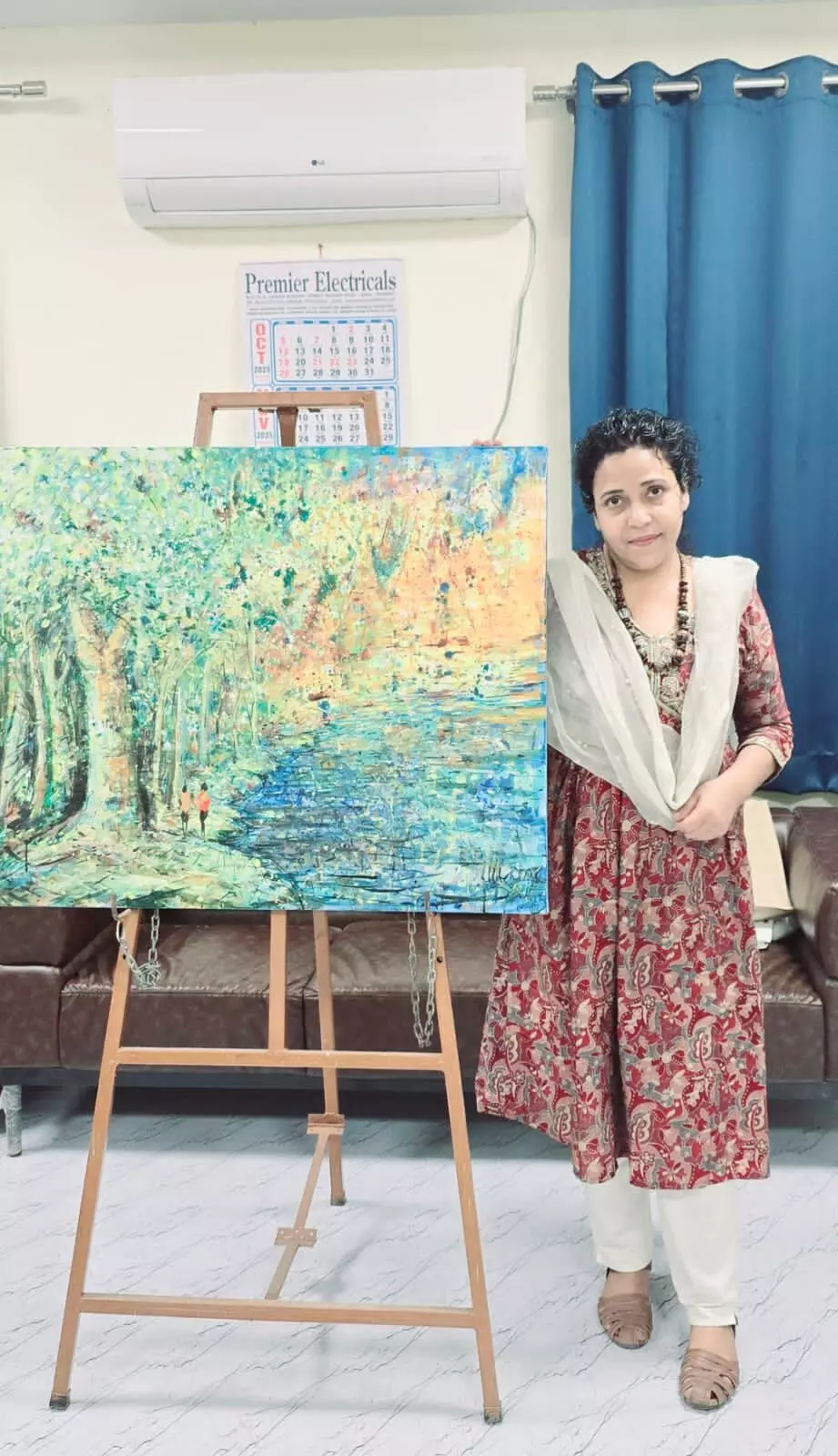
In a world that speaks too loudly, she remains a rare presence — quiet, observant, almost elusive. She does not debate, she does not insist, she does not claim mastery over anything. When asked a question, she offers only one response: a painting. And somehow, that single response answers everything.
Her canvases do what words often fail to do. They pull the viewer into a world where nature is not scenery but scripture. Standing before her work, one feels the breath of Wordsworth’s meadows, the fragrant hush of Keats, the romantic turbulence of Byron, and the delicate bloom of Nirala’s “Juhi ki Kali.” These voices shaped the world’s understanding of nature; her paintings continue the conversation.
Prof. Uttama, Dean of the Faculty of Visual Arts at Banaras Hindu University, is not merely an artist — she is a custodian of a civilizational memory. Her art is not decorative; it is declarative. It tells us why we must love nature, why we must care for it, and why we must labour for it. She works through nights, often without breakfast, sometimes without even touching the brush she longs for, yet she never abandons her commitment. Her devotion is not to acclaim; it is to Lord Shiva, to Kashi, and to the sacred discipline of creation.
Her paintings echo the philosophical foundations of natural justice — the belief, articulated by Hugo Grotius and John Locke, that nature itself grants dignity and moral order. In her work, justice is not a legal abstraction; it is a riverbank truth, a ghat‑side whisper, a leaf trembling in the wind. She paints not to impress but to remind humanity of its original covenant with the earth.
Kashi has always attracted artists, but only a few have captured its soul. William Daniell and Thomas Daniell painted its ghats in the 18th and 19th centuries; Nandalal Bose shaped its modern artistic grammar. Art history often suggests that before them, Kashi’s visual narrative was scarcely explored. If that is so, then Prof. Uttama stands today as the inheritor of that rare lineage — not repeating it, but extending it.
Ask her why Kashi matters so deeply, and she smiles — a quiet, knowing smile — before offering a simple instruction: “Close your eyes and whisper slowly: Kashi. Tell me what you see.”
Even those who are not artists can visualise it instantly — the saffron, the bells, the river, the smoke, the silence, the eternity. If a non‑artist can see so much in a second, she asks, what must happen within someone born for creation, for beauty, for messages of peace, for the resurrection of lost traditions? She pushes herself to search, to discover, to capture. She does not know whether she will succeed — but she knows she must try.
She rarely speaks, but when she does, her words carry the weight of centuries. “Look,” she once said, “in the entire world, Kashi is the only place where you find the world itself in the alhad‑masti of Kashi. Why worry? When you touch this land, spiritualism and creation focus themselves. They bind you. Sometimes, even I don’t know how ideas come. My fingers begin to dance on the canvas, and suddenly, there is a message waiting to be understood. I only capture it professionally.”
Kashi is the city of 84 ghats. Most people count only the famous ones — especially Assi Ghat, her favourite — but she insists that each visit reveals a new ghat, a new energy, a new truth. What she saw yesterday changed today. What she felt last evening had transformed by morning. As a teacher and Head of Department, she has coordinated countless programmes from the university, yet each time she finds herself astonished by the city’s ability to renew itself. This, she says, is the speciality of Kashi — the boon of Lord Shiva — that creation never ends here. It only changes form.
Her love for nature is not sentimental; it is existential. She believes that without love, no living being can survive. She cannot do everything, but she can create. She can paint. She can convey the message of Mother Earth to her children — that trees, rivers, gardens, and birds are not luxuries but necessities. She often says she does not need malls or complexes; for survival, she needs a garden, a riverbank, a tree full of birds, and a beautiful evening on the ghats of Varanasi. Her art is therefore not merely aesthetic; it is civilizational. It is cultural. It is ecological. It is a reminder of what humanity once valued and must value again.
Every stroke she paints is a tribute to Kashi’s art, culture, and civilization — the first preference of human existence. Her canvases are not just images; they are philosophies. They are not just colours; they are prayers. They are not just compositions; they are conversations with time.
Prof. Uttama does not speak much. She does not need to.
Her paintings speak for her — and for Kashi, and for nature, and for the quiet justice of the human spirit.
By Guest Editor