Delhi’s India Gate Protest: When Citizens Reclaim Their Right to Breathe
Delhi residents gathered at India Gate demanding urgent government action on toxic air pollution, reclaiming their right to breathe clean, safe air.

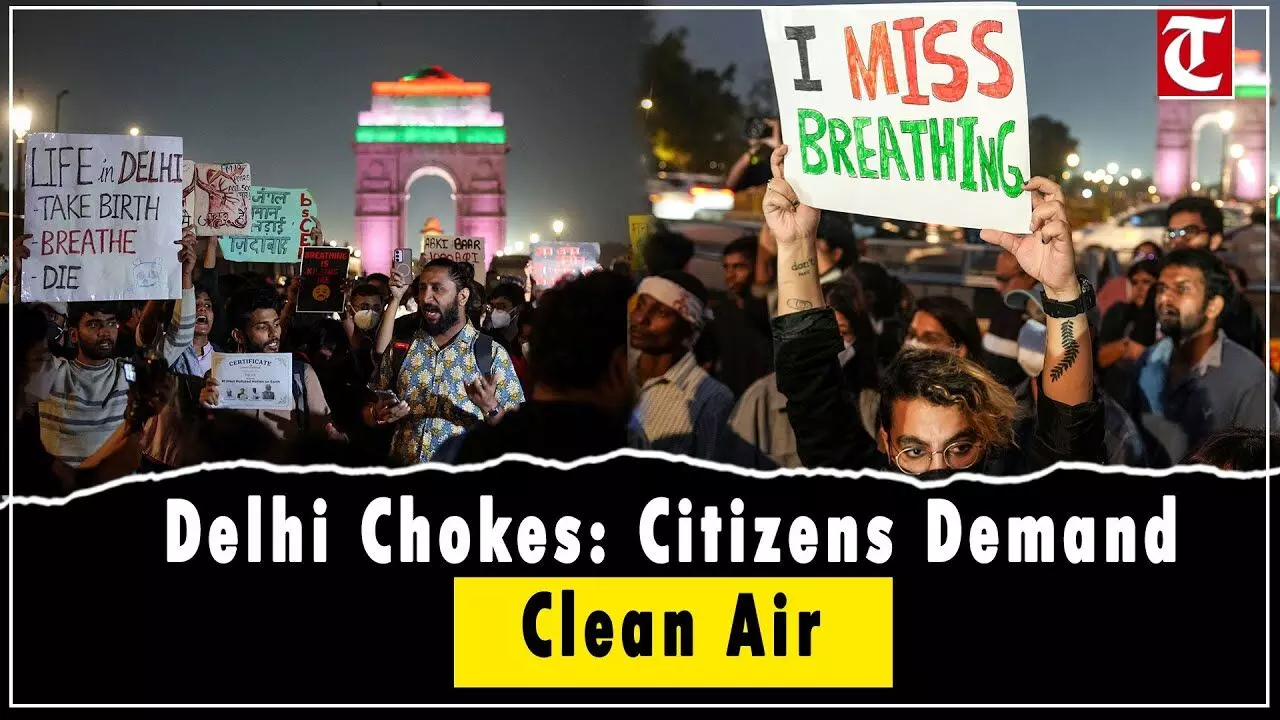
Images Credit - Tribune
The scenes at India Gate last week were both heartbreaking and inspiring. Hundreds of Delhi residents, armed with masks, placards, and portable air quality monitors, gathered at the heart of the nation’s capital to protest what has become an annual public health catastrophe: the city’s catastrophic air pollution. As the Air Quality Index (AQI) soared past 400—classified as “severe”—citizens took to the streets not with anger alone, but with a desperate plea for the fundamental right to breathe clean air.
This wasn’t just another protest. It was a collective cry of anguish from a population that has been forced to normalize the abnormal, to accept that several months of every year will be spent inhaling toxic air equivalent to smoking dozens of cigarettes daily. The India Gate demonstration represents a watershed moment in Delhi’s environmental activism, signaling that citizens have reached their breaking point with government inaction and hollow promises.
*The Crisis We Can No Longer Ignore*
Delhi’s air pollution crisis is not new, but its severity and persistence have reached unprecedented levels. Every winter, as temperatures drop and wind speeds decrease, the city transforms into a gas chamber. PM2.5 particles—fine particulate matter small enough to penetrate deep into lungs and enter the bloodstream—regularly exceed safe limits by more than ten times. Schools shut down, flights get diverted, and hospitals overflow with patients suffering from respiratory distress.
The health consequences are staggering. Studies indicate that air pollution reduces the life expectancy of Delhi residents by nearly ten years. Children are developing stunted lungs, asthma rates are skyrocketing, and cardiovascular diseases linked to air pollution are claiming thousands of lives annually. The poorest communities, who lack access to air purifiers or the luxury of staying indoors, bear the brunt of this environmental injustice.
Yet despite this ongoing public health emergency, government responses have remained largely reactive and superficial. Odd-even vehicle schemes are implemented sporadically, construction bans are announced and then ignored, and blame is shifted between neighboring states over crop stubble burning. Meanwhile, citizens are left to fend for themselves, investing in expensive air purifiers and wearing masks that offer limited protection against the invisible killer surrounding them.
*Why India Gate Matters*
The choice of India Gate as the protest venue carries profound symbolic weight. This iconic monument, which commemorates Indian soldiers who died serving the nation, now serves as the backdrop for citizens demanding that their government protect them from an enemy that kills more Indians annually than most conflicts ever have. The irony is impossible to miss: we honor those who sacrificed their lives for the nation while our own citizens slowly suffocate in plain sight.
The protest also demonstrates a crucial evolution in India’s civil society activism. Environmental issues have often been perceived as elite concerns, divorced from the immediate needs of ordinary citizens. But air pollution is the great equalizer—it affects the wealthy and the poor, the powerful and the marginalized. The diversity of protesters at India Gate—students, professionals, parents with young children, elderly residents with oxygen tanks—reflected this universal impact.
Moreover, these citizens came prepared. Many brought data, scientific studies, and comparative analyses showing how other polluted cities have successfully tackled similar crises. They presented concrete solutions: strict enforcement of emission norms, investment in public transportation, year-round action plans rather than emergency measures, and accountability mechanisms for government officials. This was not merely venting frustration; it was informed advocacy demanding systemic change.
*The Failure of Governance*
The protest at India Gate exposes a fundamental failure of governance at multiple levels. The problem of Delhi’s air pollution is well-documented, its causes well-understood, and its solutions well-established. What is missing is political will and coordinated action.
State and central governments engage in endless finger-pointing. Delhi blames Punjab and Haryana for crop burning. The center points to vehicular emissions under state jurisdiction. Everyone cites unfavorable meteorological conditions as if weather is an excuse for inaction. Meanwhile, construction dust continues to choke the city, industrial emissions go unregulated, and garbage burning remains widespread.
This abdication of responsibility is particularly galling given that governments worldwide have successfully addressed air pollution when prioritizing it. London overcame its deadly smog through decisive regulation. Beijing, once synonymous with poor air quality, has made remarkable improvements through aggressive policy interventions. These success stories prove that political will, not technological impossibility, is the primary barrier to clean air.
*A Call for Sustained Activism*
The India Gate protest must not be a one-time event but the beginning of sustained civil society pressure. History shows that governments respond to persistent public demand. The environmental movements that led to the banning of plastic bags, the cleaning of rivers, and the protection of forests all required years of consistent advocacy.
Citizens must hold elected representatives accountable at every level. Air quality should be a voting issue, featured prominently in election debates and manifestos. Local communities need to organize monitoring committees to ensure implementation of pollution control measures. Professional associations, resident welfare groups, and educational institutions should mobilize their members for coordinated action.
Media also has a critical role in maintaining focus on this crisis beyond the winter months when pollution peaks. The problem requires year-round attention and solution-building. Success stories from neighborhoods or cities that have reduced local pollution sources should be highlighted and replicated.
*The Path Forward*
Delhi’s air pollution crisis demands emergency action combined with long-term structural reforms. Immediate measures should include strictly enforcing vehicular emission standards, halting all non-essential construction during high-pollution periods, providing compensation to farmers for alternative stubble disposal methods, and temporarily restricting industrial operations that violate emission norms.
Long-term solutions require transforming urban planning and development models. Delhi needs massive investment in electric public transportation, creation of green corridors and urban forests, decentralization of economic activity to reduce pollution concentration, and integration of air quality considerations into all policy decisions.
The protesters at India Gate weren’t asking for charity or special treatment. They were demanding what should be every citizen’s birthright: the ability to breathe without fear, to raise children without watching them develop respiratory problems, to grow old without pollution-induced diseases. These are not unreasonable demands. They are the minimum requirements of dignified human existence.
As one protester’s placard poignantly asked: “If the India Gate soldiers died for the nation, who will live for it?” The answer must be all of us—citizens demanding accountability and governments finally rising to meet their most fundamental responsibility: protecting the lives and health of the people they serve. The protest at India Gate was not the end of a conversation but the beginning of one that Delhi, and India, can no longer afford to postpone.