Democracy’s Tightrope: Supreme Court’s Balanced Approach to Bihar’s Electoral Roll Revision
Supreme Court’s intervention in Bihar’s electoral roll revision safeguards voters’ rights while ensuring transparency and electoral integrity ahead of 2025 Assembly polls.

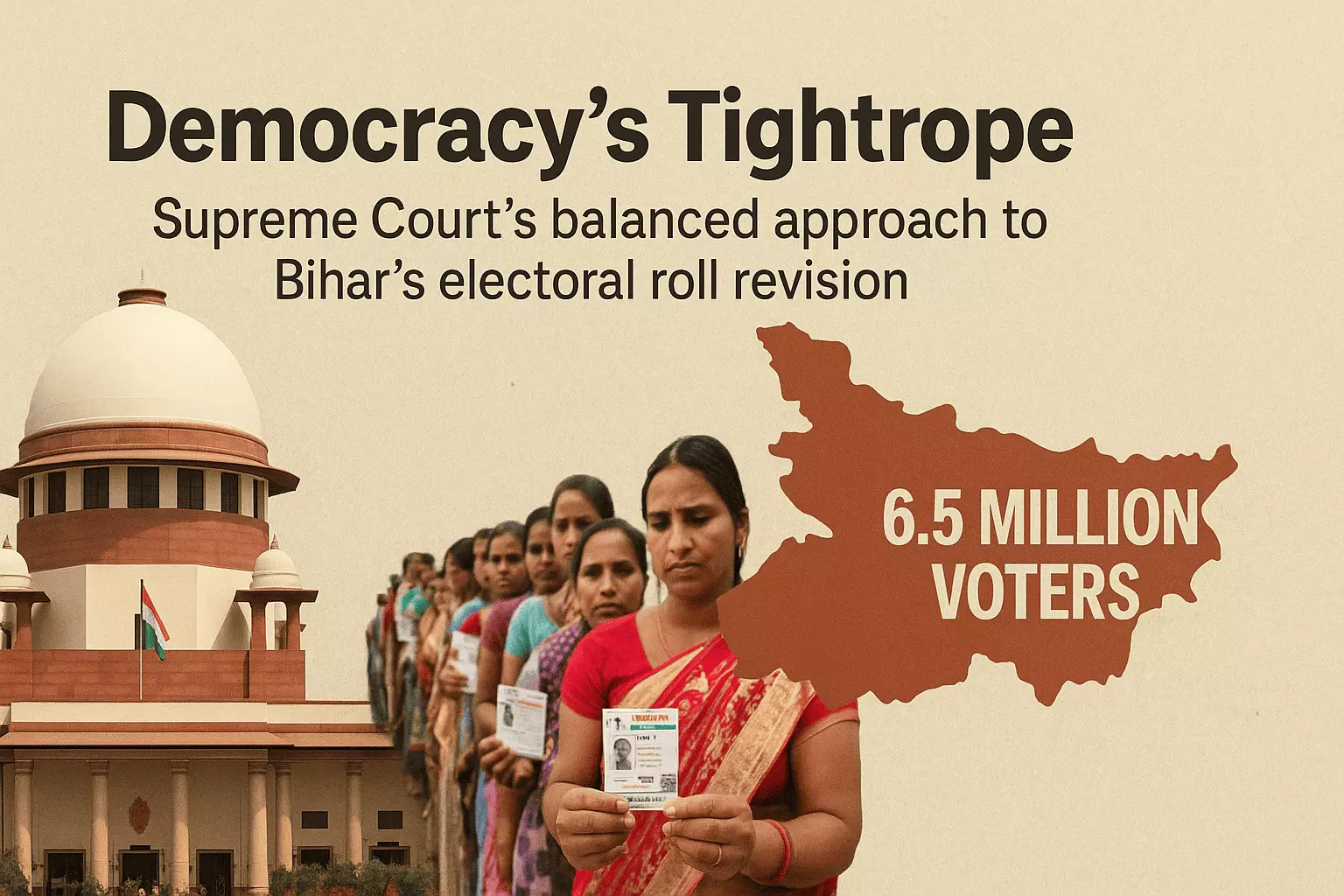
The Supreme Court’s recent interventions in Bihar’s Special Intensive Revision (SIR) of electoral rolls represent a masterclass in judicial balancing—protecting democratic participation while ensuring electoral integrity. As Bihar prepares for its assembly elections, the Court’s directives to the Election Commission of India have emerged as a critical safeguard against potential voter disenfranchisement while maintaining the legitimacy of the electoral process.
The controversy surrounding Bihar’s SIR began when the Election Commission announced on June 24, 2025, its decision to conduct a comprehensive revision of the state’s electoral rolls with a demanding 90-day timeline. This unprecedented move, coming just months before crucial state elections, raised immediate red flags among civil society organizations, opposition parties, and electoral reform advocates who petitioned the Supreme Court, fearing mass disenfranchisement.
*The Stakes at Play*
The numbers tell a sobering story. With approximately 6.5 million voters potentially removed from Bihar’s electoral rolls, the SIR process affects roughly 10% of the state’s electorate. For context, Bihar has historically witnessed razor-thin electoral margins where even small shifts in voter participation can dramatically alter political outcomes. The 2020 assembly elections, for instance, saw the NDA coalition win by a mere 12 seats, making every vote count literally and figuratively.
The Supreme Court’s intervention becomes even more significant when viewed against Bihar’s unique socio-economic landscape. According to the state’s own 2022 caste survey, only 14.71% of Bihar’s population are matriculates, indicating limited literacy levels that could complicate document submission processes. This demographic reality makes the Court’s emphasis on accessibility and inclusivity not just legally sound but democratically essential.
*Judicial Wisdom in Action*
The Supreme Court’s handling of this case demonstrates remarkable judicial restraint combined with democratic vigilance. Rather than imposing a blanket stay on the SIR process—which could have undermined legitimate efforts to clean up electoral rolls—the Court chose a more nuanced approach that addresses specific concerns while allowing the process to continue.
The Court’s directive requiring the Election Commission to publish the names and reasons for deletion of all 6.5 million removed voters represents a masterstroke of transparency. By mandating that this information be made “easily accessible to every voter,” the Court has created a practical mechanism for affected citizens to understand and challenge their exclusion. This directive transforms an opaque bureaucratic process into a transparent, accountable exercise in democratic housekeeping.
Equally significant is the Court’s intervention regarding acceptable identity documents. By directing the Election Commission to accept Aadhaar cards as one of the eleven permissible documents for voter verification, the Court recognized ground realities. Aadhaar, with its near-universal coverage, often represents the most accessible form of official identification for marginalized communities who might otherwise struggle to produce alternative documents.
*The Broader Democratic Imperative*
The Bihar SIR controversy illuminates a fundamental tension in modern electoral democracy: the balance between maintaining clean, accurate voter rolls and ensuring maximum democratic participation. Fraudulent voting undermines electoral legitimacy, but so does the systematic exclusion of eligible voters through overly burdensome verification processes.
The Election Commission’s initial approach, requiring citizens not listed in the 2003 electoral roll to submit citizenship documents, and demanding that those born after December 2004 provide their parents’ citizenship documents, created potentially insurmountable barriers for legitimate voters. These requirements, while perhaps well-intentioned, failed to account for the practical challenges faced by marginalized communities in accessing and maintaining official documentation.
The Supreme Court’s interventions have effectively course-corrected this approach without abandoning the underlying goal of electoral roll accuracy. By insisting on transparency in deletions and flexibility in acceptable documents, the Court has created a framework that serves both electoral integrity and democratic inclusion.
*Lessons for Electoral Governance*
The Bihar SIR case offers several crucial lessons for electoral governance in India and other democracies. First, the timing of major electoral reforms matters enormously. Conducting comprehensive voter roll revisions with tight timelines immediately before elections inevitably raises questions about political motivations, regardless of actual intent. Election Commissions must be more sensitive to such perceptions and plan major reforms well in advance of election cycles.
Second, transparency isn’t just a democratic virtue—it’s a practical necessity for electoral legitimacy. The Court’s insistence on publishing deletion lists with reasons creates accountability mechanisms that benefit both election administrators and citizens. When voters understand why they’ve been removed from rolls, they can either accept legitimate corrections or challenge erroneous deletions.
Third, document requirements for electoral participation must reflect social realities rather than administrative convenience. In a country where significant populations lack comprehensive documentation, electoral processes must be designed for inclusion rather than exclusion, while still maintaining appropriate safeguards against fraud.
*Looking Forward*
As Bihar’s SIR process continues under the Supreme Court’s watchful eye, its implementation will likely become a template for future electoral roll management across India. The Court’s balanced approach—permitting the process while ensuring transparency and accessibility—offers a model for reconciling electoral integrity with democratic participation.
The real test, however, lies in execution. The Election Commission must now demonstrate that it can implement these directives in both letter and spirit, ensuring that legitimate voters aren’t excluded while maintaining the quality of electoral rolls. This requires not just administrative efficiency but genuine commitment to democratic values.
*The Democratic Dividend*
Ultimately, the Supreme Court’s interventions in Bihar’s SIR represent more than judicial oversight—they embody the institutional checks and balances that make Indian democracy resilient. By refusing to take sides in partisan disputes while insisting on constitutional principles, the Court has reinforced the foundational premise that electoral processes must serve democracy rather than any particular political interest.
As Bihar prepares for elections under revised voter rolls, the success of the SIR process will be measured not just by the accuracy of the rolls but by the degree to which eligible citizens remain empowered to participate in their democracy. The Supreme Court’s directives provide the framework; now comes the crucial work of democratic implementation.
In an era of growing concerns about democratic backsliding globally, India’s institutional response to the Bihar SIR controversy offers a heartening example of judicial vigilance protecting democratic participation. It reminds us that in a constitutional democracy, no institution—however well-intentioned—operates beyond the reach of accountability, and that the arc of justice, as always, bends toward greater democratic inclusion.