Green Crackers in Delhi: A Pyrrhic Victory for Public Health
Discover the truth about green crackers in Delhi and their impact on air quality. Learn why experts advocate for a complete ban on firecrackers.

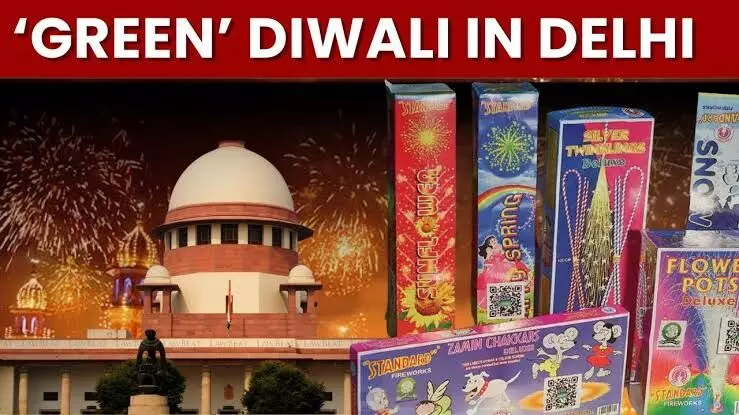
The Supreme Court’s decision to permit the use of “green crackers” in Delhi during festive seasons represents a troubling compromise between cultural celebration and environmental protection. While the judiciary’s intent to balance tradition with public health is understandable, this middle path may ultimately serve neither objective effectively. As an environmental expert who has studied air quality patterns in the National Capital Region for years, I believe this decision overlooks critical realities about pollution control, enforcement challenges, and the fundamental chemistry of combustion.
The Myth of Green Crackers
First, we must examine what “green crackers” actually are. Developed by the Council of Scientific and Industrial Research, these crackers supposedly reduce emissions by 25-30% compared to conventional fireworks. They eliminate certain harmful chemicals like barium salts and reduce particulate matter. On paper, this sounds like progress. In practice, the difference is marginal at best and misleading at worst.
The term “green” creates a dangerous perception that these products are environmentally benign. They are not. Green crackers still involve combustion, still release particulate matter into the atmosphere, and still contribute to the toxic cocktail that makes Delhi’s air unbreathable every winter. The reduction in emissions, while scientifically measurable in laboratory conditions, becomes negligible when thousands of people burst crackers simultaneously across a densely populated urban landscape.
Moreover, the chemistry of combustion is immutable. When you burn materials, you produce carbon dioxide, carbon monoxide, sulfur dioxide, and particulate matter. Green crackers may reduce the quantity of certain pollutants, but they cannot eliminate the fundamental environmental impact of setting off explosives for entertainment.
The Enforcement Nightmare
Even if we accept that green crackers are marginally better than conventional ones, the Supreme Court’s decision creates an enforcement nightmare that ultimately renders the distinction meaningless. How do authorities differentiate between green and conventional crackers in a city of twenty million people during the chaos of Diwali night? How do they verify compliance when crackers are sold through thousands of informal vendors, many operating in gray markets?
The reality is that conventional crackers, which are cheaper and more widely available, will continue to flood the market disguised as green alternatives. The certification process for green crackers is opaque, quality control is inconsistent, and the profit motive for selling conventional crackers as “green” ones is enormous. Delhi’s pollution control authorities are already stretched thin monitoring industrial emissions, vehicular pollution, and construction dust. Adding firecracker verification to their mandate is unrealistic.
This enforcement gap means that in practice, the Supreme Court’s nuanced ruling will likely result in widespread use of conventional crackers with legal cover. Sellers will claim they’re selling green crackers, buyers will purchase whatever is available, and the net result will be business as usual with a green label attached.
Delhi’s Air Quality Crisis Demands Radical Solutions
To understand why half-measures are inadequate, we must grasp the severity of Delhi’s air quality crisis. Every winter, the city transforms into a gas chamber. Air Quality Index readings regularly exceed 400, categorized as “severe” and equivalent to smoking dozens of cigarettes daily. Children develop chronic respiratory conditions, hospital emergency rooms overflow with patients struggling to breathe, and life expectancy in the region drops by years compared to areas with cleaner air.
This crisis is multifactorial. Stubble burning in neighboring states, vehicular emissions, industrial pollution, construction dust, and weather patterns that trap pollutants all contribute. But firecracker use during Diwali consistently marks one of the worst air quality episodes of the year. Studies have shown that PM2.5 levels spike to catastrophic levels in the days following Diwali, and these fine particulate matter particles penetrate deep into lungs, causing irreversible damage.
In this context, allowing any form of crackers seems unconscionable. Delhi needs aggressive interventions, not marginal improvements. The city needs a complete ban on firecracker use, not a slight modification in their chemical composition. When your house is on fire, you don’t reduce the flames by 25%—you extinguish them entirely.
Cultural Celebration Without Environmental Destruction
Opponents of firecracker bans often invoke cultural tradition and religious freedom. These are important considerations in a diverse democracy. However, culture evolves, and traditions must adapt to contemporary realities. There is nothing intrinsically Hindu or essential about bursting crackers during Diwali. The festival of lights is fundamentally about the triumph of good over evil, knowledge over ignorance, and light over darkness. These values can be celebrated without poisoning the air that children breathe.
Across India, communities are finding alternative ways to celebrate. Laser light shows, community gatherings, traditional diyas, rangoli competitions, and charity drives capture the spirit of Diwali without the environmental devastation. In fact, many religious leaders have spoken out against the pollution caused by firecrackers, recognizing that harming public health contradicts the festival’s deeper spiritual meaning.
The argument that banning crackers infringes on religious freedom also misunderstands the nature of constitutional rights. No right is absolute when its exercise significantly harms others. Your freedom to celebrate cannot include the freedom to make others sick. This is especially true when the victims are often the most vulnerable—children, the elderly, and those with pre-existing respiratory conditions who have no choice but to breathe the polluted air.
A Call for Judicial Courage
The Supreme Court has shown remarkable leadership on environmental issues in the past, from protecting forest rights to mandating emission standards. This decision on green crackers, however, feels like a retreat. It attempts to satisfy all stakeholders and ends up protecting none—not the environment, not public health, and not meaningful cultural celebration.
What Delhi needs is judicial courage to prioritize public health over commercial interests and tokenistic cultural preservation. A complete ban on firecrackers, enforced strictly with significant penalties for violations, would send a clear message that the right to clean air trumps the desire to burst explosives. Such a ban would need to be coupled with public education campaigns, enforcement mechanisms, and support for alternative celebration methods.
The Supreme Court should reconsider its position. Half-measures on air pollution are ineffective measures. Green crackers are a distraction from the difficult choices Delhi must make to ensure its residents can breathe safely. In the battle between tradition and survival, between profit and public health, between comfort and crisis response, the choice should be clear.
Delhi’s children deserve to celebrate Diwali with joy, not in hospital emergency rooms struggling to breathe. That is the tradition worth preserving.