Respect Without Questions? Teaching the Judiciary, Silencing the Question
NCERT textbook controversy sparks debate on institutional critique and transparency. Should judiciary be shielded from scrutiny? #NCERT #Judiciary #Education"

In the stories of Tenali Rama, there is one where a group of scholars arrives at court claiming unmatched wisdom. They speak in grand language, cloak simple ideas in complex words, and impress everyone, except Tenali. Instead of arguing with them, he quietly serves them a meal covered with empty bowls. When they protest, he replies that the food is “too refined to be seen by ordinary eyes.” The court laughs. The illusion collapses. What sounded profound is revealed to be hollow.
The story is playful, but its lesson is not. Systems often rely not just on truth, but on how convincingly that truth is presented, withheld, or dressed up. Sometimes, the problem is not falsehood. It is the insistence that certain things must not be seen or said too plainly.
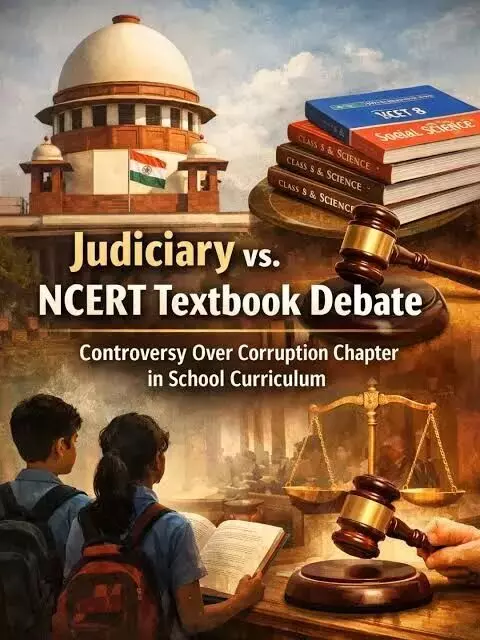
That tension sits at the heart of the recent controversy involving the NCERT (National Council of Educational Research and Training) and the Supreme Court of India. A Class 8 textbook, in a chapter on the judiciary, attempted something deceptively straightforward. It acknowledged delays in courts, the burden of pending cases, and the possibility, carefully phrased, that corruption can exist within the system. None of these claims were radical. They are part of public knowledge, discussed in legal circles, reflected in reports, and even acknowledged within the judiciary itself.
And yet, the reaction was swift and uncompromising. The Supreme Court took suo motu cognisance, described the content as part of a “deep-rooted conspiracy” to defame the judiciary, and ordered the complete withdrawal of the textbook. Physical copies were pulled back, digital versions taken down, and the NCERT issued an apology, calling it an error of judgment. Those associated with the content were quickly distanced. The system did not pause to revise, debate, or contextualise. It chose to remove.
At one level, the instinct is understandable. The judiciary occupies a unique position in a democracy. It does not command force like the executive or numbers like the legislature. Its authority rests almost entirely on public trust. To introduce the idea of corruption within such an institution, particularly to young students, raises legitimate concerns. There is a fine line between fostering awareness and breeding cynicism. There is a responsibility to ensure that criticism does not turn into casual distrust.
But that is precisely why the nature of the response matters. Because the issue was not that the textbook presented a demonstrable falsehood. It was that it presented a discomfort. There is a difference between correcting something inaccurate and suppressing something inconvenient. A more measured response could have involved refining the language, adding context, or presenting a fuller picture. The judiciary faces challenges, but it also delivers critical judgments, protects rights, and acts as a check on power. Education, at its best, holds these contradictions together rather than erasing one side of them.
Instead, what unfolded suggested a zero-tolerance approach to critique. This moment does not stand alone. Across the country, textbooks have increasingly become spaces where narratives are adjusted, emphasised, or softened. Chapters are edited, passages removed, and perspectives recalibrated. This is not new, nor is it confined to any one government. It reflects a broader understanding that education shapes how citizens perceive institutions, history, and authority.
The judiciary, however, has largely remained insulated from this kind of intervention. The NCERT episode suggests that even this space is no longer untouched. The irony is difficult to ignore. A passage that hinted at declining trust in the judiciary was removed in the name of preserving that trust. In doing so, it sparked a wider conversation about whether trust is being protected through engagement or enforced through silence.
It is important to recognise that not all criticism is responsible. Precision matters, especially in educational material. Young students are still forming their understanding, and sweeping statements can mislead as much as they can inform. Context is not optional. It is essential. A line about corruption, without adequate explanation, risks oversimplifying a complex issue.
But silence carries its own risks. To shield students entirely from institutional imperfections is not to prepare them for democratic participation. It is to present them with a version of reality that is incomplete. Democracies do not function on blind faith. They rely on informed trust. And informed trust is built not by avoiding difficult truths, but by explaining them carefully and honestly.
There is, in fact, a quiet strength in institutions that can withstand scrutiny. The most resilient systems are not those that claim perfection, but those that acknowledge limitations without losing credibility. The judiciary, at its best, has demonstrated this capacity. It has delivered judgments that have expanded freedoms, corrected executive overreach, and, at times, reflected critically on its own functioning.
Which is why the language of conspiracy in this context feels excessive. It transforms a question of pedagogy into one of intent. It narrows the space for dialogue and replaces it with suspicion. And when that happens, the possibility of meaningful engagement diminishes.
The larger issue, then, extends beyond a single textbook. It concerns the relationship between institutions and questioning in India. There is an increasing tendency to view critique as an attack and inquiry as a threat. The response, often, is to neutralise rather than engage. This approach may find some justification in political contestation. It sits uneasily within education.
Because education is, fundamentally, about questioning. It is where assumptions are examined, where complexity is introduced, and where understanding is built through exploration rather than imposition. To present institutions as beyond scrutiny is not to cultivate respect. It is to discourage curiosity. And curiosity, even when inconvenient, is central to a healthy democracy.
There is also a practical dimension that cannot be ignored. Students today are exposed to a wide range of information beyond textbooks. They encounter debates, controversies, and contradictions in real time. To offer them a version of reality that excludes acknowledged challenges risks creating a disconnect between what they are taught and what they observe. That disconnect does not strengthen trust. It weakens it.
When systems rely too heavily on controlling perception, they risk appearing less credible, not more. What is hidden often invites more suspicion than what is explained. In the Indian context, the judiciary remains indispensable. Its authority, its credibility, and its role as a constitutional guardian are fundamental. But that is precisely why it must be able to coexist with scrutiny. Trust that depends on silence is fragile. Trust that survives questioning is far more durable. The NCERT episode is, in that sense, less a crisis and more a moment of reflection. It offers an opportunity to consider how institutions respond to discomfort. Whether they choose engagement over erasure, explanation over suppression.
Because in the end, the question is not whether students should learn that institutions have flaws. They will. The question is how they are taught to understand those flaws. Whether as reasons for cynicism or as invitations to think more deeply about how systems work. And that choice will shape not just what they know, but how they choose to believe.